Difference between revisions of "Copernicia ekmanii"
| Line 28: | Line 28: | ||
==Comments and Curiosities== | ==Comments and Curiosities== | ||
Easily one of the most beautiful and most rare Copernicia, this medium-sized palm is found only along the dry northern coast of Haiti, where a few small and overexploited populations cling to life in rocky scrubland. They are used, some overused, for thatch and regeneration is poor. It forms a slender trunk to about 12 m tall that holds a dense crown of stiff, light blue leaves. Dead leaves form a thick skirt below the crown if left untrimmed. The slender inflorescences reach far beyond the leaves. Although easy to grow in most tropical and many warm temperate climates, in cultivation it is only found in very few collections. (RPS.com) | Easily one of the most beautiful and most rare Copernicia, this medium-sized palm is found only along the dry northern coast of Haiti, where a few small and overexploited populations cling to life in rocky scrubland. They are used, some overused, for thatch and regeneration is poor. It forms a slender trunk to about 12 m tall that holds a dense crown of stiff, light blue leaves. Dead leaves form a thick skirt below the crown if left untrimmed. The slender inflorescences reach far beyond the leaves. Although easy to grow in most tropical and many warm temperate climates, in cultivation it is only found in very few collections. (RPS.com) | ||
| − | |||
| − | |||
| − | |||
| − | |||
| − | |||
| − | |||
| − | |||
| − | |||
| − | |||
| − | |||
| − | |||
| − | |||
| + | <br style="clear:both;"/> | ||
| + | {{#Widget:AdResban}} | ||
<center><gallery caption="IMAGE GALLERY" perrow="" widths="" heights=""> | <center><gallery caption="IMAGE GALLERY" perrow="" widths="" heights=""> | ||
Image:IMG 0252.JPG|So. West Florida. | Image:IMG 0252.JPG|So. West Florida. | ||
| Line 65: | Line 55: | ||
image:Copernicia-ekmanii-5.jpg|In habitat. Photo-Rare Palm Seeds.com | image:Copernicia-ekmanii-5.jpg|In habitat. Photo-Rare Palm Seeds.com | ||
</gallery></center> | </gallery></center> | ||
| + | ==External Links== | ||
| + | *[http://eunops.org/content/glossary-palm-terms Glossary of Palm Terms] | ||
| + | *[http://www.calflora.net/botanicalnames/pronunciation.html MODERN BOTANICAL LATIN] | ||
| + | *[http://www.jlhudsonseeds.net/Pronunciation.htm "Just To Be Clear"] | ||
| + | ==References== | ||
| + | Phonetic spelling of Latin names by edric. | ||
| + | |||
| + | Special thanks to Geoff Stein, (Palmbob) for his hundreds of photos. | ||
| + | |||
| + | Special thanks to [http://palmweb.org/?q=node/2 Palmweb.org], Dr. John Dransfield, Dr. Bill Baker & team, for their volumes of information and photos. | ||
| + | |||
| + | Glossary of Palm Terms; Based on the glossary in Dransfield, J., N.W. Uhl, C.B. Asmussen-Lange, W.J. Baker, M.M. Harley & C.E. Lewis. 2008. Genera Palmarum - Evolution and Classification of the Palms. Royal Botanic Gardens, Kew. All images copyright of the artists and photographers (see images for credits). | ||
| + | |||
{{SpeciesListBackLink}} | {{SpeciesListBackLink}} | ||
[[Category:COPERNICIA|ekmanii]] | [[Category:COPERNICIA|ekmanii]] | ||
Revision as of 01:21, 31 October 2014
| Copernicia (koh-pehr-nee-SEE-ah) ekmanii (ek-mahn'-ee) | |||||||
|---|---|---|---|---|---|---|---|
 | |||||||
| Scientific Classification | |||||||
| |||||||
| Synonyms | |||||||
|
| |||||||
| Native Continent | |||||||
 | |||||||
| Morphology | |||||||
| |||||||
| Culture | |||||||
|
| |||||||
| Survivability index | |||||||
|
| |||||||
| Common names | |||||||
|
| |||||||
Contents
Habitat and Distribution
Copernicia ekmanii is endemic to Hispanola esp. Northern Haiti.

Description
Medium sized fan palm to about 12 m tall, with glaucous tightly grouped leaves. Editing by edric.
Culture
Lightly shaded, moist, but well drained position.
Comments and Curiosities
Easily one of the most beautiful and most rare Copernicia, this medium-sized palm is found only along the dry northern coast of Haiti, where a few small and overexploited populations cling to life in rocky scrubland. They are used, some overused, for thatch and regeneration is poor. It forms a slender trunk to about 12 m tall that holds a dense crown of stiff, light blue leaves. Dead leaves form a thick skirt below the crown if left untrimmed. The slender inflorescences reach far beyond the leaves. Although easy to grow in most tropical and many warm temperate climates, in cultivation it is only found in very few collections. (RPS.com)
- IMAGE GALLERY

So. West Florida.

Very old specimen, Miami FL.

Another Fairchild specimen.


IPS Biennial in South Florida. Photo by Gileno Machado.

IPS Biennial in South Florida. Photo by Gileno Machado.

IPS Biennial in South Florida. Photo by Gileno Machado.

Palmetum de Tenerife (Canary Islands). Photo by Jose M. Zerolo, edric.

Miami FL. Photo by Ryan D. Gallivan, edric.

Miami FL. Photo by Ryan D. Gallivan, edric.

Miami FL. Photo by Jody Haynes, edric.


In habitat. Photo-Rare Palm Seeds.com
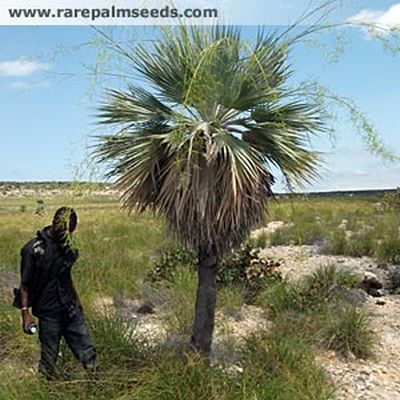
In habitat. Photo-Rare Palm Seeds.com

In habitat. Photo-Rare Palm Seeds.com

In habitat. Photo-Rare Palm Seeds.com

In habitat. Photo-Rare Palm Seeds.com


External Links
References
Phonetic spelling of Latin names by edric.
Special thanks to Geoff Stein, (Palmbob) for his hundreds of photos.
Special thanks to Palmweb.org, Dr. John Dransfield, Dr. Bill Baker & team, for their volumes of information and photos.
Glossary of Palm Terms; Based on the glossary in Dransfield, J., N.W. Uhl, C.B. Asmussen-Lange, W.J. Baker, M.M. Harley & C.E. Lewis. 2008. Genera Palmarum - Evolution and Classification of the Palms. Royal Botanic Gardens, Kew. All images copyright of the artists and photographers (see images for credits).
Many Special Thanks to Ed Vaile for his long hours of tireless editing and numerous contributions.