Difference between revisions of "Brahea aculeata"
| (27 intermediate revisions by 2 users not shown) | |||
| Line 1: | Line 1: | ||
__noeditsection__ | __noeditsection__ | ||
| − | |||
{{Palmbox | {{Palmbox | ||
| − | |image= | + | |image=Braac0005.jpg|Photo by Geoff Stein. |
| − | |image_caption= | + | |image_caption= |
|genus=Brahea (brah-HEH-ah) | |genus=Brahea (brah-HEH-ah) | ||
| − | |species=<br>aculeata (ah-koo-leh-AH- | + | |species=<br>aculeata (ah-koo-leh-AH-tah) |
|subspecies= | |subspecies= | ||
|cultivar= | |cultivar= | ||
| Line 20: | Line 19: | ||
|common_names=Sinaloa Hesper Palm, Aculeata Fan Palm. | |common_names=Sinaloa Hesper Palm, Aculeata Fan Palm. | ||
}} | }} | ||
| − | |||
==Habitat and Distribution== | ==Habitat and Distribution== | ||
| − | + | ''Brahea aculeata'' is found in Mexico Northeast, Mexico Northwest, [[image:Brahea_aculeata_-_Koko_Crater_Botanical_Garden_-_IMG_2345.JPG|thumb|left|400px|]](Sonora, Sinaloa, Durango) in the southern part of Sonora Desert on very dry, stony soils. | |
==Description== | ==Description== | ||
| − | Brahea aculeata is a small tree between 6 and 29 feet tall (2-9 m), with serrated leaf stalks attaching to the trunk. It grows in the higher elevation TDF in the Río Mayo region. Habitat: Western Mexico. Leaf type: Costapalmate, Yellowish green. 30 to 40 leaflets. Leaf split to 2/3 of its ., sharp distantly spaced thorns. Trunk: closely ringed trunk, 8 inches in diameter (20 cm). Flower: small, white, [[monoecious]]. Flower stalk coming from between the leaves, shorter than the leaves. 2. 6, 3 carpels stamens. Fruit: black. 0.75 to 1 inch in diameter (2-2.5 cm) | + | Brahea aculeata is a small tree between 6 and 29 feet tall (2-9 m), with serrated leaf stalks attaching to the trunk. It grows in the higher elevation TDF in the Río Mayo region. Habitat: Western Mexico. Leaf type: Costapalmate, Yellowish green. 30 to 40 leaflets. Leaf split to 2/3 of its ., sharp distantly spaced thorns. Trunk: closely ringed trunk, 8 inches in diameter (20 cm). Flower: small, white, [[monoecious]]. Flower stalk coming from between the leaves, shorter than the leaves. 2. 6, 3 carpels stamens. Fruit: black. 0.75 to 1 inch in diameter (2-2.5 cm) roundish. Editing by edric. |
| − | + | ||
==Culture== | ==Culture== | ||
| − | + | Requirements: Min. Temperature: Approx. 23°F (-5°C) Requirements: Water sparingly, Full sun, very well drained position; drought and frost tolerant. Slow growing, but a good plant for desert gardens, and warm temperate climates. Rarely seen in cultivation. | |
| + | <center>[[file:PFC_for_PP.png|500px|link=http://www.palmpedia.net/palmsforcal/index.php5/Brahea_aculeata]]</center> | ||
==Comments and Curiosities== | ==Comments and Curiosities== | ||
| − | + | Etymology: This genus was named after Tycho Brahe, a Danish astronomer. | |
| − | + | Uses: Residents within its range have long used the durable, pliable fronds of this fan palm for rope-making, basketry, and roof thatching. As a roofing material they provide superb protection from heat and are quiet during heavy rains. Roofs last about twenty five years. | |
| − | Today, I had the pleasure of visiting with Dale Motiska, the king of brahea. Dale is an early pioneer when it comes to brahea. He has brought back many seeds from habitat over the years. I got to look at a lot of aculeata, and the amount of variation amongst the various aculeata was stunning. He told me that he had found a nice grove of aculeata near San Carlos, and in the midst of all the green aculeata was a blue one. That's the one he collected seed from. The resulting offspring literally were like a rainbow of colors, from metallic green all the way to armata blue, with some aqua marine in between, and going from super pleaded complex thick, highly costa-palmate leaves to simpler, droopy "clara-style" leaves. Some of those aculeata very closely resembled the more mature"San Carlos" shown above. (see Palmtalk link san-carlos) | + | Today, I had the pleasure of visiting with Dale Motiska, the king of brahea. Dale is an early pioneer when it comes to brahea. He has brought back many seeds from habitat over the years. I got to look at a lot of aculeata, and the amount of variation amongst the various aculeata was stunning. He told me that he had found a nice grove of aculeata near San Carlos, and in the midst of all the green aculeata was a blue one. That's the one he collected seed from. The resulting offspring literally were like a rainbow of colors, from metallic green all the way to armata blue, with some aqua marine in between, and going from super pleaded complex thick, highly costa-palmate leaves to simpler, droopy "clara-style" leaves. Some of those aculeata very closely resembled the more mature "San Carlos" shown above. (see Palmtalk link san-carlos) |
| − | + | {{read more top}} | |
What all the aculeata did have in common were narrower trunks when compared to armata, and shorter inflorescences with the bigger seeds. A lot of the aculeata had leaf forms that reminded me tremendously of brahea clara, making me wonder if clara really isn't just a cross between aculeata and armata as opposed to brandegei and armata. I would not be surprised if some of the seed circulating as "clara" even from RPS happen to be some sort of aculeata versions. | What all the aculeata did have in common were narrower trunks when compared to armata, and shorter inflorescences with the bigger seeds. A lot of the aculeata had leaf forms that reminded me tremendously of brahea clara, making me wonder if clara really isn't just a cross between aculeata and armata as opposed to brandegei and armata. I would not be surprised if some of the seed circulating as "clara" even from RPS happen to be some sort of aculeata versions. | ||
| Line 46: | Line 44: | ||
Brahea aculeata are notoriously slow, which is why I splurged and purchased several 24" and 30" boxes of brahea aculeata. The goal is to capture the amazing diversity of aculeata and showcase them in one spot. I selected a location that is scorching hot during the Summer with super fast draining sandy soil and in somewhat of the rain shadow on our property. The soil there is partially dry, so I couldn't ask for a better habitat for these. (Dr. Axel kratel) | Brahea aculeata are notoriously slow, which is why I splurged and purchased several 24" and 30" boxes of brahea aculeata. The goal is to capture the amazing diversity of aculeata and showcase them in one spot. I selected a location that is scorching hot during the Summer with super fast draining sandy soil and in somewhat of the rain shadow on our property. The soil there is partially dry, so I couldn't ask for a better habitat for these. (Dr. Axel kratel) | ||
| − | + | {{read more bottom}} | |
| − | + | ||
| − | + | ||
| − | + | ||
| − | + | ||
| − | + | ||
| − | + | ||
| − | + | ||
| − | + | ||
| − | + | ||
| − | + | ||
| − | + | ||
| − | + | ||
| − | + | ||
| − | <center><gallery caption="IMAGE GALLERY" perrow=" | + | <br style="clear:both;"/> |
| + | {{#Widget:AdResban}} | ||
| + | <center><gallery caption="IMAGE GALLERY" perrow="" widths="" heights=""> | ||
Image:Brahea aculeata bluegreen Hunt.jpg|Younger Plant, Huntington | Image:Brahea aculeata bluegreen Hunt.jpg|Younger Plant, Huntington | ||
Image:Brahea aculeata seed Hunt.jpg|Seed | Image:Brahea aculeata seed Hunt.jpg|Seed | ||
| Line 68: | Line 55: | ||
Image:Brahea aculeata100 0193.jpg|Fairchild FL | Image:Brahea aculeata100 0193.jpg|Fairchild FL | ||
image:143680164.vxMvaHDez.jpg | image:143680164.vxMvaHDez.jpg | ||
| − | image:Aculeata04z.jpg|Photo by Fred | + | image:Aculeata04z.jpg|Photo by Fred |
| − | image:Aculeata05z.jpg|Photo by Colin wilson | + | image:Aculeata05z.jpg|Photo by Colin wilson |
| − | image:Aculeata011z.jpg|Photo by Colin wilson | + | image:Aculeata011z.jpg|Photo by Colin wilson |
| − | image:Aculeata022z.jpg|Photo by Fred | + | image:Aculeata022z.jpg|Photo by Fred |
| − | image:Aculeata033z.jpg|Photo by Fred | + | image:Aculeata033z.jpg|Photo by Fred |
image:Braac0001z.jpg | image:Braac0001z.jpg | ||
image:Braac0002.jpg | image:Braac0002.jpg | ||
image:Braac0004.jpg | image:Braac0004.jpg | ||
| − | image:Braac0005.jpg | + | image:Braac0005.jpg|Photo by Geoff Stein. |
image:Braac0006.jpg | image:Braac0006.jpg | ||
image:Braac0007.jpg | image:Braac0007.jpg | ||
| Line 94: | Line 81: | ||
image:Brahea_aculeata11.jpg | image:Brahea_aculeata11.jpg | ||
image:Sp_7_1z.jpg | image:Sp_7_1z.jpg | ||
| − | image:-gallery-members- | + | image:-gallery-members-Brahea_aculeata_craft.jpg|Huntington Botanical Gardens, Los Angeles California, photo by Paul Craft |
| + | image:braheasancarloswhole.jpg|San Carlos, Mexico. Brahea aculeata var. 'San Carlos'. Photo by Justin Brent | ||
| + | image:braheapetioles.jpg|San Carlos, Mexico. Brahea aculeata var. 'San Carlos'. Photo by Justin Brent | ||
| + | image:braheasancarlosleaf.jpg|San Carlos, Mexico. Brahea aculeata var. 'San Carlos'. Photo by Justin Brent | ||
| + | image:braheascwhole.jpg|From seeds collected off of the Brahea in San Carlos, Mexico. Photo by Justin Brent | ||
| + | image:braheascstem.jpg|From seeds collected off of the Brahea in San Carlos, Mexico. Photo by Justin Brent | ||
| + | image:braheascleaf.jpg|From seeds collected off of the Brahea in San Carlos, Mexico. Photo by Justin Brent | ||
| + | image:post-376-0-43049200-1364834991.jpg|Central Valley, Ca. Photo by Glenn | ||
| + | image:16jj3m1.jpg|Brahea elegans, Nacapule Canyon southern Sonora. Photo by richtrav | ||
| + | image: | ||
image:20140426_122447_zpskxknw8or.jpg|This is the first aculeata to go into the ground, an enormous 30" box with a foot of trunk, which is pretty good considering the seed for this palm was germinated in the early 1990's. All of the boxed specimens are about 22-24 years old. We had to wedge all of the boxes through a thicket of apple trees to get to the spot. Photo by Dr. Axel kratel. | image:20140426_122447_zpskxknw8or.jpg|This is the first aculeata to go into the ground, an enormous 30" box with a foot of trunk, which is pretty good considering the seed for this palm was germinated in the early 1990's. All of the boxed specimens are about 22-24 years old. We had to wedge all of the boxes through a thicket of apple trees to get to the spot. Photo by Dr. Axel kratel. | ||
image:20140426_122452_zpsswmad2db.jpg|Here is another shot of this specimen, which looks a lot like a brahea elegans, it's slightly glaucous, and has beautiful droopy leaves similar to a brahea clara. It reminds me a lot of JD's brahea 'San Carlos'. But it's definitely in the aculeata complex. Imagine a clara but with a much thinner trunk, this palm will look spectacular once it makes a few more feet of trunk. Photo by Dr. Axel kratel. | image:20140426_122452_zpsswmad2db.jpg|Here is another shot of this specimen, which looks a lot like a brahea elegans, it's slightly glaucous, and has beautiful droopy leaves similar to a brahea clara. It reminds me a lot of JD's brahea 'San Carlos'. But it's definitely in the aculeata complex. Imagine a clara but with a much thinner trunk, this palm will look spectacular once it makes a few more feet of trunk. Photo by Dr. Axel kratel. | ||
| Line 104: | Line 100: | ||
image:20140426_142349_zpsqufzjmyh.jpg|Next we had to haul in an enormous 30" box brahea aculeata var 'nuri'. These are much faster palms, but I honestly had a tough time telling it apart from the first aculeata at the top of the post, the one I'd call brahea aculeata var. 'San Carlos'. Photo by Dr. Axel kratel. | image:20140426_142349_zpsqufzjmyh.jpg|Next we had to haul in an enormous 30" box brahea aculeata var 'nuri'. These are much faster palms, but I honestly had a tough time telling it apart from the first aculeata at the top of the post, the one I'd call brahea aculeata var. 'San Carlos'. Photo by Dr. Axel kratel. | ||
image:20140426_144643_zpsto3kzvyu.jpg|Here it is finally in it's hole. Photo by Dr. Axel kratel. | image:20140426_144643_zpsto3kzvyu.jpg|Here it is finally in it's hole. Photo by Dr. Axel kratel. | ||
| − | image: | + | image:20140426_162912_zpswbgpilug.jpg|A fourth aculeata in a 24" inch that has deeply pleated, more erect super costa-palmate leaves went into the ground above the 'nuri' and the 'san carlos'. A very nice grotto is taking shape. Photo by Dr. Axel kratel. |
| − | image: | + | image:20140426_165517_zpsepntr2p0.jpg|The box gets removed and in goes the dolomite lime, azomite and sul-po-mag. Photo by Dr. Axel kratel. |
| − | image: | + | image:20140426_181852_zpsp0n6rd8y.jpg|But wait, that's not all! The 'rainbow' aculeata also needs some company. Another very green but glaucous, more classic looking brahea aculeata goes in next to it. Pardon my thumb, galaxy phones make really hard to hold cameras. Photo by Dr. Axel kratel. |
| − | image: | + | image:20140426_181920_zpslrzcj2ag.jpg|Close-up. This aculeata looks similar to the green aculeatas planted at the Huntington Library Photo by Dr. Axel kratel. |
| − | image: | + | image:20140426_181858_zpsnuzgi1ql.jpg|The leaf. Green yet glaucous, giving that metallic green appearance! Photo by Dr. Axel kratel. |
| − | image: | + | image:20140426_182005_zpsyosb564y.jpg|Brahea aculeata var. "San Carlos". Photo by Dr. Axel kratel. |
| + | image:20140426_182011_zps5qrh8qni.jpg|Brahea aculeata var. 'nuri'. Photo by Dr. Axel kratel. | ||
| + | image:20140426_181846_zpseoqc6fkr.jpg|Brahea aculeata var. 'rainbow'. Photo by Dr. Axel kratel. | ||
| + | image:20140426_181852_zpsp0n6rd8y.jpg|Brahea aculeata var. 'Huntington'. Photo by Dr. Axel kratel. | ||
| + | image:20140426_165517_zpsepntr2p0.jpg|Brahea aculeata, no var name because this is pretty much what the botanical literature describes aculeata as. Photo by Dr. Axel kratel. | ||
| + | image:baDSCN2318_zpsde5dfc0d.jpg|The Huntington Botanical Gardens, San Marino, CA. Photo by Dr. Axel kratel. | ||
| + | image:baDSCN2392_zps8abd48f0.jpg|The Huntington Botanical Gardens, San Marino, CA. A brahea aculeata pushed to its drought tolerance limits. Photo by Dr. Axel kratel. | ||
| + | |||
| + | |||
</gallery></center> | </gallery></center> | ||
| + | ==External Links== | ||
| + | *[http://eunops.org/content/glossary-palm-terms Glossary of Palm Terms] | ||
| + | *[http://www.calflora.net/botanicalnames/pronunciation.html MODERN BOTANICAL LATIN] | ||
| + | *[http://www.jlhudsonseeds.net/Pronunciation.htm "Just To Be Clear"] | ||
| + | *http://www.palmtalk.org/forum/index.php?/topic/19939-brahea-san-carlos/ | ||
| + | *http://www.palmtalk.org/forum/index.php?/topic/41590-planting-a-grotto-of-brahea-aculeata/ | ||
| + | ==References== | ||
| + | Phonetic spelling of Latin names by edric. | ||
| + | |||
| + | Special thanks to Geoff Stein, (Palmbob) for his hundreds of photos. | ||
| + | |||
| + | Special thanks to [http://palmweb.org/?q=node/2 Palmweb.org], Dr. John Dransfield, Dr. Bill Baker & team, for their volumes of information and photos. | ||
| + | |||
| + | Glossary of Palm Terms; Based on the glossary in Dransfield, J., N.W. Uhl, C.B. Asmussen-Lange, W.J. Baker, M.M. Harley & C.E. Lewis. 2008. Genera Palmarum - Evolution and Classification of the Palms. Royal Botanic Gardens, Kew. All images copyright of the artists and photographers (see images for credits). | ||
| + | |||
{{SpeciesListBackLink}} | {{SpeciesListBackLink}} | ||
[[Category:BRAHEA|aculeata]] | [[Category:BRAHEA|aculeata]] | ||
Latest revision as of 08:07, 30 December 2015
| Brahea (brah-HEH-ah) aculeata (ah-koo-leh-AH-tah) | |||||||
|---|---|---|---|---|---|---|---|
 | |||||||
| Scientific Classification | |||||||
| |||||||
| Synonyms | |||||||
|
| |||||||
| Native Continent | |||||||
 | |||||||
| Morphology | |||||||
| |||||||
| Culture | |||||||
|
| |||||||
| Survivability index | |||||||
|
| |||||||
| Common names | |||||||
|
| |||||||
Contents
Habitat and Distribution
Brahea aculeata is found in Mexico Northeast, Mexico Northwest,
Description
Brahea aculeata is a small tree between 6 and 29 feet tall (2-9 m), with serrated leaf stalks attaching to the trunk. It grows in the higher elevation TDF in the Río Mayo region. Habitat: Western Mexico. Leaf type: Costapalmate, Yellowish green. 30 to 40 leaflets. Leaf split to 2/3 of its ., sharp distantly spaced thorns. Trunk: closely ringed trunk, 8 inches in diameter (20 cm). Flower: small, white, monoecious. Flower stalk coming from between the leaves, shorter than the leaves. 2. 6, 3 carpels stamens. Fruit: black. 0.75 to 1 inch in diameter (2-2.5 cm) roundish. Editing by edric.
Culture
Requirements: Min. Temperature: Approx. 23°F (-5°C) Requirements: Water sparingly, Full sun, very well drained position; drought and frost tolerant. Slow growing, but a good plant for desert gardens, and warm temperate climates. Rarely seen in cultivation.

Comments and Curiosities
Etymology: This genus was named after Tycho Brahe, a Danish astronomer.
Uses: Residents within its range have long used the durable, pliable fronds of this fan palm for rope-making, basketry, and roof thatching. As a roofing material they provide superb protection from heat and are quiet during heavy rains. Roofs last about twenty five years.
Today, I had the pleasure of visiting with Dale Motiska, the king of brahea. Dale is an early pioneer when it comes to brahea. He has brought back many seeds from habitat over the years. I got to look at a lot of aculeata, and the amount of variation amongst the various aculeata was stunning. He told me that he had found a nice grove of aculeata near San Carlos, and in the midst of all the green aculeata was a blue one. That's the one he collected seed from. The resulting offspring literally were like a rainbow of colors, from metallic green all the way to armata blue, with some aqua marine in between, and going from super pleaded complex thick, highly costa-palmate leaves to simpler, droopy "clara-style" leaves. Some of those aculeata very closely resembled the more mature "San Carlos" shown above. (see Palmtalk link san-carlos)
| read more |
|---|
|
What all the aculeata did have in common were narrower trunks when compared to armata, and shorter inflorescences with the bigger seeds. A lot of the aculeata had leaf forms that reminded me tremendously of brahea clara, making me wonder if clara really isn't just a cross between aculeata and armata as opposed to brandegei and armata. I would not be surprised if some of the seed circulating as "clara" even from RPS happen to be some sort of aculeata versions. One of the most interesting palms was brahea nuri. This is a palm that Dale introduced into cultivation long time ago. They also come in a number of colors, from light green to armata silver, but generally they have a bluish color and look like a clara but with more elegant leaves. This is yet another fabulous brahea. Unlike regular aculeata, the nuri have the thicker trunks associated with the armata family. Dale did have one of the more classic looking aculeata right by his pool, that's the one with the steel green colored leaves that can also be seen at the Huntington. He thinks those might also be nuri, but to me, they looked like what one would think a regular green aculeata would look like, not to mention they match what's in the botanical description. Finally, I did get to look at a bunch of brahea armata. I was amazed as to the large amount of variation there was. Seems like Home Depot and the usual nurseries all just carry one standard form. In Dale's garden, some had thick, highly pleated leaves, others were more flat and upright, and yet others looked like they wanted to go in the direction of a clara look alike. Colors also ranged from darker blue to almost white. My conclusion from this trip is that aculeata is perhaps one of the most interesting species within brahea, at the very least, it's probably as complex and variable as dulcis. From now on, I think I will refer to the "aculeata complex" and the "dulcis complex", since there are so many crosses. (Dr. Axel kratel) Brahea aculeata are notoriously slow, which is why I splurged and purchased several 24" and 30" boxes of brahea aculeata. The goal is to capture the amazing diversity of aculeata and showcase them in one spot. I selected a location that is scorching hot during the Summer with super fast draining sandy soil and in somewhat of the rain shadow on our property. The soil there is partially dry, so I couldn't ask for a better habitat for these. (Dr. Axel kratel) |
- IMAGE GALLERY

Younger Plant, Huntington

Seed

Trunk Detail

Trunk

Fairchild FL


Photo by Fred

Photo by Colin wilson

Photo by Colin wilson

Photo by Fred

Photo by Fred


Photo by Geoff Stein.


Huntington Botanical Gardens, Los Angeles California, photo by Paul Craft

San Carlos, Mexico. Brahea aculeata var. 'San Carlos'. Photo by Justin Brent

San Carlos, Mexico. Brahea aculeata var. 'San Carlos'. Photo by Justin Brent

San Carlos, Mexico. Brahea aculeata var. 'San Carlos'. Photo by Justin Brent

From seeds collected off of the Brahea in San Carlos, Mexico. Photo by Justin Brent

From seeds collected off of the Brahea in San Carlos, Mexico. Photo by Justin Brent

From seeds collected off of the Brahea in San Carlos, Mexico. Photo by Justin Brent

Central Valley, Ca. Photo by Glenn

Brahea elegans, Nacapule Canyon southern Sonora. Photo by richtrav

This is the first aculeata to go into the ground, an enormous 30" box with a foot of trunk, which is pretty good considering the seed for this palm was germinated in the early 1990's. All of the boxed specimens are about 22-24 years old. We had to wedge all of the boxes through a thicket of apple trees to get to the spot. Photo by Dr. Axel kratel.

Here is another shot of this specimen, which looks a lot like a brahea elegans, it's slightly glaucous, and has beautiful droopy leaves similar to a brahea clara. It reminds me a lot of JD's brahea 'San Carlos'. But it's definitely in the aculeata complex. Imagine a clara but with a much thinner trunk, this palm will look spectacular once it makes a few more feet of trunk. Photo by Dr. Axel kratel.

specimen #1 in ground. Photo by Dr. Axel kratel.

The next brahea aculeata from the same seed batch looks much smaller in stature and features the famous rainbow palette that Geoff Stein writes about. The leaves show green, aqua-blue, yellow, glaucous-white and light blue all at once, but it's much harder to capture on camera. This is a 24" box. I like to refer to these types of brahea aculeata as brahea aculeata var 'rainbow'. Photo by Dr. Axel kratel.

What's interesting about this one is that it appears to be less hardy than the other aculeata posted above. All of the brahea I purchased in this batch were exposed to 18F during the December freeze. Large washingtonia, livistona australis, livistona chinensis were significantly damaged, and the freeze even killed a batch of 5 gallon phoenix canariensis. I had to purchase this one despite the frost damage. The last picture shows more of the green color. This photo shows more blue and yellow. Photo by Dr. Axel kratel.

Same specimen as last photo, different angle. Photo by Dr. Axel kratel.

And finally, this one shows more of the blue, ironically it was later in the afternoon when the sun was heading down. It's really hard to photograph this palm, it's almost like a hologram, depending on which angle you look at it, it gives you a different color. Maybe it should be called brahea aculeata var. 'hologram', but it just doesn't sound as good as 'rainbow'. Photo by Dr. Axel kratel.

Next we had to haul in an enormous 30" box brahea aculeata var 'nuri'. These are much faster palms, but I honestly had a tough time telling it apart from the first aculeata at the top of the post, the one I'd call brahea aculeata var. 'San Carlos'. Photo by Dr. Axel kratel.

Here it is finally in it's hole. Photo by Dr. Axel kratel.

A fourth aculeata in a 24" inch that has deeply pleated, more erect super costa-palmate leaves went into the ground above the 'nuri' and the 'san carlos'. A very nice grotto is taking shape. Photo by Dr. Axel kratel.

The box gets removed and in goes the dolomite lime, azomite and sul-po-mag. Photo by Dr. Axel kratel.

But wait, that's not all! The 'rainbow' aculeata also needs some company. Another very green but glaucous, more classic looking brahea aculeata goes in next to it. Pardon my thumb, galaxy phones make really hard to hold cameras. Photo by Dr. Axel kratel.

Close-up. This aculeata looks similar to the green aculeatas planted at the Huntington Library Photo by Dr. Axel kratel.

The leaf. Green yet glaucous, giving that metallic green appearance! Photo by Dr. Axel kratel.

Brahea aculeata var. "San Carlos". Photo by Dr. Axel kratel.

Brahea aculeata var. 'nuri'. Photo by Dr. Axel kratel.
Brahea aculeata var. 'rainbow'. Photo by Dr. Axel kratel.
Brahea aculeata var. 'Huntington'. Photo by Dr. Axel kratel.
Brahea aculeata, no var name because this is pretty much what the botanical literature describes aculeata as. Photo by Dr. Axel kratel.
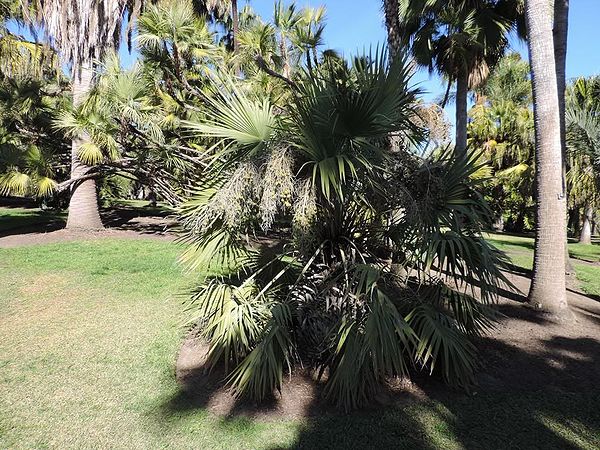
The Huntington Botanical Gardens, San Marino, CA. Photo by Dr. Axel kratel.

The Huntington Botanical Gardens, San Marino, CA. A brahea aculeata pushed to its drought tolerance limits. Photo by Dr. Axel kratel.


External Links
- Glossary of Palm Terms
- MODERN BOTANICAL LATIN
- "Just To Be Clear"
- http://www.palmtalk.org/forum/index.php?/topic/19939-brahea-san-carlos/
- http://www.palmtalk.org/forum/index.php?/topic/41590-planting-a-grotto-of-brahea-aculeata/
References
Phonetic spelling of Latin names by edric.
Special thanks to Geoff Stein, (Palmbob) for his hundreds of photos.
Special thanks to Palmweb.org, Dr. John Dransfield, Dr. Bill Baker & team, for their volumes of information and photos.
Glossary of Palm Terms; Based on the glossary in Dransfield, J., N.W. Uhl, C.B. Asmussen-Lange, W.J. Baker, M.M. Harley & C.E. Lewis. 2008. Genera Palmarum - Evolution and Classification of the Palms. Royal Botanic Gardens, Kew. All images copyright of the artists and photographers (see images for credits).
Many Special Thanks to Ed Vaile for his long hours of tireless editing and numerous contributions.