Difference between revisions of "Colpothrinax cookii"
| (31 intermediate revisions by one user not shown) | |||
| Line 1: | Line 1: | ||
__noeditsection__ | __noeditsection__ | ||
| − | |||
| − | |||
{{Palmbox | {{Palmbox | ||
| − | |image= | + | |image=1f2642.jpg |
|image_caption= | |image_caption= | ||
| − | |genus= | + | |genus=Colpothrinax (kol-poh-TRIH-naks) |
| − | |species= | + | |species=<br>cookii (cook'-ee) |
|subspecies= | |subspecies= | ||
|cultivar= | |cultivar= | ||
| Line 12: | Line 10: | ||
|continent=america | |continent=america | ||
|habit=Solitary | |habit=Solitary | ||
| − | |leaf_type= | + | |leaf_type=Costapalmate |
|height= | |height= | ||
|trunk_diameter= | |trunk_diameter= | ||
| Line 21: | Line 19: | ||
|common_names=Guanu (Belize); xan ("Kekchi", Guatemala), shan (Guatemala); suyate, suyate colorado, caral, guano (Honduras). | |common_names=Guanu (Belize); xan ("Kekchi", Guatemala), shan (Guatemala); suyate, suyate colorado, caral, guano (Honduras). | ||
}} | }} | ||
| − | |||
==Habitat and Distribution== | ==Habitat and Distribution== | ||
| − | Belize, Guatemala, and Honduras, 700-1,200(-1,600) m; typically in premontane, sometimes lower montane, wet forests on the Caribbean slope. Colpothrinax cookii, is restricted to the upper slopes and crests, of ridges of premontane wet forests, above 700 m elevation and, like C. aphanopetala, often occurs in association with Euterpe precatoria. Both staminate and pistillate anthesis in the strong-smelling, creamy yellow flowers of C. cookii, appear to occur while the reproductive parts, are still enclosed within the unopened corollas, suggesting beetle pollination. | + | ''Colpothrinax cookii'' is found in Belize, Guatemala, and Honduras, 700-1,200 [[Image:Colpothrinax cookii large Ho.jpg|thumb|left|350px|Ho'omaluhia, Hawaii.]](-1,600) m; typically in premontane, sometimes lower montane, wet forests on the Caribbean slope. Colpothrinax cookii, is restricted to the upper slopes and crests, of ridges of premontane wet forests, above 700 m elevation and, like C. aphanopetala, often occurs in association with Euterpe precatoria. Both staminate and pistillate anthesis in the strong-smelling, creamy yellow flowers of C. cookii, appear to occur while the reproductive parts, are still enclosed within the unopened corollas, suggesting beetle pollination. (R.J. Evans. 2001)/Palmweb. |
==Description== | ==Description== | ||
| − | + | Trunk (5+) 10-20 m tall, erect, 15-25 cm diam. breast high, columnar, usually in the open, sometimes, in closed forest, upper portion partially or completely enclosed in a mat of persistent leaf sheath fibers; trunks of juveniles less than about 6-8 m tall usually completely enclosed in this mat; when present, usually 20-30 cm thick. Leaves I5-30 per crown; petiole (1+) 1.5-2.5 (-3) m long, 2.3-3.4 cm wide at attachment to blade; sheath tomentose, the trichomes of two intermixed types: .1 soft, stellate trichomes, about 0.5 mm long, basally ferruginous, with free, white distal ends and .2 coarser, longer, wavy, twisted, compressed trichomes, these larger trichomes sparsest, shortest (about 1.5 mm long), and lightest in color (± tannish) on the basal portion of the sheath, becoming progressively denser, longer (to 9 mm long), and darker (rufous) distally; sheath disintegrating and fraying into fine, loosely woven, pendulous, filiform, typically ± terete fibers, 0.3-0.5 mm in diam.; hastula appressed to or slightly elevated above the blade, 2.3-3.4 x 2.4-3.9 cm, 0.7-1.4 times as wide as long, broadly to very broadly triangular, usually cuspidate apically; costa 16.5-38.5 cm long; blade 131-170 cm long centrally, 62-136 cm long laterally, divided into single-fold segments, | |
| + | {{read more top}} | ||
| + | except for lateral-most segment of each blade half, composed of 2 (-4) folds; central division extending to within 46-67 cm of (1/2 to 2/3) base, the lateral-most division extending to within 11.5-19.0 cm of (about 4/5) base; folds per blade half 25-35; widest single-fold segment 4.3-5.0 cm wide. Inflorescences with flowers or fruit to about 5(-8), plus about 5 (-7) marcescent; primary-axis 1.2-2.1 m long; inflorescence bracts Ianate, with trichomes 2-8 mm long; peduncle 0.2-0.8 m long; prophyll about 25 x 8.0-10.0 cm; peduncular bracts 6-7, 27.0-45.0 cm long; rachis 0.9-1.4 m long; rachis bracts 14.0-47.0 cm long; first-order branches 9-12; axes creamy yellow, their primary-axes 12.0-58.5 cm long, with unbranched proximal portion 2.5-37.0 cm long, the branched distal portion 6.0-32.0 cm long; prophyll 10.5-40.5 cm long; rachillae typically 40-50 per basal first-order branch, 10-20 per apical first-order branch, 3.0-15.5 cm long, tomentose, the trichomes (tannish to) ferruginous, 0.2-0.3 mm long; flower-bearing spurs 0.2-0.8 (-1.2) mm long, the subtending bracteole 0.7-2.0 mm long, 0.4-1.0 mm wide basally. Floral receptacle 0.7-1.7 mm long; calyx 3.5-5.4 mm long, free distally from corolla for 1/2-2/3 its length, creamy yellow, the lobes 0.5-0.8 mm long; corolla 4.0-6.0 mm long, connate basally for 1/5-1/3 its length, mostly creamy yellow, the lobes valvate, with parallel sides and mucronulate apices, fleshy, adaxially furrowed with involute or thickened margins, forming a hood apically, persistent; filaments 2.1-4.0 mm long, connate basally for 1.1-2.0 mm (2/5-3/5 their length), cream-colored, stamen-cup shorter than or ± same length as calyx-cup, 1.5-2.2 mm in diam., anthers 2.3-3.5 x 0.9-1.3 mm; pollen 25-30 x 20-30 pm, tectum on non-apertural face coarsely perforate to reticulate; gynoecium 2.5-3.4 x 1.1-1.6 mm, carpels 1.1-1.6 x 0.7-1.3 mm, cream-colored, styles 1.5-2.2 mm long, cream-colored. Fruit 1.6-2.1 cm in diam. Seed 1.0-1.2 x 1.3-1.5 cm. (R.J. Evans. 2001)/Palmweb. Editing by edric. | ||
| + | |||
| + | Colpothrinax cookii differs from C. wrightii in its cylindrical, non-swollen trunk, larger fruits and seeds, and more persistent corolla lobes which do not have a basal line of abscission. Its large, fleshy, yellow petals and yellow higher-order inflorescence branches differentiate it from C. aphanopetala. Colpothrinax cookii cannot, however, be differentiated from C. aphanopetala when sterile. Although C. cookii often has larger leaves (blades and petioles) than C. aphanopetala, this tendency is not useful for identification purposes (see discussion under C. aphanopetala). (R.J. Evans. 2001)/Palmweb. | ||
| + | {{read more bottom}} | ||
==Culture== | ==Culture== | ||
Shaded, moist, but well drained position. Quite slow growing. | Shaded, moist, but well drained position. Quite slow growing. | ||
| − | ==Curiosities== | + | ==Comments and Curiosities== |
| − | Named Colpothrinax cookii in honor of Orator Fuller Cook, who, along with R. F. Griggs, first collected this species, and also first recognized that it represented a new taxon | + | Etymology: Named Colpothrinax cookii in honor of Orator Fuller Cook, who, along with R. F. Griggs, first collected this species, and also first recognized that it represented a new taxon. |
| − | + | ||
| − | + | ||
| − | + | ||
| − | + | ||
| − | <center><gallery caption="IMAGE GALLERY" perrow=" | + | Uses: The leaves of C. cookii, are sometimes used for thatching, and for making brooms. Local people in Honduras and Belize, have admitted to setting fire, to the mat of highly flammable leaf-sheath fibers, enclosing the trunks of some individuals, merely for the pyrotechnic display. |
| − | Image:Colpothrinax cookii large Ho.jpg|Ho'omaluhia, Hawaii | + | |
| − | Image:Colpothrinax cookii trunk.jpg|Trunk Detail | + | <br style="clear:both;"/> |
| + | {{#Widget:AdResban}} | ||
| + | <center><gallery caption="IMAGE GALLERY" perrow="" widths="" heights=""> | ||
| + | Image:Colpothrinax cookii large Ho.jpg|Ho'omaluhia, Hawaii. | ||
| + | Image:Colpothrinax cookii trunk.jpg|Trunk Detail. | ||
image:6828306936_951c7b3f65_o.jpg | image:6828306936_951c7b3f65_o.jpg | ||
| − | image: | + | image:Colp_cook_060815_fvz.jpg|Photo by Bo-Gran Lundkvist. |
| − | image: | + | image:Colp_cook_060815_trunkz.jpg|Photo by Bo-Gran Lundkvist. |
image:Colphothrinax_cookii_juv.JPG | image:Colphothrinax_cookii_juv.JPG | ||
| − | image: | + | image:Colpothrinax_cookii00z.jpg |
| − | image:Cookii02Bo- | + | image:Cookii02Bo-Gran_Lundkvistz.jpg|Photo by Bo-Gran Lundkvist. |
| − | image:Cookii03Bo- | + | image:Cookii03Bo-Gran_Lundkvistz.jpg|Photo by Bo-Gran Lundkvist. |
| − | image:CookiiBo- | + | image:CookiiBo-Gran_Lundkvistz.jpg|Photo by Bo-Gran Lundkvist. |
| − | image: | + | File:C. cookii9bo.jpg|Photo by Bo-Gran Lundkvist. |
| − | image: | + | image:IMG_0303z.jpg|Photo by Bob Weas. |
| + | image:IMG_0332z.jpg|Photo by Bob Weas. | ||
| + | image:1f2642.jpg | ||
| + | image:23ffb1.jpg | ||
| + | image:61c093.jpg | ||
| + | image:4459dc.jpg | ||
| + | image:CcP1050105.jpg|Gold Coast Hinterland, Queensland. Photo by Daryl O'Connor. | ||
| + | File:post-42-053314300 1339403879daryl.jpg|Gold Coast Hinterland, Queensland. Photo by Daryl O'Connor. | ||
| + | File:_52de82a585eb1.jpg|Belize. | ||
| + | File:_52de82e2c8c3f.jpg|Belize. | ||
| + | File:faff8f77784e21f04623c4e34030f04costarica.jpg|Costa Rica. | ||
| + | File:cc001873428.JPG|Belize. | ||
| + | |||
</gallery></center> | </gallery></center> | ||
| + | ==External Links== | ||
| + | *[http://eunops.org/content/glossary-palm-terms Glossary of Palm Terms] | ||
| + | *[http://www.calflora.net/botanicalnames/pronunciation.html MODERN BOTANICAL LATIN] | ||
| + | *[http://www.jlhudsonseeds.net/Pronunciation.htm "Just To Be Clear"] | ||
| + | *http://www.lundkvistpalmgarden.com/Colpothrinax.html | ||
| + | *http://wp5.e-taxonomy.eu/media/palmae/protologe/palm_tc_46333_P.pdf | ||
| + | ==References== | ||
| + | Phonetic spelling of Latin names by edric. | ||
| + | |||
| + | Special thanks to Geoff Stein, (Palmbob) for his hundreds of photos. | ||
| + | |||
| + | Special thanks to [http://palmweb.org/?q=node/2 Palmweb.org], Dr. John Dransfield, Dr. Bill Baker & team, for their volumes of information and photos. | ||
| + | |||
| + | Glossary of Palm Terms; Based on the glossary in Dransfield, J., N.W. Uhl, C.B. Asmussen-Lange, W.J. Baker, M.M. Harley & C.E. Lewis. 2008. Genera Palmarum - Evolution and Classification of the Palms. Royal Botanic Gardens, Kew. All images copyright of the artists and photographers (see images for credits). | ||
| + | |||
| + | Evans, R.J.2001. Monograph of Colpothrinax. Palms 45(4): 177-195. | ||
| + | |||
{{SpeciesListBackLink}} | {{SpeciesListBackLink}} | ||
[[Category:COLPOTHRINAX|cookii]] | [[Category:COLPOTHRINAX|cookii]] | ||
Latest revision as of 09:11, 14 January 2016
| Colpothrinax (kol-poh-TRIH-naks) cookii (cook'-ee) | |||||||
|---|---|---|---|---|---|---|---|
 | |||||||
| Scientific Classification | |||||||
| |||||||
| Synonyms | |||||||
|
| |||||||
| Native Continent | |||||||
 | |||||||
| Morphology | |||||||
| |||||||
| Culture | |||||||
|
| |||||||
| Survivability index | |||||||
|
| |||||||
| Common names | |||||||
|
| |||||||
Contents
Habitat and Distribution
Colpothrinax cookii is found in Belize, Guatemala, and Honduras, 700-1,200
Description
Trunk (5+) 10-20 m tall, erect, 15-25 cm diam. breast high, columnar, usually in the open, sometimes, in closed forest, upper portion partially or completely enclosed in a mat of persistent leaf sheath fibers; trunks of juveniles less than about 6-8 m tall usually completely enclosed in this mat; when present, usually 20-30 cm thick. Leaves I5-30 per crown; petiole (1+) 1.5-2.5 (-3) m long, 2.3-3.4 cm wide at attachment to blade; sheath tomentose, the trichomes of two intermixed types: .1 soft, stellate trichomes, about 0.5 mm long, basally ferruginous, with free, white distal ends and .2 coarser, longer, wavy, twisted, compressed trichomes, these larger trichomes sparsest, shortest (about 1.5 mm long), and lightest in color (± tannish) on the basal portion of the sheath, becoming progressively denser, longer (to 9 mm long), and darker (rufous) distally; sheath disintegrating and fraying into fine, loosely woven, pendulous, filiform, typically ± terete fibers, 0.3-0.5 mm in diam.; hastula appressed to or slightly elevated above the blade, 2.3-3.4 x 2.4-3.9 cm, 0.7-1.4 times as wide as long, broadly to very broadly triangular, usually cuspidate apically; costa 16.5-38.5 cm long; blade 131-170 cm long centrally, 62-136 cm long laterally, divided into single-fold segments,
| read more |
|---|
|
except for lateral-most segment of each blade half, composed of 2 (-4) folds; central division extending to within 46-67 cm of (1/2 to 2/3) base, the lateral-most division extending to within 11.5-19.0 cm of (about 4/5) base; folds per blade half 25-35; widest single-fold segment 4.3-5.0 cm wide. Inflorescences with flowers or fruit to about 5(-8), plus about 5 (-7) marcescent; primary-axis 1.2-2.1 m long; inflorescence bracts Ianate, with trichomes 2-8 mm long; peduncle 0.2-0.8 m long; prophyll about 25 x 8.0-10.0 cm; peduncular bracts 6-7, 27.0-45.0 cm long; rachis 0.9-1.4 m long; rachis bracts 14.0-47.0 cm long; first-order branches 9-12; axes creamy yellow, their primary-axes 12.0-58.5 cm long, with unbranched proximal portion 2.5-37.0 cm long, the branched distal portion 6.0-32.0 cm long; prophyll 10.5-40.5 cm long; rachillae typically 40-50 per basal first-order branch, 10-20 per apical first-order branch, 3.0-15.5 cm long, tomentose, the trichomes (tannish to) ferruginous, 0.2-0.3 mm long; flower-bearing spurs 0.2-0.8 (-1.2) mm long, the subtending bracteole 0.7-2.0 mm long, 0.4-1.0 mm wide basally. Floral receptacle 0.7-1.7 mm long; calyx 3.5-5.4 mm long, free distally from corolla for 1/2-2/3 its length, creamy yellow, the lobes 0.5-0.8 mm long; corolla 4.0-6.0 mm long, connate basally for 1/5-1/3 its length, mostly creamy yellow, the lobes valvate, with parallel sides and mucronulate apices, fleshy, adaxially furrowed with involute or thickened margins, forming a hood apically, persistent; filaments 2.1-4.0 mm long, connate basally for 1.1-2.0 mm (2/5-3/5 their length), cream-colored, stamen-cup shorter than or ± same length as calyx-cup, 1.5-2.2 mm in diam., anthers 2.3-3.5 x 0.9-1.3 mm; pollen 25-30 x 20-30 pm, tectum on non-apertural face coarsely perforate to reticulate; gynoecium 2.5-3.4 x 1.1-1.6 mm, carpels 1.1-1.6 x 0.7-1.3 mm, cream-colored, styles 1.5-2.2 mm long, cream-colored. Fruit 1.6-2.1 cm in diam. Seed 1.0-1.2 x 1.3-1.5 cm. (R.J. Evans. 2001)/Palmweb. Editing by edric. Colpothrinax cookii differs from C. wrightii in its cylindrical, non-swollen trunk, larger fruits and seeds, and more persistent corolla lobes which do not have a basal line of abscission. Its large, fleshy, yellow petals and yellow higher-order inflorescence branches differentiate it from C. aphanopetala. Colpothrinax cookii cannot, however, be differentiated from C. aphanopetala when sterile. Although C. cookii often has larger leaves (blades and petioles) than C. aphanopetala, this tendency is not useful for identification purposes (see discussion under C. aphanopetala). (R.J. Evans. 2001)/Palmweb. |
Culture
Shaded, moist, but well drained position. Quite slow growing.
Comments and Curiosities
Etymology: Named Colpothrinax cookii in honor of Orator Fuller Cook, who, along with R. F. Griggs, first collected this species, and also first recognized that it represented a new taxon.
Uses: The leaves of C. cookii, are sometimes used for thatching, and for making brooms. Local people in Honduras and Belize, have admitted to setting fire, to the mat of highly flammable leaf-sheath fibers, enclosing the trunks of some individuals, merely for the pyrotechnic display.
- IMAGE GALLERY

Ho'omaluhia, Hawaii.

Trunk Detail.


Photo by Bo-Gran Lundkvist.

Photo by Bo-Gran Lundkvist.
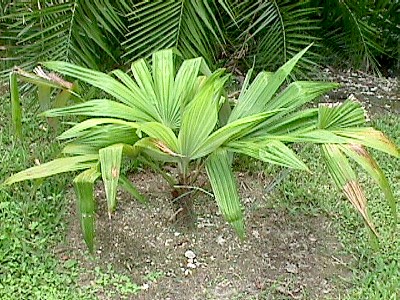


Photo by Bo-Gran Lundkvist.

Photo by Bo-Gran Lundkvist.

Photo by Bo-Gran Lundkvist.

Photo by Bo-Gran Lundkvist.

Photo by Bob Weas.

Photo by Bob Weas.


Gold Coast Hinterland, Queensland. Photo by Daryl O'Connor.

Gold Coast Hinterland, Queensland. Photo by Daryl O'Connor.

Belize.

Belize.

Costa Rica.
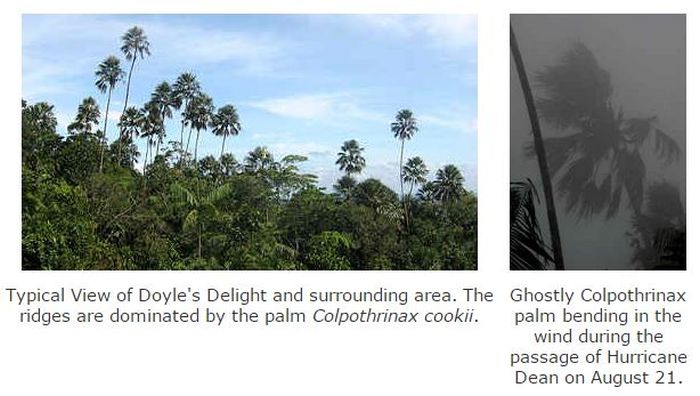
Belize.


External Links
- Glossary of Palm Terms
- MODERN BOTANICAL LATIN
- "Just To Be Clear"
- http://www.lundkvistpalmgarden.com/Colpothrinax.html
- http://wp5.e-taxonomy.eu/media/palmae/protologe/palm_tc_46333_P.pdf
References
Phonetic spelling of Latin names by edric.
Special thanks to Geoff Stein, (Palmbob) for his hundreds of photos.
Special thanks to Palmweb.org, Dr. John Dransfield, Dr. Bill Baker & team, for their volumes of information and photos.
Glossary of Palm Terms; Based on the glossary in Dransfield, J., N.W. Uhl, C.B. Asmussen-Lange, W.J. Baker, M.M. Harley & C.E. Lewis. 2008. Genera Palmarum - Evolution and Classification of the Palms. Royal Botanic Gardens, Kew. All images copyright of the artists and photographers (see images for credits).
Evans, R.J.2001. Monograph of Colpothrinax. Palms 45(4): 177-195.
Many Special Thanks to Ed Vaile for his long hours of tireless editing and numerous contributions.