Difference between revisions of "Marojejya insignis"
| (46 intermediate revisions by one user not shown) | |||
| Line 1: | Line 1: | ||
| − | |||
__noeditsection__ | __noeditsection__ | ||
| − | |||
| − | |||
{{Palmbox | {{Palmbox | ||
| − | |image= | + | |image=Ddbc0939-9ded-4628-9983-bef4e86eacaa.jpg |
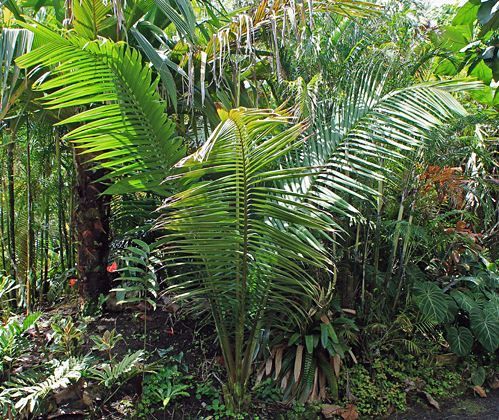
| − | |image_caption= | + | |image_caption=Maroansetra, Madagascar. Photo by Dr. John Dransfield, Royal Botanic Gardens, Kew/Palmweb. |
|genus=Marojejya (mahr-oh-JEH-jah) | |genus=Marojejya (mahr-oh-JEH-jah) | ||
| − | |species=<br>insignis (in-SIG- | + | |species=<br>insignis (in-SIG-niss) |
|subspecies= | |subspecies= | ||
|cultivar= | |cultivar= | ||
| Line 22: | Line 19: | ||
|common_names=Menamoso, Beondroka (Tsimihety); Maroalavehivavy (the female Beccariophoenix), Betefoka, Besofina, Hovotralanana, Mandanzezika (Betsimisaraka); Fohitanana, kona (Tanala). | |common_names=Menamoso, Beondroka (Tsimihety); Maroalavehivavy (the female Beccariophoenix), Betefoka, Besofina, Hovotralanana, Mandanzezika (Betsimisaraka); Fohitanana, kona (Tanala). | ||
}} | }} | ||
| − | |||
==Habitat and Distribution== | ==Habitat and Distribution== | ||
| − | Madagascar, | + | Madagascar, Found in the following protected areas: Marojejy, Masoala, Mananara [[image:Post_Madagascar_2005_092.JPG|thumb|left|500px|Marojejy Park, Madagascar. Photo by Jeff Searle, Searle Brothers Nursery, FL.]]Avaratra, Ambatovaky, Mantadia Betampona and Andohahela. Occasional monitoring of the species, especially the harvest trends, is required Occurs in lowland to mid-altitude rain forest growing on ridgetops or steep slopes at altitudes ranging from 50 up to 1,200 m. |
==Description== | ==Description== | ||
Solitary tree palm. TRUNK 2-8 m. high, 14-40 cm in diam. (with sheath remnants up to 50 cm), obscurely ringed; distal part (about 1 m) of trunk, covered in sheath/petiole remnants, often with zigzag roots of other plants visible; internodes brown, 1.5-2.5 cm, nodal scars about 1 cm. Superficial roots sometimes present. LEAVES 15-20 in the crown, spirally arranged, 4-5 m long, held porrect in shuttlecock mode, marcescent; sheath glabrous, 40-94 cm long, attenuate towards the blade, without auricles or with clear auricles to 6 x 5 cm, abaxially densely red-tomentose to almost glabrous, bright green to cherry-red, distally (together with the proximal part of the lamina) litter- and water-accumulating with aerial roots penetrating the litter, soon splitting opposite the petiole, the margins often fibrous, the margins with conspicuous robust parallel veins, those of the auricles sinuous or arching; (apparent?) petiole 0-143 cm, adaxially channelled with sharp edges to flat, 4-9 x 3-6.5 cm. in diam., in older leaves with scattered scales; rachis 3-5.8 m long, in midleaf 1.5-3 cm wide and keeled, abaxially with scattered chocolate-coloured to reddish scales (up to 5 x 1 mm) in shallow depressions or ± glabrous; either with the lamina entire in proximal quarter, multi-fold, outer margin 1.5-2 m long, 20-30 cm wide and more distally regularly pinnate, with (22, Amby) 30-60 leaflets on each side of the rachis, or with the leaf regularly pinnate with 59-84 leaflets on each side of the rachis, and nearly all leaflets single-fold, stiff or slightly arching, in one plane, green, the proximal 36-80 x 0.4-2.6 (-7.5) cm (the basal two occasionally 2-fold), the median 75-120 x 2-5 (-15) cm (interval 2-7.5 cm), distal 28-52 x 1-7 cm, connate for 2.5-12 cm, main veins 1-10, fold interfaces with medium-sized reddish scales (floccose whan young, with minute reddish dots or not visible ly reddish-tomentellous; prophyll 26-35 x 6.5-15 cm, with small scattered scales, split over its length, adnate for 3 cm; first peduncular bract inserted at about 8 cm from the base of the peduncle, 34-45 x 5-15 cm, with a beak 2-4 cm or not beaked at all, with scattered scales; non-tubular peduncular bracts 9-15, decreasing in size from base to apex of the peduncle, 2-31 x 1.2-7 cm; rachis 8-18 cm, densely reddish-tomentellous, with 16-50 rachillae; rachillae 5-12 cm long, with a short bare base to 1.5 cm long and 7-13 x 4 mm diam. with a few narrowly triangular sterile bracts, the rest about 12 mm in diam., very densely set with solitary pistillate flowers; bracteoles two, 3-6 x 3-4 mm, acute, very similar to the sepals. PISTILLATE FLOWERS green to creamcoloured; bracteoles 2-6 x 2.3-6 mm, the largest very similar to the sepals; sepals imbricate, slightly asymmetrical (more so in fruit), broadly ovate with slightly thickened, darker apex, the margins ciliolate, 5-8 x 4.5-7.5 mm, with slightly ragged edges; petals broadly ovate with small fleshy triangular apices, 7-16 x 5-12 mm; staminodes slender, 1-1.7 mm, sometimes connate for up to 0.2 mm, in fruit connate with the fruit base and carried upwards for up to 1 mm; pistil 9-12 x 4-6 mm, styles to 2 mm long, papillose adaxially. FRUIT bright to dark plum red to purplish turning black, irregularly obovoid, 18-21 x 11-20 x 10-14 mm, with a pronounced style boss to 5 mm high, this either subapical to almost sub-basal; mesocarp fleshy, 1-1.5 mm thick; endocarp fibrous, 14-16 x 12-16 mm, the fibres parallel near the base, anastomosing distally, without a beak. SEED subglobose, 11-14 x 10-15 x 9-10 mm, with homogeneous endosperm; embryo basal. EOPHYLL bifid, with a long petiole (> 13 cm). (J. Dransfield and H. Beentje. 1995)/Palmweb. Editing by edric. | Solitary tree palm. TRUNK 2-8 m. high, 14-40 cm in diam. (with sheath remnants up to 50 cm), obscurely ringed; distal part (about 1 m) of trunk, covered in sheath/petiole remnants, often with zigzag roots of other plants visible; internodes brown, 1.5-2.5 cm, nodal scars about 1 cm. Superficial roots sometimes present. LEAVES 15-20 in the crown, spirally arranged, 4-5 m long, held porrect in shuttlecock mode, marcescent; sheath glabrous, 40-94 cm long, attenuate towards the blade, without auricles or with clear auricles to 6 x 5 cm, abaxially densely red-tomentose to almost glabrous, bright green to cherry-red, distally (together with the proximal part of the lamina) litter- and water-accumulating with aerial roots penetrating the litter, soon splitting opposite the petiole, the margins often fibrous, the margins with conspicuous robust parallel veins, those of the auricles sinuous or arching; (apparent?) petiole 0-143 cm, adaxially channelled with sharp edges to flat, 4-9 x 3-6.5 cm. in diam., in older leaves with scattered scales; rachis 3-5.8 m long, in midleaf 1.5-3 cm wide and keeled, abaxially with scattered chocolate-coloured to reddish scales (up to 5 x 1 mm) in shallow depressions or ± glabrous; either with the lamina entire in proximal quarter, multi-fold, outer margin 1.5-2 m long, 20-30 cm wide and more distally regularly pinnate, with (22, Amby) 30-60 leaflets on each side of the rachis, or with the leaf regularly pinnate with 59-84 leaflets on each side of the rachis, and nearly all leaflets single-fold, stiff or slightly arching, in one plane, green, the proximal 36-80 x 0.4-2.6 (-7.5) cm (the basal two occasionally 2-fold), the median 75-120 x 2-5 (-15) cm (interval 2-7.5 cm), distal 28-52 x 1-7 cm, connate for 2.5-12 cm, main veins 1-10, fold interfaces with medium-sized reddish scales (floccose whan young, with minute reddish dots or not visible ly reddish-tomentellous; prophyll 26-35 x 6.5-15 cm, with small scattered scales, split over its length, adnate for 3 cm; first peduncular bract inserted at about 8 cm from the base of the peduncle, 34-45 x 5-15 cm, with a beak 2-4 cm or not beaked at all, with scattered scales; non-tubular peduncular bracts 9-15, decreasing in size from base to apex of the peduncle, 2-31 x 1.2-7 cm; rachis 8-18 cm, densely reddish-tomentellous, with 16-50 rachillae; rachillae 5-12 cm long, with a short bare base to 1.5 cm long and 7-13 x 4 mm diam. with a few narrowly triangular sterile bracts, the rest about 12 mm in diam., very densely set with solitary pistillate flowers; bracteoles two, 3-6 x 3-4 mm, acute, very similar to the sepals. PISTILLATE FLOWERS green to creamcoloured; bracteoles 2-6 x 2.3-6 mm, the largest very similar to the sepals; sepals imbricate, slightly asymmetrical (more so in fruit), broadly ovate with slightly thickened, darker apex, the margins ciliolate, 5-8 x 4.5-7.5 mm, with slightly ragged edges; petals broadly ovate with small fleshy triangular apices, 7-16 x 5-12 mm; staminodes slender, 1-1.7 mm, sometimes connate for up to 0.2 mm, in fruit connate with the fruit base and carried upwards for up to 1 mm; pistil 9-12 x 4-6 mm, styles to 2 mm long, papillose adaxially. FRUIT bright to dark plum red to purplish turning black, irregularly obovoid, 18-21 x 11-20 x 10-14 mm, with a pronounced style boss to 5 mm high, this either subapical to almost sub-basal; mesocarp fleshy, 1-1.5 mm thick; endocarp fibrous, 14-16 x 12-16 mm, the fibres parallel near the base, anastomosing distally, without a beak. SEED subglobose, 11-14 x 10-15 x 9-10 mm, with homogeneous endosperm; embryo basal. EOPHYLL bifid, with a long petiole (> 13 cm). (J. Dransfield and H. Beentje. 1995)/Palmweb. Editing by edric. | ||
| − | + | {{read more top}} | |
This palm, described as late as 1955, remained very poorly known until it was recollected by Harold Moore in 1971. Since then, numerous collections of Marojejya-like palms have been made from the Marojejy mountains in the north to Andohahela in the south. At first, every collection from a new area appeared to differ in some way from the type, as well as from each other. Features such as the presence or absence of a petiole, combined with the presence or absence of auricles, and the dissection of the leaf have proved to be extraordinarily variable. We even found such variation within populations. For a time we felt there were at least two separate taxa, but upon careful examination of the now ample material we have been forced to admit that all this variation occurs within a single taxon, M. insignis. Andapa: Mt Beondroka, March 1949 (ster.), Humbert 23424 (K, P); Marojejy East peak slopes, March 1949 (fr.), Humbert 23632 (K, L, P, type); idem, Oct. 1988 (old infl.), Miller et al. 3508 (K); idem, Nov. 1989 (y.fr.), Dransfield et al. JD6754 (K, TAN). Maroantsetra: Sahavary, Oct. 1986 (bud), Dransfield et al. JD6404 (BH, K, MO, P, TAN); idem, Feb. 1988 (y.fr.), Dransfield et al. JD6462 (K, P); idem, Feb. 1988 (old infl.), Dransfield et al. JD6484 (K, TAN). Toamasina: Ankiririryra Forest, March 1971 (fl.), Moore 9901 (P); Betampona, Oct. 1991 (fl.), Beentje 4499 (BH, K, MO, P, TAN); idem, Beentje 4500 (BH, K, MO, P, TAN). Moramanga: Anranomenabe, Nov. 1986 (ster.), Dransfield et al. JD6432 (K, P, TAN); Mantady, Dec. 1991 (fr.), Beentje & Andriampaniry 4547 (BH, K, MO, P, TAN); idem, Beentje & Andriampaniry 4551 (BH, K, MO, P, TAN). Ifanadiana: Ambinanindrano, Nov. 1991 (fl., fr., seedling), Beentje 4533 (BH, K, MO, P, TAN); idem, July 1992 (fr.), Beentje & Andriampaniry 4733 (K); idem, Jan. 1993 (y.fr.), Beentje & Andriampaniry 4804 (K). Manakara: Amby, May 1992 (old infl.), Beentje & Andriampaniry 4663 (K, MO, TAN); idem, July 1992 (fl.), Beentje & Andriampaniry 4725 (K, MO, TAN). Tolanaro: Andohahela, Dec. 1989 (y.fr.), Dransfield et al. JD6775 (K, P, TAN); idem, (old infl.), Dransfield et al. JD6778 (K, TAN). S. Andranomifotitra valley (reported in protologue), Ambatasoratra slopes (reported). Mananara Avaratra (Beentje & Dransfield). (J. Dransfield and H. Beentje. 1995)/Palmweb. | This palm, described as late as 1955, remained very poorly known until it was recollected by Harold Moore in 1971. Since then, numerous collections of Marojejya-like palms have been made from the Marojejy mountains in the north to Andohahela in the south. At first, every collection from a new area appeared to differ in some way from the type, as well as from each other. Features such as the presence or absence of a petiole, combined with the presence or absence of auricles, and the dissection of the leaf have proved to be extraordinarily variable. We even found such variation within populations. For a time we felt there were at least two separate taxa, but upon careful examination of the now ample material we have been forced to admit that all this variation occurs within a single taxon, M. insignis. Andapa: Mt Beondroka, March 1949 (ster.), Humbert 23424 (K, P); Marojejy East peak slopes, March 1949 (fr.), Humbert 23632 (K, L, P, type); idem, Oct. 1988 (old infl.), Miller et al. 3508 (K); idem, Nov. 1989 (y.fr.), Dransfield et al. JD6754 (K, TAN). Maroantsetra: Sahavary, Oct. 1986 (bud), Dransfield et al. JD6404 (BH, K, MO, P, TAN); idem, Feb. 1988 (y.fr.), Dransfield et al. JD6462 (K, P); idem, Feb. 1988 (old infl.), Dransfield et al. JD6484 (K, TAN). Toamasina: Ankiririryra Forest, March 1971 (fl.), Moore 9901 (P); Betampona, Oct. 1991 (fl.), Beentje 4499 (BH, K, MO, P, TAN); idem, Beentje 4500 (BH, K, MO, P, TAN). Moramanga: Anranomenabe, Nov. 1986 (ster.), Dransfield et al. JD6432 (K, P, TAN); Mantady, Dec. 1991 (fr.), Beentje & Andriampaniry 4547 (BH, K, MO, P, TAN); idem, Beentje & Andriampaniry 4551 (BH, K, MO, P, TAN). Ifanadiana: Ambinanindrano, Nov. 1991 (fl., fr., seedling), Beentje 4533 (BH, K, MO, P, TAN); idem, July 1992 (fr.), Beentje & Andriampaniry 4733 (K); idem, Jan. 1993 (y.fr.), Beentje & Andriampaniry 4804 (K). Manakara: Amby, May 1992 (old infl.), Beentje & Andriampaniry 4663 (K, MO, TAN); idem, July 1992 (fl.), Beentje & Andriampaniry 4725 (K, MO, TAN). Tolanaro: Andohahela, Dec. 1989 (y.fr.), Dransfield et al. JD6775 (K, P, TAN); idem, (old infl.), Dransfield et al. JD6778 (K, TAN). S. Andranomifotitra valley (reported in protologue), Ambatasoratra slopes (reported). Mananara Avaratra (Beentje & Dransfield). (J. Dransfield and H. Beentje. 1995)/Palmweb. | ||
| + | {{read more bottom}} | ||
==Culture== | ==Culture== | ||
| − | + | Lightly shaded, moist but well drained position. Apparantly not quite as moisture loving as its sibling M. darianii . Requires at least warm sub-tropical conditions. | |
==Comments and Curiosities== | ==Comments and Curiosities== | ||
| − | This is one of the grandest palms of Madagascar. First discovered in 1949 on the spectacular mountain massif of Marojejy, it has now been found to occur throughout the length of the eastern rain forests. There is even a handsome individual growing in the Parc de Tsimbazaza in Antananarivo opposite the Herbarium building. This is a rather massive, litter-trapping palm | + | This is one of the grandest palms of Madagascar. First discovered in 1949 on the spectacular mountain massif of Marojejy, it has now been found to occur throughout the length of the eastern rain forests. There is even a handsome individual growing in the Parc de Tsimbazaza in Antananarivo opposite the Herbarium building. This is a rather massive, litter-trapping palm. |
| − | + | Etymology: The specific epithet is from the Latin for "outstanding" or "remarkable". | |
| − | Uses: | + | Conservation: Least Concern - (IUCN Red List). Widespread in the east of Madagascar, where about 1,700 mature individuals are estimated to occur at about 15 known sites. The threats to this species are not causing any significant declines at present and the extent of occurrence and area of occupancy are well above the thresholds for a threatened listing. The species is therefore listed as Least Concern. It was previously assessed as Vulnerable, but there is more information available on the species now. Periodic monitoring is required because if harvest levels increase or there is is significant loss of habitat, this species could easily slip back into a threatened category again. Although the distribution range is large, it is rather rarely encountered. Where it does occur, it may be locally abundant but in large parts of its range, it appears to be absent. The whole population is estimated to comprise about 1,700 mature individuals. The population appears to be relatively stable at present. (Dr's. Rakotoarinivo, M. & Dransfield, J. 2012.) |
| + | |||
| + | Uses: The palm-heart is eaten by local people, and trees are felled to obtain this. | ||
| + | |||
| + | Similar and almost as stunning as its entire-leaved cousin M. darianii, this impressive species from northeastern Madagascar sports a large crown of pinnate leaves atop a tall trunk. It is best suited for the humid, tropical garden. (RPS.com) | ||
| + | |||
| + | <br style="clear:both;"/> | ||
| + | {{#Widget:AdResban}} | ||
| + | <center><gallery caption="IMAGE GALLERY" perrow="" widths="" heights=""> | ||
| + | Image:P1010031 Marojejya insignis.JPG|Habitat - Photo by Phil Arrowsmith. | ||
| + | Image:P1010098 Marjojeya insignis,Tanna Bot. Garden.JPG|Tanna Botanical Garden, Photo Phil Arrowsmith. | ||
| + | image:Post_Madagascar_2005_092.JPG|Marojejy Park, Madagascar. Photo by Jeff Searle, Searle Brothers Nursery, FL. | ||
| + | image:Post_Madagascar_2005_094.JPG|Marojejy Park, Madagascar. Photo by Jeff Searle, Searle Brothers Nursery, FL. | ||
| + | Image:P1010029 Marojejya insignis.JPG|Madagascar. Taken by Philip Arrowsmith in habitat on the trip to Madagascar with John dransfield. | ||
| + | Image:P1010030 Marojejya insignis.JPG|Madagascar. Taken by Philip Arrowsmith in habitat on the trip to Madagascar with John dransfield. | ||
| + | Image:P1010042 Marjojeya insignis.JPG|Madagascar. Taken by Philip Arrowsmith in habitat on the trip to Madagascar with John dransfield. | ||
| + | image:JMMAD_Maro_insi1.jpg|In Andohahela Forest in far So. Madagascar. Photo by Jeff Marcus. | ||
| + | image:JMMAD_Maro_insi2.jpg|In Andohahela Forest in far So. Madagascar. Photo by Jeff Marcus. | ||
| + | image:JMMAD_Maro_insi3.jpg|In Andohahela Forest in far So. Madagascar. Photo by Jeff Marcus. | ||
| + | image:C66d15c9-294d-4d29-b1a4-266ed2541126.jpg|Near Ifanadiana, Madagascar. Photo by Dr. William J. Baker, Royal Botanic Gardens, Kew/Palmweb. | ||
| + | image:B92dbb44-fbe8-4725-8c0d-0b5340030d27.jpg|Maroansetra, Madagascar. Photo by Dr. John Dransfield, Royal Botanic Gardens, Kew/Palmweb. | ||
| + | image:1d07845d-20e2-4f35-ab19-3cac3041657a.jpg|Marojejy, Madagascar. Photo by Dr. John Dransfield, Royal Botanic Gardens, Kew/Palmweb. | ||
| + | image:Ddbc0939-9ded-4628-9983-bef4e86eacaa.jpg|Maroansetra, Madagascar. Photo by Dr. John Dransfield, Royal Botanic Gardens, Kew/Palmweb. | ||
| + | image:457c7a33-0bc0-4957-be7a-c7cf4a1b339e.jpg|Marojejy, Madagascar. Photo by Dr. John Dransfield, Royal Botanic Gardens, Kew/Palmweb. | ||
| + | image:Ca18b1a9-3340-48ea-900e-4be1759de3aa.jpg|Sahavary, Madagascar. Photo by Dr. John Dransfield, Royal Botanic Gardens, Kew/Palmweb. | ||
| + | image:A001c33c-d028-42b8-bc26-85b3a6171b76.jpg|Andohahela, Madagascar. Photo by Dr. John Dransfield, Royal Botanic Gardens, Kew/Palmweb. | ||
| + | image:1c87608d-6cc7-4957-8dc3-2e73aff164fc.jpg|Sahavary, Madagascar. Photo by Dr. John Dransfield, Royal Botanic Gardens, Kew/Palmweb. | ||
| + | image:E0ad35ed-3fda-4d9a-afd5-c9524f35bc23.jpg|Sahavary, Madagascar. Photo by Dr. John Dransfield, Royal Botanic Gardens, Kew/Palmweb. | ||
| + | image:3bd72f34-4cb5-4464-85a0-0ac9910c33ad.jpg|Near Ifanadiana, Madagascar. Photo by Dr. William J. Baker, Royal Botanic Gardens, Kew/Palmweb. | ||
| + | image:15dab8d2-3b70-4b7e-9764-6080c95f081f.jpg|Andohahela, Madagascar. Photo by Dr. John Dransfield, Royal Botanic Gardens, Kew/Palmweb. | ||
| + | image:77c2c3e2-3e66-44b1-8f7a-2f2f1b072a89.jpg|Andohahela, Madagascar. Photo by Dr. John Dransfield, Royal Botanic Gardens, Kew/Palmweb. | ||
| + | image:9e16b107-1f47-45e1-a3d3-31f10bc07b61.jpg|Betampona, Madagascar. Photo by Dr. Henk Beentje, Royal Botanic Gardens, Kew/Palmweb. | ||
| + | File:572584804.jpg|Sambava, Madagascar. Photo by Dr. Mijoro Rakotoarinivo, Royal Botanic Gardens, Kew. | ||
| + | File:mioriginal770563.jpg|Ifanadiana, Madagascar. Photo by Dr. Mijoro Rakotoarinivo, Royal Botanic Gardens, Kew. | ||
| + | image:Mipost-3609-0-87617400-1358057023.jpg|Hilo, Hawaii. Photo by Dr. George Peavy. | ||
| + | image:Mipost-3609-0-22033100-1358057450.jpg|Hilo, Hawaii. Photo by Dr. George Peavy. | ||
| + | image:Mipost-3609-0-49110300-1358057053.jpg|Panaewa Rainforest Zoo and Gardens, Hilo, Hawaii. Photo by Dr. George Peavy. | ||
| + | image:GBPIX_photo_546973.jpg|At the "Parc de Tsimbazaza" - Antananarivo, Madagascar. "Photo by Olivier Reilhes". | ||
| + | image:GBPIX_photo_546970.jpg|At the "Parc de Tsimbazaza" - Antananarivo, Madagascar. "Photo by Olivier Reilhes". | ||
| + | image:GBPIX_photo_546974.jpg|At the "Parc de Tsimbazaza" - Antananarivo, Madagascar. "Photo by Olivier Reilhes". | ||
| + | File:15689378337_6aaa2af4e9_o.jpg|Maromizaha - Madagascar (2014). "Photo by Olivier Reilhes". | ||
| + | File:15687824090_1a00c52bbb_o.jpg|Maromizaha - Madagascar (2014). "Photo by Olivier Reilhes". | ||
| + | File:15873155961_573997a017_o.jpg|Maromizaha - Madagascar (2014). "Photo by Olivier Reilhes". | ||
| + | File:15849334356_e5f10114d7_o.jpg|Maromizaha - Madagascar (2014). "Photo by Olivier Reilhes". | ||
| + | File:15875154045_ee14778cf0_o.jpg|Maromizaha - Madagascar (2014). "Photo by Olivier Reilhes". | ||
| + | File:15687638228_0c94745c4e_o.jpg|Maromizaha - Madagascar (2014). "Photo by Olivier Reilhes". | ||
| + | File:15874502332_b1065644f4_o.jpg|Maromizaha - Madagascar (2014). "Photo by Olivier Reilhes". | ||
| + | File:15255494183_c368084dc9_o.jpg|Maromizaha - Madagascar (2014). "Photo by Olivier Reilhes". | ||
| + | File:15873157021_611d832668_o.jpg|Maromizaha - Madagascar (2014). "Photo by Olivier Reilhes". | ||
| + | |||
| + | |||
| + | |||
| + | File:503- Marojeyja insinis-Réserve de Maromizaha.JPG|Maromizaha réserve, Madagascar. Photo by Jean Pierre Riviere. | ||
| + | File:504- Marojeyja insinis-Réserve de Maromizaha.JPG|Maromizaha réserve, Madagascar. Photo by Jean Pierre Riviere. | ||
| + | File:506-Marojeyja insinis-Réserve de Maromizaha.JPG|Maromizaha réserve, Madagascar. Photo by Jean Pierre Riviere. | ||
| + | File:post-5709-0-88614500-1357963750.jpg|Mt Warning Caldera Nth NSW Australia. Photo by Pete. | ||
| + | |||
| + | image:Insignis6.jpg|At the "Parc de Tsimbazaza" - Antananarivo, Madagascar. "Photo by Jack Sayers. | ||
| + | File:3441046l.JPG|Antsiranana, Madagascar. Photo by Dr. James S. Miller. | ||
| + | File:Marojejya_insignis1a.jpg|Parc Tsimbazaza in Antananarivo, Madagascar. Photo by Dr. Fred Triep. | ||
| + | File:mi09894320120.JPG|Floribunda Nursery, Hawaii. Photo by Paul Craft. | ||
| + | File:mi556007428022.JPG|Floribunda Nursery, Hawaii. Photo by Paul Craft. | ||
| + | File:mi443487033.JPG|Floribunda Nursery, Hawaii. Photo by Paul Craft. | ||
| + | File:post-1300-047150800 1313439729.jpg|Diana Soler's garden, five miles south of Pahoa, Hawaii. Photo by Timothy Brian. | ||
| + | |||
| + | |||
| + | |||
| + | |||
| + | image:1f0a3c.jpg|Hawaii. Photo by Geoff Stein. | ||
| + | File:post-42-0-94485600-1431244050.jpg|Wollongong Botanical Gardens Palm Collection, 90 minute drive south of Sydney. Photo by Daryl O'Connor. | ||
| + | File:mi908544021774.JPG|Hawaii. Photo by Bo. | ||
| + | |||
| + | |||
| + | |||
| + | File:marojejya-insignis.jpg|Madagascar. Photo: Rare Palm Seeds.com | ||
| + | File:marojejya-insignis-2.jpg|Madagascar. Photo: Rare Palm Seeds.com | ||
| + | File:marojejya-insignis-3.jpg|Madagascar. Photo: Rare Palm Seeds.com | ||
| + | File:marojejya-insignis-4.jpg|Madagascar. Photo: Rare Palm Seeds.com | ||
| + | File:Marojejya insignis1 (Large).JPG|Photo: Jungle Music Palms & Cycads.com | ||
| + | File:ml99657342188.JPG|Thailand. Photo by Philippe Alvarez. | ||
| + | File:ml9908402096577.JPG|Thailand. Photo by Philippe Alvarez. | ||
| + | File:ml779492210.JPG|Thailand. Photo by Philippe Alvarez. | ||
| + | File:ml66580569075.JPG|Thailand. Photo by Philippe Alvarez. | ||
| + | File:ml440669721.JPG|Thailand. Photo by Philippe Alvarez. | ||
| + | File:ml5530907721.JPG|Thailand. Photo by Philippe Alvarez. | ||
| + | File:ml338062341.JPG|Thailand. Photo by Philippe Alvarez. | ||
| + | File:mi0978964532109.JPG|Range map. All information copyright, Royal Botanic Gardens, Kew. | ||
| + | </gallery></center> | ||
==External Links== | ==External Links== | ||
*[http://eunops.org/content/glossary-palm-terms Glossary of Palm Terms] | *[http://eunops.org/content/glossary-palm-terms Glossary of Palm Terms] | ||
| Line 45: | Line 129: | ||
Phonetic spelling of Latin names by edric. | Phonetic spelling of Latin names by edric. | ||
| − | Special thanks to Geoff Stein, (Palmbob) for his hundreds of photos | + | Special thanks to Geoff Stein, (Palmbob) for his hundreds of photos. |
| − | Special thanks to [http://palmweb.org/?q=node/2 Palmweb.org], Dr. John Dransfield, Dr. Bill Baker & team, for their volumes of information and photos | + | Special thanks to [http://palmweb.org/?q=node/2 Palmweb.org], Dr. John Dransfield, Dr. Bill Baker & team, for their volumes of information and photos. |
Glossary of Palm Terms; Based on the glossary in Dransfield, J., N.W. Uhl, C.B. Asmussen-Lange, W.J. Baker, M.M. Harley & C.E. Lewis. 2008. Genera Palmarum - Evolution and Classification of the Palms. Royal Botanic Gardens, Kew. All images copyright of the artists and photographers (see images for credits). | Glossary of Palm Terms; Based on the glossary in Dransfield, J., N.W. Uhl, C.B. Asmussen-Lange, W.J. Baker, M.M. Harley & C.E. Lewis. 2008. Genera Palmarum - Evolution and Classification of the Palms. Royal Botanic Gardens, Kew. All images copyright of the artists and photographers (see images for credits). | ||
| Line 53: | Line 137: | ||
J. Dransfield & H. Beentje, The Palms of Madagascar. 1995. The Palms of Madagascar. Royal Botanic Gardens, Kew and The International Palm Society. | J. Dransfield & H. Beentje, The Palms of Madagascar. 1995. The Palms of Madagascar. Royal Botanic Gardens, Kew and The International Palm Society. | ||
| − | |||
| − | |||
| − | |||
| − | |||
| − | |||
| − | |||
| − | |||
| − | |||
| − | |||
| − | |||
| − | |||
| − | |||
| − | |||
| − | |||
| − | |||
| − | |||
| − | |||
| − | |||
| − | |||
| − | |||
| − | |||
| − | |||
| − | |||
| − | |||
| − | |||
| − | |||
| − | |||
| − | |||
| − | |||
| − | |||
| − | |||
| − | |||
| − | |||
| − | |||
| − | |||
| − | |||
| − | |||
| − | |||
| − | |||
| − | |||
| − | |||
| − | |||
| − | |||
| − | |||
| − | |||
| − | |||
| − | |||
| − | |||
| − | |||
| − | |||
| − | |||
| − | |||
| − | |||
| − | |||
| − | |||
| − | |||
| − | |||
| − | |||
{{SpeciesListBackLink}} | {{SpeciesListBackLink}} | ||
[[Category:Palms of Madagascar]] | [[Category:Palms of Madagascar]] | ||
[[Category:MAROJEJYA|insignis]] | [[Category:MAROJEJYA|insignis]] | ||
Latest revision as of 09:35, 9 February 2016
| Marojejya (mahr-oh-JEH-jah) insignis (in-SIG-niss) | |||||||
|---|---|---|---|---|---|---|---|
 Maroansetra, Madagascar. Photo by Dr. John Dransfield, Royal Botanic Gardens, Kew/Palmweb. | |||||||
| Scientific Classification | |||||||
| |||||||
| Synonyms | |||||||
|
| |||||||
| Native Continent | |||||||
 | |||||||
| Morphology | |||||||
| |||||||
| Culture | |||||||
|
| |||||||
| Survivability index | |||||||
|
| |||||||
| Common names | |||||||
|
| |||||||
Contents
Habitat and Distribution
Madagascar, Found in the following protected areas: Marojejy, Masoala, Mananara
Description
Solitary tree palm. TRUNK 2-8 m. high, 14-40 cm in diam. (with sheath remnants up to 50 cm), obscurely ringed; distal part (about 1 m) of trunk, covered in sheath/petiole remnants, often with zigzag roots of other plants visible; internodes brown, 1.5-2.5 cm, nodal scars about 1 cm. Superficial roots sometimes present. LEAVES 15-20 in the crown, spirally arranged, 4-5 m long, held porrect in shuttlecock mode, marcescent; sheath glabrous, 40-94 cm long, attenuate towards the blade, without auricles or with clear auricles to 6 x 5 cm, abaxially densely red-tomentose to almost glabrous, bright green to cherry-red, distally (together with the proximal part of the lamina) litter- and water-accumulating with aerial roots penetrating the litter, soon splitting opposite the petiole, the margins often fibrous, the margins with conspicuous robust parallel veins, those of the auricles sinuous or arching; (apparent?) petiole 0-143 cm, adaxially channelled with sharp edges to flat, 4-9 x 3-6.5 cm. in diam., in older leaves with scattered scales; rachis 3-5.8 m long, in midleaf 1.5-3 cm wide and keeled, abaxially with scattered chocolate-coloured to reddish scales (up to 5 x 1 mm) in shallow depressions or ± glabrous; either with the lamina entire in proximal quarter, multi-fold, outer margin 1.5-2 m long, 20-30 cm wide and more distally regularly pinnate, with (22, Amby) 30-60 leaflets on each side of the rachis, or with the leaf regularly pinnate with 59-84 leaflets on each side of the rachis, and nearly all leaflets single-fold, stiff or slightly arching, in one plane, green, the proximal 36-80 x 0.4-2.6 (-7.5) cm (the basal two occasionally 2-fold), the median 75-120 x 2-5 (-15) cm (interval 2-7.5 cm), distal 28-52 x 1-7 cm, connate for 2.5-12 cm, main veins 1-10, fold interfaces with medium-sized reddish scales (floccose whan young, with minute reddish dots or not visible ly reddish-tomentellous; prophyll 26-35 x 6.5-15 cm, with small scattered scales, split over its length, adnate for 3 cm; first peduncular bract inserted at about 8 cm from the base of the peduncle, 34-45 x 5-15 cm, with a beak 2-4 cm or not beaked at all, with scattered scales; non-tubular peduncular bracts 9-15, decreasing in size from base to apex of the peduncle, 2-31 x 1.2-7 cm; rachis 8-18 cm, densely reddish-tomentellous, with 16-50 rachillae; rachillae 5-12 cm long, with a short bare base to 1.5 cm long and 7-13 x 4 mm diam. with a few narrowly triangular sterile bracts, the rest about 12 mm in diam., very densely set with solitary pistillate flowers; bracteoles two, 3-6 x 3-4 mm, acute, very similar to the sepals. PISTILLATE FLOWERS green to creamcoloured; bracteoles 2-6 x 2.3-6 mm, the largest very similar to the sepals; sepals imbricate, slightly asymmetrical (more so in fruit), broadly ovate with slightly thickened, darker apex, the margins ciliolate, 5-8 x 4.5-7.5 mm, with slightly ragged edges; petals broadly ovate with small fleshy triangular apices, 7-16 x 5-12 mm; staminodes slender, 1-1.7 mm, sometimes connate for up to 0.2 mm, in fruit connate with the fruit base and carried upwards for up to 1 mm; pistil 9-12 x 4-6 mm, styles to 2 mm long, papillose adaxially. FRUIT bright to dark plum red to purplish turning black, irregularly obovoid, 18-21 x 11-20 x 10-14 mm, with a pronounced style boss to 5 mm high, this either subapical to almost sub-basal; mesocarp fleshy, 1-1.5 mm thick; endocarp fibrous, 14-16 x 12-16 mm, the fibres parallel near the base, anastomosing distally, without a beak. SEED subglobose, 11-14 x 10-15 x 9-10 mm, with homogeneous endosperm; embryo basal. EOPHYLL bifid, with a long petiole (> 13 cm). (J. Dransfield and H. Beentje. 1995)/Palmweb. Editing by edric.
| read more |
|---|
|
This palm, described as late as 1955, remained very poorly known until it was recollected by Harold Moore in 1971. Since then, numerous collections of Marojejya-like palms have been made from the Marojejy mountains in the north to Andohahela in the south. At first, every collection from a new area appeared to differ in some way from the type, as well as from each other. Features such as the presence or absence of a petiole, combined with the presence or absence of auricles, and the dissection of the leaf have proved to be extraordinarily variable. We even found such variation within populations. For a time we felt there were at least two separate taxa, but upon careful examination of the now ample material we have been forced to admit that all this variation occurs within a single taxon, M. insignis. Andapa: Mt Beondroka, March 1949 (ster.), Humbert 23424 (K, P); Marojejy East peak slopes, March 1949 (fr.), Humbert 23632 (K, L, P, type); idem, Oct. 1988 (old infl.), Miller et al. 3508 (K); idem, Nov. 1989 (y.fr.), Dransfield et al. JD6754 (K, TAN). Maroantsetra: Sahavary, Oct. 1986 (bud), Dransfield et al. JD6404 (BH, K, MO, P, TAN); idem, Feb. 1988 (y.fr.), Dransfield et al. JD6462 (K, P); idem, Feb. 1988 (old infl.), Dransfield et al. JD6484 (K, TAN). Toamasina: Ankiririryra Forest, March 1971 (fl.), Moore 9901 (P); Betampona, Oct. 1991 (fl.), Beentje 4499 (BH, K, MO, P, TAN); idem, Beentje 4500 (BH, K, MO, P, TAN). Moramanga: Anranomenabe, Nov. 1986 (ster.), Dransfield et al. JD6432 (K, P, TAN); Mantady, Dec. 1991 (fr.), Beentje & Andriampaniry 4547 (BH, K, MO, P, TAN); idem, Beentje & Andriampaniry 4551 (BH, K, MO, P, TAN). Ifanadiana: Ambinanindrano, Nov. 1991 (fl., fr., seedling), Beentje 4533 (BH, K, MO, P, TAN); idem, July 1992 (fr.), Beentje & Andriampaniry 4733 (K); idem, Jan. 1993 (y.fr.), Beentje & Andriampaniry 4804 (K). Manakara: Amby, May 1992 (old infl.), Beentje & Andriampaniry 4663 (K, MO, TAN); idem, July 1992 (fl.), Beentje & Andriampaniry 4725 (K, MO, TAN). Tolanaro: Andohahela, Dec. 1989 (y.fr.), Dransfield et al. JD6775 (K, P, TAN); idem, (old infl.), Dransfield et al. JD6778 (K, TAN). S. Andranomifotitra valley (reported in protologue), Ambatasoratra slopes (reported). Mananara Avaratra (Beentje & Dransfield). (J. Dransfield and H. Beentje. 1995)/Palmweb. |
Culture
Lightly shaded, moist but well drained position. Apparantly not quite as moisture loving as its sibling M. darianii . Requires at least warm sub-tropical conditions.
Comments and Curiosities
This is one of the grandest palms of Madagascar. First discovered in 1949 on the spectacular mountain massif of Marojejy, it has now been found to occur throughout the length of the eastern rain forests. There is even a handsome individual growing in the Parc de Tsimbazaza in Antananarivo opposite the Herbarium building. This is a rather massive, litter-trapping palm.
Etymology: The specific epithet is from the Latin for "outstanding" or "remarkable".
Conservation: Least Concern - (IUCN Red List). Widespread in the east of Madagascar, where about 1,700 mature individuals are estimated to occur at about 15 known sites. The threats to this species are not causing any significant declines at present and the extent of occurrence and area of occupancy are well above the thresholds for a threatened listing. The species is therefore listed as Least Concern. It was previously assessed as Vulnerable, but there is more information available on the species now. Periodic monitoring is required because if harvest levels increase or there is is significant loss of habitat, this species could easily slip back into a threatened category again. Although the distribution range is large, it is rather rarely encountered. Where it does occur, it may be locally abundant but in large parts of its range, it appears to be absent. The whole population is estimated to comprise about 1,700 mature individuals. The population appears to be relatively stable at present. (Dr's. Rakotoarinivo, M. & Dransfield, J. 2012.)
Uses: The palm-heart is eaten by local people, and trees are felled to obtain this.
Similar and almost as stunning as its entire-leaved cousin M. darianii, this impressive species from northeastern Madagascar sports a large crown of pinnate leaves atop a tall trunk. It is best suited for the humid, tropical garden. (RPS.com)
- IMAGE GALLERY

Habitat - Photo by Phil Arrowsmith.

Tanna Botanical Garden, Photo Phil Arrowsmith.

Marojejy Park, Madagascar. Photo by Jeff Searle, Searle Brothers Nursery, FL.

Marojejy Park, Madagascar. Photo by Jeff Searle, Searle Brothers Nursery, FL.

Madagascar. Taken by Philip Arrowsmith in habitat on the trip to Madagascar with John dransfield.

Madagascar. Taken by Philip Arrowsmith in habitat on the trip to Madagascar with John dransfield.

Madagascar. Taken by Philip Arrowsmith in habitat on the trip to Madagascar with John dransfield.

In Andohahela Forest in far So. Madagascar. Photo by Jeff Marcus.

In Andohahela Forest in far So. Madagascar. Photo by Jeff Marcus.

In Andohahela Forest in far So. Madagascar. Photo by Jeff Marcus.

Near Ifanadiana, Madagascar. Photo by Dr. William J. Baker, Royal Botanic Gardens, Kew/Palmweb.

Maroansetra, Madagascar. Photo by Dr. John Dransfield, Royal Botanic Gardens, Kew/Palmweb.

Marojejy, Madagascar. Photo by Dr. John Dransfield, Royal Botanic Gardens, Kew/Palmweb.

Maroansetra, Madagascar. Photo by Dr. John Dransfield, Royal Botanic Gardens, Kew/Palmweb.

Marojejy, Madagascar. Photo by Dr. John Dransfield, Royal Botanic Gardens, Kew/Palmweb.

Sahavary, Madagascar. Photo by Dr. John Dransfield, Royal Botanic Gardens, Kew/Palmweb.

Andohahela, Madagascar. Photo by Dr. John Dransfield, Royal Botanic Gardens, Kew/Palmweb.

Sahavary, Madagascar. Photo by Dr. John Dransfield, Royal Botanic Gardens, Kew/Palmweb.

Sahavary, Madagascar. Photo by Dr. John Dransfield, Royal Botanic Gardens, Kew/Palmweb.

Near Ifanadiana, Madagascar. Photo by Dr. William J. Baker, Royal Botanic Gardens, Kew/Palmweb.

Andohahela, Madagascar. Photo by Dr. John Dransfield, Royal Botanic Gardens, Kew/Palmweb.

Andohahela, Madagascar. Photo by Dr. John Dransfield, Royal Botanic Gardens, Kew/Palmweb.

Betampona, Madagascar. Photo by Dr. Henk Beentje, Royal Botanic Gardens, Kew/Palmweb.

Sambava, Madagascar. Photo by Dr. Mijoro Rakotoarinivo, Royal Botanic Gardens, Kew.

Ifanadiana, Madagascar. Photo by Dr. Mijoro Rakotoarinivo, Royal Botanic Gardens, Kew.

Hilo, Hawaii. Photo by Dr. George Peavy.

Hilo, Hawaii. Photo by Dr. George Peavy.

Panaewa Rainforest Zoo and Gardens, Hilo, Hawaii. Photo by Dr. George Peavy.

At the "Parc de Tsimbazaza" - Antananarivo, Madagascar. "Photo by Olivier Reilhes".

At the "Parc de Tsimbazaza" - Antananarivo, Madagascar. "Photo by Olivier Reilhes".

At the "Parc de Tsimbazaza" - Antananarivo, Madagascar. "Photo by Olivier Reilhes".

Maromizaha - Madagascar (2014). "Photo by Olivier Reilhes".

Maromizaha - Madagascar (2014). "Photo by Olivier Reilhes".

Maromizaha - Madagascar (2014). "Photo by Olivier Reilhes".

Maromizaha - Madagascar (2014). "Photo by Olivier Reilhes".

Maromizaha - Madagascar (2014). "Photo by Olivier Reilhes".

Maromizaha - Madagascar (2014). "Photo by Olivier Reilhes".

Maromizaha - Madagascar (2014). "Photo by Olivier Reilhes".

Maromizaha - Madagascar (2014). "Photo by Olivier Reilhes".

Maromizaha - Madagascar (2014). "Photo by Olivier Reilhes".

Maromizaha réserve, Madagascar. Photo by Jean Pierre Riviere.

Maromizaha réserve, Madagascar. Photo by Jean Pierre Riviere.

Maromizaha réserve, Madagascar. Photo by Jean Pierre Riviere.

Mt Warning Caldera Nth NSW Australia. Photo by Pete.

At the "Parc de Tsimbazaza" - Antananarivo, Madagascar. "Photo by Jack Sayers.

Antsiranana, Madagascar. Photo by Dr. James S. Miller.

Parc Tsimbazaza in Antananarivo, Madagascar. Photo by Dr. Fred Triep.
Floribunda Nursery, Hawaii. Photo by Paul Craft.

Floribunda Nursery, Hawaii. Photo by Paul Craft.

Floribunda Nursery, Hawaii. Photo by Paul Craft.

Diana Soler's garden, five miles south of Pahoa, Hawaii. Photo by Timothy Brian.

Hawaii. Photo by Geoff Stein.

Wollongong Botanical Gardens Palm Collection, 90 minute drive south of Sydney. Photo by Daryl O'Connor.

Hawaii. Photo by Bo.

Madagascar. Photo: Rare Palm Seeds.com

Madagascar. Photo: Rare Palm Seeds.com

Madagascar. Photo: Rare Palm Seeds.com

Madagascar. Photo: Rare Palm Seeds.com

Photo: Jungle Music Palms & Cycads.com

Thailand. Photo by Philippe Alvarez.

Thailand. Photo by Philippe Alvarez.

Thailand. Photo by Philippe Alvarez.

Thailand. Photo by Philippe Alvarez.

Thailand. Photo by Philippe Alvarez.

Thailand. Photo by Philippe Alvarez.

Thailand. Photo by Philippe Alvarez.

Range map. All information copyright, Royal Botanic Gardens, Kew.


.JPG)


External Links
- Glossary of Palm Terms
- MODERN BOTANICAL LATIN
- "Just To Be Clear"
- http://www.cites.org/common/com/pc/20/inf%20docs/F20-11i-A6.pdf
References
Phonetic spelling of Latin names by edric.
Special thanks to Geoff Stein, (Palmbob) for his hundreds of photos.
Special thanks to Palmweb.org, Dr. John Dransfield, Dr. Bill Baker & team, for their volumes of information and photos.
Glossary of Palm Terms; Based on the glossary in Dransfield, J., N.W. Uhl, C.B. Asmussen-Lange, W.J. Baker, M.M. Harley & C.E. Lewis. 2008. Genera Palmarum - Evolution and Classification of the Palms. Royal Botanic Gardens, Kew. All images copyright of the artists and photographers (see images for credits).
J. Dransfield & H. Beentje, The Palms of Madagascar. 1995. The Palms of Madagascar. Royal Botanic Gardens, Kew and The International Palm Society.
Many Special Thanks to Ed Vaile for his long hours of tireless editing and numerous contributions.