Difference between revisions of "Pinanga dicksonii"
Dypsisdean (Talk | contribs) |
|||
| (18 intermediate revisions by one user not shown) | |||
| Line 1: | Line 1: | ||
__noeditsection__ | __noeditsection__ | ||
{{Palmbox | {{Palmbox | ||
| − | |image= | + | |image=Ab7241.jpg |
|image_caption=Hawaii. Photo by Geoff Stein | |image_caption=Hawaii. Photo by Geoff Stein | ||
|genus=Pinanga (pih-NAHN-gah) | |genus=Pinanga (pih-NAHN-gah) | ||
| Line 20: | Line 20: | ||
}} | }} | ||
==Habitat and Distribution== | ==Habitat and Distribution== | ||
| − | India. Native to the Andaman Islands east of India. Endemic to the Western Ghats- South and Central Sahyadris. Indian distribution: State - Kerala, District/s: Kollam, Malappuram, Kannur, Palakkad, Thiruvananthapuram, Thrissur, Wayanad, Kasaragode, Kozhikkode, Idukki. Locally common in moist pockets in evergreen forests. Red Sandy Soils. | + | India. Native to the Andaman Islands east of India. Endemic to the Western Ghats [[image:PdD096268.jpg|thumb|left|365px|Agumbe, Karnataka, India. Photo by Kalyan Varma]]- South and Central Sahyadris. Indian distribution: State - Kerala, District/s: Kollam, Malappuram, Kannur, Palakkad, Thiruvananthapuram, Thrissur, Wayanad, Kasaragode, Kozhikkode, Idukki. Locally common in moist pockets in evergreen forests. Red Sandy Soils. |
| − | + | ||
==Description== | ==Description== | ||
Slender monoecious palm, with annular leaf scars, up to 5 m tall. Leaves compound, pinnate, to 1.5 m long; sheath to 30 cm long; leaflets to 50 x 3 cm, linear-lanceolate, opposite, apex premorse, glabrous. Inflorescence to 35 cm long. Drupe, ellipsoid; seed ovoid or ellipsoid, ruminate. | Slender monoecious palm, with annular leaf scars, up to 5 m tall. Leaves compound, pinnate, to 1.5 m long; sheath to 30 cm long; leaflets to 50 x 3 cm, linear-lanceolate, opposite, apex premorse, glabrous. Inflorescence to 35 cm long. Drupe, ellipsoid; seed ovoid or ellipsoid, ruminate. | ||
| − | Slender clustered palms, 4-6 m high, 6-8 cm in diam. Leaves pinnate, 1-1.3 cm long; leaflets 2-3 united, 30-50 cm long, 2-3 cm wide, toothed margins. Spadix small, at axil below the crown, 4-6 branched, deflexed and drooping. Spathe 1. Flowers unisexual, 3 at a node, middle female and side ones male. Male: Sepals keeled. Petals valvate, 0.2-0.3 cm, ovate lanceolate. Stamens 6. Female: sepals and petals orbicular, 0.1 cm; staminodes 6. Ovary 1-celled; ovule 1. Fruit 0.6-1 x 0.2-0.3 cm, ellipsoid; seed solitary, ellipsoid. (Dr. N Sasidharan (Dr. B P Pal Fellow), Kerala Forest Research Institute, Peechi) | + | Slender clustered palms, 4-6 m high, 6-8 cm in diam. Leaves pinnate, 1-1.3 cm long; leaflets 2-3 united, 30-50 cm long, 2-3 cm wide, toothed margins. Spadix small, at axil below the crown, 4-6 branched, deflexed and drooping. Spathe 1. Flowers unisexual, 3 at a node, middle female and side ones male. Male: Sepals keeled. Petals valvate, 0.2-0.3 cm, ovate lanceolate. Stamens 6. Female: sepals and petals orbicular, 0.1 cm; staminodes 6. Ovary 1-celled; ovule 1. Fruit 0.6-1 x 0.2-0.3 cm, ellipsoid; seed solitary, ellipsoid. (Dr. N Sasidharan (Dr. B P Pal Fellow), Kerala Forest Research Institute, Peechi) Editing by edric. |
==Culture== | ==Culture== | ||
Fast grower in Florida 10a-up. | Fast grower in Florida 10a-up. | ||
| Line 43: | Line 42: | ||
image:Resized_Pinanga_dicksonii.0002.JPG|India. Photo by Clayton York, Utopia Palms & Cycads | image:Resized_Pinanga_dicksonii.0002.JPG|India. Photo by Clayton York, Utopia Palms & Cycads | ||
image:Resized_Pinanga_dicksonii..0003.JPG|India. Photo by Clayton York, Utopia Palms & Cycads | image:Resized_Pinanga_dicksonii..0003.JPG|India. Photo by Clayton York, Utopia Palms & Cycads | ||
| − | image:Pinadick_01.jpg|Photo by Dr.'s. B. R. Ramesh, N. Ayyappan, Pierre Grard, Juliana Prosperi, S. Aravajy, Jean Pierre Pascal, The Biotik Team, French Institute of Pondicherry | + | image:Pinadick_01.jpg|Vai; Crete, Greece (18-Apr-1985). Photo by Dr.'s. B. R. Ramesh, N. Ayyappan, Pierre Grard, Juliana Prosperi, S. Aravajy, Jean Pierre Pascal, The Biotik Team, French Institute of Pondicherry |
| − | image:Pinadick_02.jpg|Photo by Dr.'s. B. R. Ramesh, N. Ayyappan, Pierre Grard, Juliana Prosperi, S. Aravajy, Jean Pierre Pascal, The Biotik Team, French Institute of Pondicherry | + | image:Pinadick_02.jpg|Vai; Crete, Greece (18-Apr-1985). Photo by Dr.'s. B. R. Ramesh, N. Ayyappan, Pierre Grard, Juliana Prosperi, S. Aravajy, Jean Pierre Pascal, The Biotik Team, French Institute of Pondicherry |
| − | image:Pinadick_04.jpg|Photo by Dr.'s. B. R. Ramesh, N. Ayyappan, Pierre Grard, Juliana Prosperi, S. Aravajy, Jean Pierre Pascal, The Biotik Team, French Institute of Pondicherry | + | image:Pinadick_04.jpg|Vai; Crete, Greece (18-Apr-1985). Photo by Dr.'s. B. R. Ramesh, N. Ayyappan, Pierre Grard, Juliana Prosperi, S. Aravajy, Jean Pierre Pascal, The Biotik Team, French Institute of Pondicherry |
| − | image:Pinadick_05.jpg|Photo by Dr.'s. B. R. Ramesh, N. Ayyappan, Pierre Grard, Juliana Prosperi, S. Aravajy, Jean Pierre Pascal, The Biotik Team, French Institute of Pondicherry | + | image:Pinadick_05.jpg|Vai; Crete, Greece (18-Apr-1985). Photo by Dr.'s. B. R. Ramesh, N. Ayyappan, Pierre Grard, Juliana Prosperi, S. Aravajy, Jean Pierre Pascal, The Biotik Team, French Institute of Pondicherry |
| − | image:Pinadick_06.jpg|Photo by Dr.'s. B. R. Ramesh, N. Ayyappan, Pierre Grard, Juliana Prosperi, S. Aravajy, Jean Pierre Pascal, The Biotik Team, French Institute of Pondicherry | + | image:Pinadick_06.jpg|Vai; Crete, Greece (18-Apr-1985). Photo by Dr.'s. B. R. Ramesh, N. Ayyappan, Pierre Grard, Juliana Prosperi, S. Aravajy, Jean Pierre Pascal, The Biotik Team, French Institute of Pondicherry |
| − | image:Pinadick_07.jpg|Photo by Dr.'s. B. R. Ramesh, N. Ayyappan, Pierre Grard, Juliana Prosperi, S. Aravajy, Jean Pierre Pascal, The Biotik Team, French Institute of Pondicherry | + | image:Pinadick_07.jpg|Vai; Crete, Greece (18-Apr-1985). Photo by Dr.'s. B. R. Ramesh, N. Ayyappan, Pierre Grard, Juliana Prosperi, S. Aravajy, Jean Pierre Pascal, The Biotik Team, French Institute of Pondicherry |
| − | image:Pinadick_08.jpg|Photo by Dr.'s. B. R. Ramesh, N. Ayyappan, Pierre Grard, Juliana Prosperi, S. Aravajy, Jean Pierre Pascal, The Biotik Team, French Institute of Pondicherry | + | image:Pinadick_08.jpg|Vai; Crete, Greece (18-Apr-1985). Photo by Dr.'s. B. R. Ramesh, N. Ayyappan, Pierre Grard, Juliana Prosperi, S. Aravajy, Jean Pierre Pascal, The Biotik Team, French Institute of Pondicherry |
| − | image:Pinadick_10.jpg|Photo by Dr.'s. B. R. Ramesh, N. Ayyappan, Pierre Grard, Juliana Prosperi, S. Aravajy, Jean Pierre Pascal, The Biotik Team, French Institute of Pondicherry | + | image:Pinadick_10.jpg|Vai; Crete, Greece (18-Apr-1985). Photo by Dr.'s. B. R. Ramesh, N. Ayyappan, Pierre Grard, Juliana Prosperi, S. Aravajy, Jean Pierre Pascal, The Biotik Team, French Institute of Pondicherry |
| − | image:Pinadick_11.jpg|Photo by Dr.'s. B. R. Ramesh, N. Ayyappan, Pierre Grard, Juliana Prosperi, S. Aravajy, Jean Pierre Pascal, The Biotik Team, French Institute of Pondicherry | + | image:Pinadick_11.jpg|Vai; Crete, Greece (18-Apr-1985). Photo by Dr.'s. B. R. Ramesh, N. Ayyappan, Pierre Grard, Juliana Prosperi, S. Aravajy, Jean Pierre Pascal, The Biotik Team, French Institute of Pondicherry |
image:Pd789.jpg|Harihara - Kollamogra Road, Hariharapallathadka, Karnataka 574218, India. Uppanga research plot, near the stream bed. Photo by Dr. N. Barathan | image:Pd789.jpg|Harihara - Kollamogra Road, Hariharapallathadka, Karnataka 574218, India. Uppanga research plot, near the stream bed. Photo by Dr. N. Barathan | ||
image:Pd700.jpg|Harihara - Kollamogra Road, Hariharapallathadka, Karnataka 574218, India. Uppanga research plot, near the stream bed. Photo by Dr. N. Barathan | image:Pd700.jpg|Harihara - Kollamogra Road, Hariharapallathadka, Karnataka 574218, India. Uppanga research plot, near the stream bed. Photo by Dr. N. Barathan | ||
| Line 69: | Line 68: | ||
image:Pd8295198414_f9210604db_z.jpg|Shimoga, Karnataka, IN. Photo by Dinesh Valke | image:Pd8295198414_f9210604db_z.jpg|Shimoga, Karnataka, IN. Photo by Dinesh Valke | ||
image:Pd8295195858_efa2d4ea3c_z.jpg|Shimoga, Karnataka, IN. Photo by Dinesh Valke | image:Pd8295195858_efa2d4ea3c_z.jpg|Shimoga, Karnataka, IN. Photo by Dinesh Valke | ||
| − | + | File:2008-05-04_09-52-56.jpg|Marco Herrero's Farm, 2008 Costa Rica. 2008 IPS Biennial. Photo by Ryan D. Gallivan. | |
| − | + | File:pinan-dick-065.jpg|Cultivated, from Fort Worth Botanic Garden. (inflorescence) (inflorescence) - photo by David C. Reed | |
| − | + | File:pinan-dick-50.jpg|Cultivated, from Fort Worth Botanic Garden. (stem and foliage) - photo by David C. Reed | |
| − | + | File:post-175-0-30717600-1441136640.jpg|Pacific coast Guatemala. Photo by scott | |
| − | + | File:post-175-0-86261900-1441136707.jpg|Pacific coast Guatemala. Photo by scott | |
| − | + | File:Pinanga_dicksonii.jpg|Photo by Luke Nancarrow. | |
| − | + | File:Pinanga_dicksonii02.jpg|Photo by Luke Nancarrow. | |
| + | |||
| + | |||
image:Pinanga_dicksonii03.jpg|Photo by Luke Nancarrow. | image:Pinanga_dicksonii03.jpg|Photo by Luke Nancarrow. | ||
image:PinDic.jpg|Photo-Rare Palm Seeds.com | image:PinDic.jpg|Photo-Rare Palm Seeds.com | ||
image:PinDic2.jpg|Photo-Rare Palm Seeds.com | image:PinDic2.jpg|Photo-Rare Palm Seeds.com | ||
| − | + | File:pd342290045512.JPG | |
</gallery></center> | </gallery></center> | ||
==External Links== | ==External Links== | ||
Latest revision as of 22:09, 18 April 2016
| Pinanga (pih-NAHN-gah) dicksonii (dik-sohn'-ee) | |||||||
|---|---|---|---|---|---|---|---|
 Hawaii. Photo by Geoff Stein | |||||||
| Scientific Classification | |||||||
| |||||||
| Synonyms | |||||||
|
| |||||||
| Native Continent | |||||||
 | |||||||
| Morphology | |||||||
| |||||||
| Culture | |||||||
|
| |||||||
| Survivability index | |||||||
|
| |||||||
| Common names | |||||||
|
| |||||||
Contents
Habitat and Distribution
India. Native to the Andaman Islands east of India. Endemic to the Western Ghats
Description
Slender monoecious palm, with annular leaf scars, up to 5 m tall. Leaves compound, pinnate, to 1.5 m long; sheath to 30 cm long; leaflets to 50 x 3 cm, linear-lanceolate, opposite, apex premorse, glabrous. Inflorescence to 35 cm long. Drupe, ellipsoid; seed ovoid or ellipsoid, ruminate.
Slender clustered palms, 4-6 m high, 6-8 cm in diam. Leaves pinnate, 1-1.3 cm long; leaflets 2-3 united, 30-50 cm long, 2-3 cm wide, toothed margins. Spadix small, at axil below the crown, 4-6 branched, deflexed and drooping. Spathe 1. Flowers unisexual, 3 at a node, middle female and side ones male. Male: Sepals keeled. Petals valvate, 0.2-0.3 cm, ovate lanceolate. Stamens 6. Female: sepals and petals orbicular, 0.1 cm; staminodes 6. Ovary 1-celled; ovule 1. Fruit 0.6-1 x 0.2-0.3 cm, ellipsoid; seed solitary, ellipsoid. (Dr. N Sasidharan (Dr. B P Pal Fellow), Kerala Forest Research Institute, Peechi) Editing by edric.
Culture
Fast grower in Florida 10a-up.
"One of the hardiest and most cold-tolerant Pinanga's. Requires a semi-shaded or shaded position with regular water." (Luke Nancarrow)
Comments and Curiosities
"Clustering species from southern India. Has nice golden to pale yellow crownshafts. Supposedly has a modicum of cold hardiness, but not aware of anyone growing this in southern California. Looks a bit like Pinanga elmeri, which does grow here, though. Clusters can be somewhat spread out as plant sometimes spreads via underground stolons. (Geoff Stein)
Even though native to the Andaman Islands east of India, this pretty Pinanga has proven to be one of the most robust and cold tolerant in the Genus. It is a clustering palm with green, ringed trunks to about 5 m (15 ft.) tall and yellow crownshafts. The leaves are light green and have attractive, broad segments. Best suited for the tropical and frost-free warm temperate garden. (RPS.com)
- IMAGE GALLERY

Saint Denis, La Réunion Island. "Photo by Olivier Reilhes"

Saint Denis, La Réunion Island. "Photo by Olivier Reilhes"
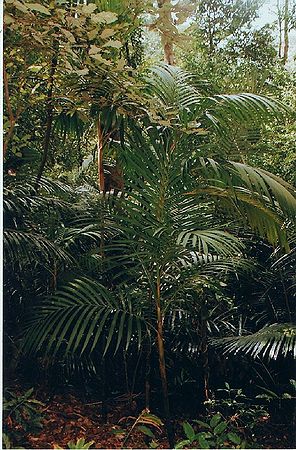
India. Photo by Clayton York, Utopia Palms & Cycads

India. Photo by Clayton York, Utopia Palms & Cycads
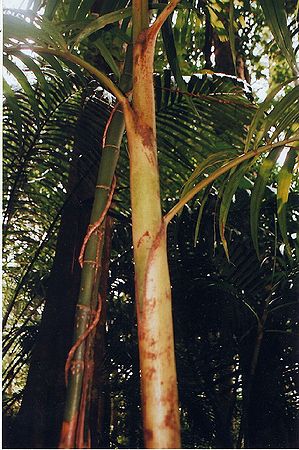
India. Photo by Clayton York, Utopia Palms & Cycads

Vai; Crete, Greece (18-Apr-1985). Photo by Dr.'s. B. R. Ramesh, N. Ayyappan, Pierre Grard, Juliana Prosperi, S. Aravajy, Jean Pierre Pascal, The Biotik Team, French Institute of Pondicherry

Vai; Crete, Greece (18-Apr-1985). Photo by Dr.'s. B. R. Ramesh, N. Ayyappan, Pierre Grard, Juliana Prosperi, S. Aravajy, Jean Pierre Pascal, The Biotik Team, French Institute of Pondicherry

Vai; Crete, Greece (18-Apr-1985). Photo by Dr.'s. B. R. Ramesh, N. Ayyappan, Pierre Grard, Juliana Prosperi, S. Aravajy, Jean Pierre Pascal, The Biotik Team, French Institute of Pondicherry

Vai; Crete, Greece (18-Apr-1985). Photo by Dr.'s. B. R. Ramesh, N. Ayyappan, Pierre Grard, Juliana Prosperi, S. Aravajy, Jean Pierre Pascal, The Biotik Team, French Institute of Pondicherry

Vai; Crete, Greece (18-Apr-1985). Photo by Dr.'s. B. R. Ramesh, N. Ayyappan, Pierre Grard, Juliana Prosperi, S. Aravajy, Jean Pierre Pascal, The Biotik Team, French Institute of Pondicherry

Vai; Crete, Greece (18-Apr-1985). Photo by Dr.'s. B. R. Ramesh, N. Ayyappan, Pierre Grard, Juliana Prosperi, S. Aravajy, Jean Pierre Pascal, The Biotik Team, French Institute of Pondicherry

Vai; Crete, Greece (18-Apr-1985). Photo by Dr.'s. B. R. Ramesh, N. Ayyappan, Pierre Grard, Juliana Prosperi, S. Aravajy, Jean Pierre Pascal, The Biotik Team, French Institute of Pondicherry

Vai; Crete, Greece (18-Apr-1985). Photo by Dr.'s. B. R. Ramesh, N. Ayyappan, Pierre Grard, Juliana Prosperi, S. Aravajy, Jean Pierre Pascal, The Biotik Team, French Institute of Pondicherry

Vai; Crete, Greece (18-Apr-1985). Photo by Dr.'s. B. R. Ramesh, N. Ayyappan, Pierre Grard, Juliana Prosperi, S. Aravajy, Jean Pierre Pascal, The Biotik Team, French Institute of Pondicherry

Harihara - Kollamogra Road, Hariharapallathadka, Karnataka 574218, India. Uppanga research plot, near the stream bed. Photo by Dr. N. Barathan

Harihara - Kollamogra Road, Hariharapallathadka, Karnataka 574218, India. Uppanga research plot, near the stream bed. Photo by Dr. N. Barathan

Harihara - Kollamogra Road, Hariharapallathadka, Karnataka 574218, India. Uppanga research plot, near the stream bed. Photo by Dr. N. Barathan

Harihara - Kollamogra Road, Hariharapallathadka, Karnataka 574218, India. Uppanga research plot, near the stream bed. Photo by Dr. N. Barathan

Hawaii. Photo by Geoff Stein

Hawaii. Photo by Geoff Stein

Hawaii. Photo by Geoff Stein

Hawaii. Photo by Geoff Stein

Photo by Paul Craft

Photo by Paul Craft

Photo by Dr. Chandni Rawat

Coral Gables, FL. Fairchild Botanical Gardens. Photo by Kyle Wicomb

McBryde Gardens at the NTBG in Kauai, Hawaii. Photo by Kyle Wicomb

Agumbe, Karnataka, India. Photo by Kalyan Varma

Clark Gardens, Fort Worth Botanic Gardens, TX. Photo by Tony Cerbone

Shimoga, Karnataka, IN. Photo by Dinesh Valke

Shimoga, Karnataka, IN. Photo by Dinesh Valke

Marco Herrero's Farm, 2008 Costa Rica. 2008 IPS Biennial. Photo by Ryan D. Gallivan.

Cultivated, from Fort Worth Botanic Garden. (inflorescence) (inflorescence) - photo by David C. Reed

Cultivated, from Fort Worth Botanic Garden. (stem and foliage) - photo by David C. Reed

Pacific coast Guatemala. Photo by scott

Pacific coast Guatemala. Photo by scott

Photo by Luke Nancarrow.

Photo by Luke Nancarrow.

Photo by Luke Nancarrow.

Photo-Rare Palm Seeds.com

Photo-Rare Palm Seeds.com


External Links
References
Phonetic spelling of Latin names by edric.
Special thanks to Geoff Stein, (Palmbob) for his hundreds of photos.
Special thanks to Palmweb.org, Dr. John Dransfield, Dr. Bill Baker & team, for their volumes of information and photos.
Glossary of Palm Terms; Based on the glossary in Dransfield, J., N.W. Uhl, C.B. Asmussen-Lange, W.J. Baker, M.M. Harley & C.E. Lewis. 2008. Genera Palmarum - Evolution and Classification of the Palms. Royal Botanic Gardens, Kew. All images copyright of the artists and photographers (see images for credits).
Many Special Thanks to Ed Vaile for his long hours of tireless editing and numerous contributions.