Difference between revisions of "Corypha utan"
| (25 intermediate revisions by 2 users not shown) | |||
| Line 1: | Line 1: | ||
__noeditsection__ | __noeditsection__ | ||
| − | |||
| − | |||
{{Palmbox | {{Palmbox | ||
| − | |image= | + | |image=P070302.jpg |
| − | |image_caption= | + | |image_caption=Photo by Geoff Stein. |
| − | |genus=Corypha (kohr- | + | |genus=Corypha (kohr-EE-fah) |
|species=<br>utan (OO-tahn) | |species=<br>utan (OO-tahn) | ||
|subspecies= | |subspecies= | ||
| Line 21: | Line 19: | ||
|common_names=Kennedy Palm, Gebang palm, Buri palm | |common_names=Kennedy Palm, Gebang palm, Buri palm | ||
}} | }} | ||
| − | |||
==Habitat and Distribution== | ==Habitat and Distribution== | ||
| − | + | ''Corypha utan'' is found along rivers, wetlands, watercourses, floodplains and grasslands, [[image:CuDSC_0349.jpg|thumb|left|370px|Thailand. Photo by Daryl O'Connor.]]found in, Andaman Is., Assam, Bangladesh, Borneo, Cambodia, India, Jawa, Laos, Lesser Sunda Is., Malaya, Maluku, Myanmar, New Guinea, Northern Territory, Philippines, Queensland, Sulawesi, Sumatera, Thailand, and Vietnam. | |
==Description== | ==Description== | ||
Trunk 10-30 m. tall, 35-100 cm. in diameter; grey and covered in persistent leaf bases in the upper part in a typical spiral pattern. No crownshaft. Leaves costapalmate, pleated, 4-6 m. long, lamina 2.36-3.0 m. wide, and divided into 80-100 very deep segments, 160 x 8 cm., greyish green to blueish green, tapering to a short, forked, pointed apex, each lobe with a single midrib; ligule 1.5-2 cm. above apex of the petiole; petiole 2-4 m. long, channelled above with black margins and armed for the entire length with 0.3-2 cm. long straight, stout spines. Flowers: Inflorescence a terminal panicle 2-5 m. tall, with up to 1 million yellowish to white bisexual flowers, having an unpleasant odour. Flowers 3-8 mm. in diameter with 3 sepals and 3 petals in clusters of 5-10 in regular spirals along the 15-40 cm. long branchlets of the inflorescence. Plants flower only after 30-60 years and then die (monocarpic). Fruit: Olive green to brownish, globu;lar, 15-30 mm. in diameter. Takes average 18 months to ripen. Seed spherical and 12-20 mm. in diameter. Editing by edric. | Trunk 10-30 m. tall, 35-100 cm. in diameter; grey and covered in persistent leaf bases in the upper part in a typical spiral pattern. No crownshaft. Leaves costapalmate, pleated, 4-6 m. long, lamina 2.36-3.0 m. wide, and divided into 80-100 very deep segments, 160 x 8 cm., greyish green to blueish green, tapering to a short, forked, pointed apex, each lobe with a single midrib; ligule 1.5-2 cm. above apex of the petiole; petiole 2-4 m. long, channelled above with black margins and armed for the entire length with 0.3-2 cm. long straight, stout spines. Flowers: Inflorescence a terminal panicle 2-5 m. tall, with up to 1 million yellowish to white bisexual flowers, having an unpleasant odour. Flowers 3-8 mm. in diameter with 3 sepals and 3 petals in clusters of 5-10 in regular spirals along the 15-40 cm. long branchlets of the inflorescence. Plants flower only after 30-60 years and then die (monocarpic). Fruit: Olive green to brownish, globu;lar, 15-30 mm. in diameter. Takes average 18 months to ripen. Seed spherical and 12-20 mm. in diameter. Editing by edric. | ||
==Culture== | ==Culture== | ||
| − | Full sun, and lots of water. Tropical to warm temperate. Slow growing, and doesn't like being disturbed once planted. In the U.S. south Florida, and Hawaii only. | + | Full sun, and lots of water. Tropical to warm temperate. Slow growing, and doesn't like being disturbed once planted. In the U.S. south Florida, and Hawaii only. Cold Hardiness Zone: 10a |
==Comments and Curiosities== | ==Comments and Curiosities== | ||
This is a[[monocarpic]] genus. | This is a[[monocarpic]] genus. | ||
| − | The sugary sap, obtained by tapping the palm top and inflorescences, is made into wine, sugar, alcohol, or vinegar. The adult leaves are used for roof thatching, manufacturing of mats and umbrellas, especially the midribs of the leaves for furniture making and constructions of interior house walls. The fibres or cutted strips, obtained from the young unfolded leaves are used in the manufacture of nets, bags, mats, sails, baskets, string, ropes, hats, cloth, and fancy articles. The terminal bud is eaten as a vegetable (palm cabbage). The young cooked fruits are consumed as sweetmeats. The hard seeds are made into rosaries, necklaces and buttons. In times of scarcity starch is extracted from the stem. | + | Uses: The sugary sap, obtained by tapping the palm top and inflorescences, is made into wine, sugar, alcohol, or vinegar. The adult leaves are used for roof thatching, manufacturing of mats and umbrellas, especially the midribs of the leaves for furniture making and constructions of interior house walls. The fibres or cutted strips, obtained from the young unfolded leaves are used in the manufacture of nets, bags, mats, sails, baskets, string, ropes, hats, cloth, and fancy articles. The terminal bud is eaten as a vegetable (palm cabbage). The young cooked fruits are consumed as sweetmeats. The hard seeds are made into rosaries, necklaces and buttons. In times of scarcity starch is extracted from the stem. |
| + | |||
| + | This palm is truly gigantic in all its parts! Its massive grey trunk reaches to 30 m (100 ft.) tall, and its enormous crown, spanning approximately 8 m (27 ft.) in diameter, is formed by about 30 huge, dark green leaves that are 3 m (10 ft.) in diameter, large enough to easily shelter more than ten people from the rain. The terminal inflorescence, which is formed after 50 to 80 years of vegetative growth, holds the record of being the world's largest flowering structure and produces literally millions of flowers and tens of thousands of seeds. It will ultimately end the life of the tree once the fruit have matured. Its native range extends all over tropical Asia and down to northern Australia. In cultivation, it does best in a hot, tropical climate and is one of the most breathtaking landscape trees available for large parks and gardens. (RPS.com) | ||
| + | |||
| + | <br style="clear:both;"/> | ||
| + | {{#Widget:AdResban}} | ||
| + | <center><gallery caption="IMAGE GALLERY" perrow="" widths="" heights=""> | ||
| + | Image:Corypha utan leaves.jpg|Leaves, Hawaii. | ||
| + | Image:Corypha utan petioles.jpg|Petioles, Hawaii. | ||
| + | Image:Corypha utan trunk 2.jpg|Trunk Detail. | ||
| + | Image:Young Corypha.jpg|Young Corypha Macropoda, India. | ||
| + | Image:Young Corypha2.jpg|Young Corypha Macropoda, trunk detail, India. | ||
| + | Image:Corypha Utan seeds.jpg|Seeds,India. | ||
| + | Image:IMG_3724.jpg|Nearly five months old, India. | ||
| + | Image:IMG_3604.jpg|Seedling, India. | ||
| + | Image:CoryphutIMG 0193z.jpg||Fairchild Tropical Botanic Garden, Coral Gables, Florida. | ||
| + | image:CuIMG_5671.jpg|Fairchild Tropical Botanic Garden, Coral Gables, Florida. Photo by Kathryn Morgan. | ||
| + | image:2079z.jpg|Photo by Geoff Stein. | ||
| + | image:2080.jpg|Photo by Geoff Stein. | ||
| + | image:2999z.jpg|Photo by Geoff Stein. | ||
| + | image:164410.3.jpg|Photo by Geoff Stein. | ||
| + | image:BG9025_3.jpg|Photo by Geoff Stein. | ||
| + | image:BG9025_4.jpg|Photo by Geoff Stein. | ||
| + | image:Corypha_utan_infljodyhaynesz.jpg|Photo by Jody Haynes. | ||
| + | image:Corypha_utan2jodyhaynes.jpg|Photo by Jody Haynes. | ||
| + | image:Corypha_utanjodyhaynes.jpg|Photo by Jody Haynes. | ||
| + | image:P070299.jpg|Fruiting. |Photo by Geoff Stein. | ||
| + | image:P070300.jpg|Photo by Geoff Stein. | ||
| + | image:P070301.jpg|Photo by Geoff Stein. | ||
| + | image:P070302.jpg|Photo by Geoff Stein. | ||
| + | image:P070303.jpg|Photo by Geoff Stein. | ||
| + | image:Cory_utan_070909_0263_rwg.jpg|Banyumas, Central Java, Indonesia. | ||
| + | image:Gebang_080717_1306_ayotz.jpg|Scattered Corypha utan, in a hilly savanna, near Ayotupas, West Timor. | ||
| + | image:Lopo_080716_1025_ayotz.jpg|Dried leaves is used as thatch. Ayotupas. | ||
| + | image:Putak_080717_1281_ayotz.jpg|Cake from starch, known as putak. | ||
| + | image:CabbagePalm01z.jpg|Corypha utan stand, at Kowanyama, Queensland. | ||
| + | image:1b338fz.jpg|Photo by Geoff Stein. | ||
| + | image:1e4d36z.jpg|Photo by Geoff Stein. | ||
| + | image:2ccc89.jpg|Corypha Macropoda,India. | ||
| + | image:4eabe6z.jpg|Photo by Geoff Stein. | ||
| + | image:4f70c4krisz.jpg|Photo by Kris Achar. | ||
| + | image:5fa030krisz.jpg|Photo by Kris Achar. | ||
| + | image:6ddd48krisz.jpg|Photo by Kris Achar. | ||
| + | image:6f9979z.jpg|Photo by Geoff Stein. | ||
| + | image:7bd844krisz.jpg|Corypha Macropoda,India,Photo by Kris Achar. | ||
| + | image:7e18c7z.jpg|Photo by Geoff Stein. | ||
| + | image:19f560z.jpg|Photo by Geoff Stein. | ||
| + | image:36f194krisz.jpg|Corypha Macropoda,Photo by Kris Achar. | ||
| + | image:45c5e5krisz.jpg|Corypha Macropoda,Photo by Kris Achar. | ||
| + | image:51d8e2z.jpg|Photo by Geoff Stein. | ||
| + | image:F9fb43z.jpg|Photo by Geoff Stein. | ||
| + | image:Dd37a9z.jpg|Flowering. |Photo by Geoff Stein. | ||
| + | image:0527fez.jpg|Fruiting. |Photo by Geoff Stein. | ||
| + | image:558a02krisz.jpg|Corypha Macropoda,Photo by Kris Achar. | ||
| + | image:799a79z.jpg|Photo by Geoff Stein. | ||
| + | image:906e28krisz.jpg|Corypha Macropoda,Photo by Kris Achar. | ||
| + | image:66815f.jpg|Photo by Geoff Stein. | ||
| + | image:72951bz.jpg|Photo by Geoff Stein. | ||
| + | image:074383krisz.jpg|Corypha Macropoda,Photo by Kris Achar. | ||
| + | image:A9e19bz.jpg|Photo by Geoff Stein. | ||
| + | image:B2ee5c.jpg|Photo by Geoff Stein. | ||
| + | image:B476daz.jpg|Photo by Geoff Stein. | ||
| + | image:C74749z.jpg|Photo by Geoff Stein. | ||
| + | image:Ca45b6krisz.jpg|Corypha Macropoda,Photo by Kris Achar. | ||
| + | image:Corypha_utan_rl.jpg | ||
| + | image:D70213krisz.jpg|Corypha Macropoda,Photo by Kris Achar. | ||
| + | image:Ed072bkrisz.jpg|Photo by Kris Achar. | ||
| + | image:407ac4.jpg|Photo by Geoff Stein. | ||
| + | image:509fe1krisz.jpg|Corypha Macropoda,Photo by Kris Achar. | ||
| + | image:F20bb5krisz.jpg|Corypha Macropoda,Photo by Kris Achar. | ||
| + | image:Talipot01z.jpg | ||
| + | image:Zutanz.jpg|In habitat, on the island of Negros, the Philippines. Photo by Eric Hanquinet. | ||
| + | image:Zutan02z.jpg|In habitat, on the island of Negros, the Philippines. Photo by Eric Hanquinet. | ||
| + | image:Zutan03z.jpg|Photo by Kyle Wicomb. | ||
| + | image:Zutan04z.jpg|Photo by Norm Scott. | ||
| + | image:-gallery-members-Corypha_elataz.jpg|Negros, near Sipalay City, Philippines. Photo by Guenter Prinz. | ||
| + | image:2022505e-def9-4d8e-baa2-754269fdbaa9z.jpg|Photo by Dr. John Dransfield, Royal Botanic Gardens, Kew/Palmweb. | ||
| + | image:12645a94-091b-4cf4-921a-bc62dca04763z.jpg|Montgomery Botanical Center, Florida. Photo by Dr. John Dransfield, Royal Botanic Gardens, Kew/Palmweb. | ||
| + | image:1b4e09e0-9eb4-42d9-91d1-6894b1544976z.jpg|Coryphoid Teeth. Thailand. Photo by Dr. John Dransfield, Royal Botanic Gardens, Kew/Palmweb. | ||
| + | image:595ef5a3-252c-4242-aafc-ababec84f4dbz.jpg|Australia. Photo by Dr. Anders S. Baford/Palmweb. | ||
| + | image:9fc75474-cc17-411f-9677-a23f8e3c0eacz.jpg|Australia. Photo by Dr. Anders S. Baford/Palmweb. | ||
| + | image:CuDSC_0349.jpg|Thailand. Photo by Daryl O'Connor. | ||
| + | image:CuDSC_8960.jpg|Thailand. Photo by Daryl O'Connor. | ||
| + | File:cuDSC_6425.jpg|At Utopia Palms and Cycads, near Yandina and Coolum, Sunshine coast, Queensland, Australia. Wal giving scale. Photo by Daryl O'Connor. | ||
| + | File:10-13octubre200937.jpg|Palmetum de Santa Cruz (Tenerife, Canarias). Photo by Carlo Morici. | ||
| + | File:cuDSC_0523.JPG|Photo by Christophe Jardinier. | ||
| + | image:CorUta.jpg|Photo-Rare Palm Seeds.com | ||
| + | image:CorUta2.jpg|Photo-Rare Palm Seeds.com | ||
| + | image:CorUta3.jpg|Photo-Rare Palm Seeds.com | ||
| + | image:Corypha-utan-5.jpg|Photo-Rare Palm Seeds.com | ||
| + | image:CorUta_seeds.jpg|Photo-Rare Palm Seeds.com | ||
| + | image: | ||
| + | image: | ||
| + | </gallery></center> | ||
==External Links== | ==External Links== | ||
*[http://eunops.org/content/glossary-palm-terms Glossary of Palm Terms] | *[http://eunops.org/content/glossary-palm-terms Glossary of Palm Terms] | ||
| Line 44: | Line 134: | ||
Phonetic spelling of Latin names by edric. | Phonetic spelling of Latin names by edric. | ||
| − | Special thanks to Geoff Stein, (Palmbob) for his hundreds of photos | + | Special thanks to Geoff Stein, (Palmbob) for his hundreds of photos. |
| − | Special thanks to palmweb.org, Dr. John Dransfield, Dr. Bill Baker & team, for their volumes of information and photos | + | Special thanks to [http://palmweb.org/?q=node/2 Palmweb.org], Dr. John Dransfield, Dr. Bill Baker & team, for their volumes of information and photos. |
| + | Glossary of Palm Terms; Based on the glossary in Dransfield, J., N.W. Uhl, C.B. Asmussen-Lange, W.J. Baker, M.M. Harley & C.E. Lewis. 2008. Genera Palmarum - Evolution and Classification of the Palms. Royal Botanic Gardens, Kew. All images copyright of the artists and photographers (see images for credits). | ||
| − | |||
| − | |||
| − | |||
| − | |||
| − | |||
| − | |||
| − | |||
| − | |||
| − | |||
| − | |||
| − | |||
| − | |||
| − | |||
| − | |||
| − | |||
| − | |||
| − | |||
| − | |||
| − | |||
| − | |||
| − | |||
| − | |||
| − | |||
| − | |||
| − | |||
| − | |||
| − | |||
| − | |||
| − | |||
| − | |||
| − | |||
| − | |||
| − | |||
| − | |||
| − | |||
| − | |||
| − | |||
| − | |||
| − | |||
| − | |||
| − | |||
| − | |||
| − | |||
| − | |||
| − | |||
| − | |||
| − | |||
| − | |||
| − | |||
| − | |||
| − | |||
| − | |||
| − | |||
| − | |||
| − | |||
| − | |||
| − | |||
| − | |||
| − | |||
| − | |||
| − | |||
| − | |||
| − | |||
| − | |||
| − | |||
| − | |||
| − | |||
| − | |||
| − | |||
| − | |||
| − | |||
| − | |||
| − | |||
| − | |||
| − | |||
| − | |||
| − | |||
| − | |||
{{SpeciesListBackLink}} | {{SpeciesListBackLink}} | ||
[[Category:CORYPHA|utan]] | [[Category:CORYPHA|utan]] | ||
Latest revision as of 21:58, 6 August 2016
| Corypha (kohr-EE-fah) utan (OO-tahn) | |||||||
|---|---|---|---|---|---|---|---|
 Photo by Geoff Stein. | |||||||
| Scientific Classification | |||||||
| |||||||
| Synonyms | |||||||
|
| |||||||
| Native Continent | |||||||
 | |||||||
| Morphology | |||||||
| |||||||
| Culture | |||||||
|
| |||||||
| Survivability index | |||||||
|
| |||||||
| Common names | |||||||
|
| |||||||
Contents
Habitat and Distribution
Corypha utan is found along rivers, wetlands, watercourses, floodplains and grasslands,
Description
Trunk 10-30 m. tall, 35-100 cm. in diameter; grey and covered in persistent leaf bases in the upper part in a typical spiral pattern. No crownshaft. Leaves costapalmate, pleated, 4-6 m. long, lamina 2.36-3.0 m. wide, and divided into 80-100 very deep segments, 160 x 8 cm., greyish green to blueish green, tapering to a short, forked, pointed apex, each lobe with a single midrib; ligule 1.5-2 cm. above apex of the petiole; petiole 2-4 m. long, channelled above with black margins and armed for the entire length with 0.3-2 cm. long straight, stout spines. Flowers: Inflorescence a terminal panicle 2-5 m. tall, with up to 1 million yellowish to white bisexual flowers, having an unpleasant odour. Flowers 3-8 mm. in diameter with 3 sepals and 3 petals in clusters of 5-10 in regular spirals along the 15-40 cm. long branchlets of the inflorescence. Plants flower only after 30-60 years and then die (monocarpic). Fruit: Olive green to brownish, globu;lar, 15-30 mm. in diameter. Takes average 18 months to ripen. Seed spherical and 12-20 mm. in diameter. Editing by edric.
Culture
Full sun, and lots of water. Tropical to warm temperate. Slow growing, and doesn't like being disturbed once planted. In the U.S. south Florida, and Hawaii only. Cold Hardiness Zone: 10a
Comments and Curiosities
This is amonocarpic genus.
Uses: The sugary sap, obtained by tapping the palm top and inflorescences, is made into wine, sugar, alcohol, or vinegar. The adult leaves are used for roof thatching, manufacturing of mats and umbrellas, especially the midribs of the leaves for furniture making and constructions of interior house walls. The fibres or cutted strips, obtained from the young unfolded leaves are used in the manufacture of nets, bags, mats, sails, baskets, string, ropes, hats, cloth, and fancy articles. The terminal bud is eaten as a vegetable (palm cabbage). The young cooked fruits are consumed as sweetmeats. The hard seeds are made into rosaries, necklaces and buttons. In times of scarcity starch is extracted from the stem.
This palm is truly gigantic in all its parts! Its massive grey trunk reaches to 30 m (100 ft.) tall, and its enormous crown, spanning approximately 8 m (27 ft.) in diameter, is formed by about 30 huge, dark green leaves that are 3 m (10 ft.) in diameter, large enough to easily shelter more than ten people from the rain. The terminal inflorescence, which is formed after 50 to 80 years of vegetative growth, holds the record of being the world's largest flowering structure and produces literally millions of flowers and tens of thousands of seeds. It will ultimately end the life of the tree once the fruit have matured. Its native range extends all over tropical Asia and down to northern Australia. In cultivation, it does best in a hot, tropical climate and is one of the most breathtaking landscape trees available for large parks and gardens. (RPS.com)
- IMAGE GALLERY

Leaves, Hawaii.

Petioles, Hawaii.

Trunk Detail.

Young Corypha Macropoda, India.

Young Corypha Macropoda, trunk detail, India.

Seeds,India.

Nearly five months old, India.

Seedling, India.

|Fairchild Tropical Botanic Garden, Coral Gables, Florida.

Fairchild Tropical Botanic Garden, Coral Gables, Florida. Photo by Kathryn Morgan.

Photo by Geoff Stein.

Photo by Geoff Stein.

Photo by Geoff Stein.

Photo by Geoff Stein.

Photo by Geoff Stein.

Photo by Geoff Stein.

Photo by Jody Haynes.
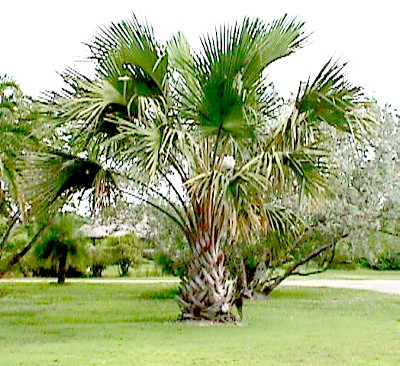
Photo by Jody Haynes.

Photo by Jody Haynes.

Fruiting. |Photo by Geoff Stein.

Photo by Geoff Stein.

Photo by Geoff Stein.

Photo by Geoff Stein.

Photo by Geoff Stein.

Banyumas, Central Java, Indonesia.

Scattered Corypha utan, in a hilly savanna, near Ayotupas, West Timor.

Dried leaves is used as thatch. Ayotupas.

Cake from starch, known as putak.

Corypha utan stand, at Kowanyama, Queensland.

Photo by Geoff Stein.

Photo by Geoff Stein.

Corypha Macropoda,India.

Photo by Geoff Stein.

Photo by Kris Achar.

Photo by Kris Achar.

Photo by Kris Achar.

Photo by Geoff Stein.

Corypha Macropoda,India,Photo by Kris Achar.

Photo by Geoff Stein.

Photo by Geoff Stein.

Corypha Macropoda,Photo by Kris Achar.

Corypha Macropoda,Photo by Kris Achar.

Photo by Geoff Stein.

Photo by Geoff Stein.

Flowering. |Photo by Geoff Stein.

Fruiting. |Photo by Geoff Stein.

Corypha Macropoda,Photo by Kris Achar.

Photo by Geoff Stein.

Corypha Macropoda,Photo by Kris Achar.

Photo by Geoff Stein.

Photo by Geoff Stein.

Corypha Macropoda,Photo by Kris Achar.

Photo by Geoff Stein.

Photo by Geoff Stein.

Photo by Geoff Stein.

Photo by Geoff Stein.

Corypha Macropoda,Photo by Kris Achar.


Corypha Macropoda,Photo by Kris Achar.

Photo by Kris Achar.

Photo by Geoff Stein.

Corypha Macropoda,Photo by Kris Achar.

Corypha Macropoda,Photo by Kris Achar.


In habitat, on the island of Negros, the Philippines. Photo by Eric Hanquinet.

In habitat, on the island of Negros, the Philippines. Photo by Eric Hanquinet.

Photo by Kyle Wicomb.

Photo by Norm Scott.

Negros, near Sipalay City, Philippines. Photo by Guenter Prinz.

Photo by Dr. John Dransfield, Royal Botanic Gardens, Kew/Palmweb.

Montgomery Botanical Center, Florida. Photo by Dr. John Dransfield, Royal Botanic Gardens, Kew/Palmweb.

Coryphoid Teeth. Thailand. Photo by Dr. John Dransfield, Royal Botanic Gardens, Kew/Palmweb.

Australia. Photo by Dr. Anders S. Baford/Palmweb.

Australia. Photo by Dr. Anders S. Baford/Palmweb.

Thailand. Photo by Daryl O'Connor.

Thailand. Photo by Daryl O'Connor.

At Utopia Palms and Cycads, near Yandina and Coolum, Sunshine coast, Queensland, Australia. Wal giving scale. Photo by Daryl O'Connor.

Palmetum de Santa Cruz (Tenerife, Canarias). Photo by Carlo Morici.

Photo by Christophe Jardinier.

Photo-Rare Palm Seeds.com

Photo-Rare Palm Seeds.com

Photo-Rare Palm Seeds.com

Photo-Rare Palm Seeds.com

Photo-Rare Palm Seeds.com


External Links
- Glossary of Palm Terms
- MODERN BOTANICAL LATIN
- "Just To Be Clear"
- Click on Arecaceae, for list of photos
- http://keys.trin.org.au/key-server/data/0e0f0504-0103-430d-8004-060d07080d04/media/Html/taxon/Corypha_utan.htm
- http://www.youtube.com/watch?v=g6K9zn3Ey-E
- http://www.globinmed.com/index.php?option=com_content&view=article&id=80271:corypha-utan-lamk&catid=367:c
- http://www.pacsoa.org.au/palms/Corypha/GerminatingCorypha.html
References
Phonetic spelling of Latin names by edric.
Special thanks to Geoff Stein, (Palmbob) for his hundreds of photos.
Special thanks to Palmweb.org, Dr. John Dransfield, Dr. Bill Baker & team, for their volumes of information and photos.
Glossary of Palm Terms; Based on the glossary in Dransfield, J., N.W. Uhl, C.B. Asmussen-Lange, W.J. Baker, M.M. Harley & C.E. Lewis. 2008. Genera Palmarum - Evolution and Classification of the Palms. Royal Botanic Gardens, Kew. All images copyright of the artists and photographers (see images for credits).
Many Special Thanks to Ed Vaile for his long hours of tireless editing and numerous contributions.