Difference between revisions of "Serenoa repens"
| (4 intermediate revisions by one user not shown) | |||
| Line 77: | Line 77: | ||
Serenoa repens (W.Bartram) Small: grows in dense thickets 6 m or more in diameter and 0,6 -2,1 m tall, or 2-7 m tall in plant forming aerial trunks. Distribution: Florida, Louisiana, South Carolina and Arkansas | Serenoa repens (W.Bartram) Small: grows in dense thickets 6 m or more in diameter and 0,6 -2,1 m tall, or 2-7 m tall in plant forming aerial trunks. Distribution: Florida, Louisiana, South Carolina and Arkansas | ||
Serenoa repens f. glauca Moldenke: is an especially attractive form with silvery-blue foliage. Distribution: occurs along the Atlantic coast in Florida. | Serenoa repens f. glauca Moldenke: is an especially attractive form with silvery-blue foliage. Distribution: occurs along the Atlantic coast in Florida. | ||
| + | |||
| + | Cultivation and Propagation: Serenoa repens is cultivated in humid tropical, subtropical and warm-temperate regions and planted in gardens and parks. If you needs a small low maintenance, but graceful looking palm, it doesn't get any better than Serenoa repens. Once established, it is virtually maintenance-free. | ||
| + | Soil: It is very adaptable to many kinds of well drained soils. It prefers sandy soils with little mineral or organic content, but may also grow on poor and rocky soils and on peaty and poorly drained sites. | ||
| + | Fertilization: Need a perfect fertilizer diet including all micro nutrients and trace elements or slow release fertilizer applied during the growin season, or according to package directions, using a fertilizer specifically formulated for palms. | ||
| + | Water Requirements: It tolerates low levels of humidity and summer drought, though it prefers evenly moist but not consistently wet medium. When supplied with adequate moisture and fertilizer it is also fairly fast growing. This palm is very drought tolerant once established. It dislikes constantly soggy soils. | ||
| + | Light: It prefers bright sunny locations, but it also does well in part shade with some direct sunlight. It will survive in rather heavy shade but "stretches" to lose its compact shape. | ||
| + | Aerosol salt tolerance: It is somewhat salt resistant and may be grown near the sea if given some protection (behind a dune, building, etc.) | ||
| + | Wind resistance: It endures drying winds. | ||
| + | Hardiness: These palms are some of the hardier palms, tolerating winter frosts down to about −12°C for short periods ( USDA Zones 8-10) | ||
| + | Roots: Usually not a problem | ||
| + | Maintenance: For the healthiest and most attractive plant, keep the palm pruned. As the old fronds die, these should be trimmed off and the leaf bases allowed to dry out, but do not prune if the frond still has some green colour. Palms recycle nutrients from dead or dying fronds and use them for healthier fronds. These days it is popular to remove all but a few of the suckers and to prune the leaves to form a cluster of clear trunked "mini" palms. | ||
| + | |||
| + | Uses: They are used massively in gardening and landscaping in many parts of the world with the silver form being especially attractive. Plant Serenoa repens in front of clumps of larger palms, or even underneath large palms. They look good massed in clumps in mixed borders, or as framing hedges. They are also excellent in containers. And thanks to their drought resistance and durability to heat they can thrive in harsh urban conditions. They can be used for watershed protection, erosion control. The leaves are used for thatching. | ||
| + | Medicine uses: A drug called serenoa can be derived from the partially dried, ripe fruits of saw-palmetto and used as a treatment for benign prostatic hyperplasia or enlarged prostate gland. They are also used as a diuretic to tone the bladder, improve urinary flow, and decrease urinary frequency. They may help prevent prostate cancer. | ||
| + | Food uses: The fruit is edible, but the more green it is the more bitter tasting it would be. | ||
| + | Warning: Do not plant this palm where children play as the sharp sawtooth leaf stems are easily capable of breaking the skin, and protection should be worn when working around a Saw Palmetto. | ||
| + | Propagation: In the nursery it may be propagated by seed. Seeds will germinate in 45 to 60 days. Seedling growth and early development are slow. Establishment requires | ||
| + | 2 to 6 years. It can also be propagated by dividing clumps or removing suckers. | ||
{{read more bottom}} | {{read more bottom}} | ||
<br style="clear:both;"/> | <br style="clear:both;"/> | ||
| Line 194: | Line 212: | ||
File:SerenoaRepens18.jpg|Illinois:: Jackson Co. Southern Illinois University Plant Biology greenhouse, Carbondale; cultivated 37 42 52.67 N, 89 13 20.01 W GOOmap VEmap , 25 March 2013. Photo by Dr. D. L. Nickrent. | File:SerenoaRepens18.jpg|Illinois:: Jackson Co. Southern Illinois University Plant Biology greenhouse, Carbondale; cultivated 37 42 52.67 N, 89 13 20.01 W GOOmap VEmap , 25 March 2013. Photo by Dr. D. L. Nickrent. | ||
File:SerenoaRepens69.jpg|Florida:: Pasco Co. Jay B. Starkey Wilderness Park, on nature trail towards Anclote River. Coordinates approximate. 28 12 49.67 N, 82 35 58.53 W GOOmap VEmap , 16 March 2016. Photo by Dr. D. L. Nickrent. | File:SerenoaRepens69.jpg|Florida:: Pasco Co. Jay B. Starkey Wilderness Park, on nature trail towards Anclote River. Coordinates approximate. 28 12 49.67 N, 82 35 58.53 W GOOmap VEmap , 16 March 2016. Photo by Dr. D. L. Nickrent. | ||
| − | Green Cay Wetlands Boynton Beach, Florida. September 25, 2009. Photo by: Forest Starr & Kim Starr. | + | File:Serenoa_repens_f._glauca_20790_l.jpg|Green Cay Wetlands Boynton Beach, Florida. September 25, 2009. Photo by: Forest Starr & Kim Starr. |
| − | + | File:MyAlbum_20791_l.jpg|Gulfstream Park, Florida. September 23, 2009. Photo by: Forest Starr & Kim Starr. | |
| + | File:MyAlbum_20792_l.jpg|Gulfstream Park, Florida. September 23, 2009. Photo by: Forest Starr & Kim Starr. | ||
| + | File:MyAlbum_20793_l.jpg|Gulfstream Park, Florida. September 23, 2009. Photo by: Forest Starr & Kim Starr. | ||
| + | File:serrep2wr.jpg|Photo: plants.ifas.ufl.edu | ||
| + | File:serrep3wr.jpg|Photo: plants.ifas.ufl.edu | ||
| + | File:serrep5wr.jpg|Photo: plants.ifas.ufl.edu | ||
| + | File:serrep4wr.jpg|Photo: plants.ifas.ufl.edu | ||
| + | File:serrep1wr.jpg|Photo: plants.ifas.ufl.edu | ||
File:serenoa_habit_blue_pja.jpg|Photo: idtools.org | File:serenoa_habit_blue_pja.jpg|Photo: idtools.org | ||
Latest revision as of 23:31, 21 September 2017
| Serenoa (sehr-eh-NO-ah) repens (REH-penz) | |||||||
|---|---|---|---|---|---|---|---|
 Home, South Miami, Florida. Photo by Dr. Scott Zona | |||||||
| Scientific Classification | |||||||
| |||||||
| Synonyms | |||||||
|
| |||||||
| Native Continent | |||||||
 | |||||||
| Morphology | |||||||
| |||||||
| Culture | |||||||
|
| |||||||
| Survivability index | |||||||
|
| |||||||
| Common names | |||||||
|
| |||||||
Contents
Habitat and Distribution
Alabama, Florida, Georgia, Louisiana, Mississippi, and South Carolina. Saw palmetto
Description
Saw palmetto is a small hardy fan palm whose stem usually remains just above ground or runs just along the surface (decumbent). In some cases, it develops an erect or arching trunk that may lift the whorl of leaves 2-16 ft (0.6-5 m) above ground. The palmate leaves are 2-3 ft (0.6-0.9 m) across and green or bluish green. The cluster of leaves gets about 4-6 ft (1.2-1.8 m) high with a similar spread. In the wild, saw palmetto often grows in clumps 20 ft (6 m) or more in diameter. The petioles (leaf stems) are about 2 ft (0.6 m) long and sharply saw-toothed. The fruits are round, black when ripe and about an inch in diameter. Growth rate: slow. Height: 5 to 10 feet. Spread: 4 to 10 feet. Trunk: showy; typically multi-trunked or clustering stems. Growth habit: Solitary and Clustering. Plant density: open. Texture: medium. Leaf arrangement: alternate. Leaf margin: parted. Leaf shape: star-shaped. Leaf venation: palmately compound. Leaf blade length: more than 36 inches. Leaf color: silver/gray; blue or blue-green or green. Flower color: yellow-white. Flower characteristic: spring flowering; pleasant fragrance. Fruit shape: oval. Fruit length: .5 to 1 inch. Fruit cover: fleshy. Fruit color: black when ripe. Fruit characteristic: inconspicuous and not showy. Editing by edric.
Culture
Light requirement: plant grows in part shade/part sun; plant grows in the shade. Soil tolerances: alkaline; clay; sand; acidic; loam. Drought tolerance: high. Soil salt tolerances: good. Plant spacing: 36 to 60 inches. Very cold hardy. Saw palmetto should be planted on 3- to 5-foot centers to establish a new mass planting. They make a wonderful ground cover effect beneath existing or newly planted trees. Upright plants can be grown into beautiful multi-stemmed specimens but these are not common and quite expensive. Propagation is usually by seed but seedlings grow very slowly.

Comments and Curiosities
The variety sericea, silver Saw Palmetto, is recognized by some authorities and has beautiful silver leaves.
Etymology: The generic name honors American botanist Sereno Watson.
Uses: The berries of saw palmetto are used as a treatment for benign prostatic hyperplasia or enlarged prostate gland. They are also used as a diuretic to tone the bladder, improve urinary flow, and decrease urinary frequency. They may help prevent prostate cancer. Saw palmetto berries have always been a valuable food source for wildlife. As their effectiveness as a treatment for various human disorders is confirmed their value has steadily increased. Wild creatures must now compete with human collectors for the saw palmetto fruits. Florida landowners are reporting cases of "saw palmetto rustling" where gangs of pickers move in and strip and area of fruit within a few hours. (floridata.com)
| read more |
|---|
|
Serenoa repens, commonly known as saw palmetto, is the sole monotypic species currently classified in the genus Serenoa. It has been known by a number of synonyms, including Sabal serrulatum, under which name it still often appears in alternative medicine. It is a small palm, normally reaching a height of around 2–4 m (3–6 ft). Its trunk is sprawling, and it grows in clumps or dense thickets in sandy coastal lands or as undergrowth in pine woods or hardwood hammocks. Erect stems or trunks are rarely produced but are found in some populations. It is endemic to the southeastern United States, most commonly along the Atlantic and Gulf Coastal plains, but also as far inland as southern Arkansas. It is a hearty plant; extremely slow growing, and long lived, with some plants, especially in Florida where it is known as simply the palmetto, possibly being as old as 500–700 years. Saw palmetto is a fan palm, with the leaves that have a bare petiole terminating in a rounded fan of about 20 leaflets. The petiole is armed with fine, sharp teeth or spines that give the species its common name. The teeth or spines are easily capable of breaking the skin, and protection should be worn when working around a Saw Palmetto. The leaves are light green inland, and silvery-white in coastal regions. The leaves are 1–2 m in length, the leaflets 50–100 cm long. They are similar to the leaves of the palmettos of genus Sabal. The flowers are yellowish-white, about 5 mm across, produced in dense compound panicles up to 60 cm long. The fruit is a large reddish-black drupe and is an important food source for wildlife and historically for humans. The plant is used as a food plant by the larvae of some Lepidoptera species such as Batrachedra decoctor, which feeds exclusively on the plant. This plant is also edible to human beings, but the more green it is the more bitter tasting it would be. Saw palmetto is an extremely sturdy palm with great textural interest that blends in well with natural or seaside landscapes. This low, clumping, bushy palm has large, fan-shaped leaves and multiple trunks that creep along the ground, creating a dense ground cover. Most saw palmettos have green leaves, but a form with blue leaves can be found along the southeast coast of Florida. Three-foot-long flower stalks appear in spring, covered with small, yellow-white, fragrant flowers, the source of a commercial high-grade honey. The flowers are followed by small, yellow berries that turn black, ripening August through October. These berries are an important food source for many mammals and birds. Surviving only on rainfall once established, saw palmetto grows on any well-drained soil in full sun to shade, and is highly salt tolerant. Best transplanted when young, larger specimens ideally should not be removed during land clearing, since plants grow very slowly and transplant so poorly. This happens because stems frequently grow along the ground as they droop under the weight of the foliage. Therefore, the root system may not be located beneath the foliage but could be 5 to 10 feet away at the base of the stem. Twice the desired number of collected saw palmetto are often planted since mortality is high. Saw palmetto is becoming more available in containers from nurseries. Homeowners should make an effort to leave native stands in place beneath existing trees when developing a new lot since they require no maintenance. (University of Florida) Origin and Habitat: Serenoa repens f. glauca (blue leafed form) occurs along the Atlantic coast in Florida and is the form most often grown in gardens and landscapes. Habitat: It grows in wet tropical, subtropical and warm-temperate regions on coastal plain from seaside sand dunes and dry scrub to moist forests, dry prairies, pine flatwoods, undergrowth in pine woods, hardwood hammocks and even wetlands. Ecology: It is an understory species that can grows in both sunny and shaded habitats and is a frequent invader of very dry or frequently burned habitats. The plant is used as a food plant by the larvae of some Lepidoptera species such as Batrachedra decoctor, which feeds exclusively on the plant and by several moths. It provides cover for wildlife, and the fruit is eaten by several bird species and mammals. Bees use the nectar to produce honey. Synonyms: Serenoa repens f. glauca Moldenke See all synonyms of Serenoa repens Common Names include: ENGLISH: Palmetto, Serenoa, Scrub palmetto, Saw palmetto ARABIC ( لعربية ): بلميط منشاري CHINESE (中文): Ju chi zong DUTCH (Nederlands): Dwergpalm, Zegepalm FRENCH (Français): Sabal, Chou palmiste, Palmier de Floride GERMAN (Deutsch): Sägepalme HUNGARIAN (Magyar): Fűrészpálma ITALIAN (Italiano): Serenoa JAPANESE (日本語): ノコギリヤシ LITHUANIAN (Lietuvių): Gulsčioji serenoja PORTUGUESE (Português): Serenoa RUSSIAN (Русский): Сереноа, Сереноя SPANISH (Español): Serenoa, Palmito salvaje Description: Serenoa repens f. glauca Moldenke is an especially attractive form that was described as differing from the typical green serenoa for its silvery-blue foliage and is the form most often grown in gardens and landscapes. Since a type specimen for Serenoa repens is lacking, it is impossible to know if Moldenke’s form differs from the type. Apart from the difference in leaf colour they are identical, so now Serenoa repens f. glauca is synonymized with Serenoa repens. Habit: Commonly known as saw palmetto Serenoa repens f. glauca is a small hardy fan palm that grows in bushy clumps or dense thickets 6 m or more in diameter and 0,6 -2,1 m tall in its more common procumbent form, or 2-7 m tall in plant forming aerial trunks. It is the sole species currently classified in the genus Serenoa. It is very slow growing, and long lived, with some plants possibly being as old as 500–700 years. Stems: Many-branched, usually sprawling parallel to the soil surface, eventually branching beneath the substrate to form rhizomes. In some populations, it develops an erect or oblique, or arching trunk that may lift the whorl of leaves up to 7 m above ground. Crown: The cluster of leaves gets about 1,2-1,8 m high with a similar spread. Leaves: Palmate, without a costa, evergreen, 0,6-1 m across, bluish green, with about 20 leaflets 30–60 cm long that are slightly cleft at the summit. They are similar to the leaves of the palmettos of genus Sabal. The petioles (leaf stems) are about 0,6 m long and sharply saw-toothed hence its common name. Flowers: About 5 mm across, white, perfect, borne on stalked, dense, compound, tomentose, panicles up to 60 cm long that grow from the leaf axils. Spadix shorter than the leaves. Blooming period: Spring to summer (between April and July in northern hemisphere). Spadix initiation begins after the danger of frost is past and may be stimulated by rising temperatures. Fruits: Round to elipsoid , fleshy, drupe, green or yellow before ripening becoming bluish or black when ripe and about 2,5 cm in diameter. Ripening period: Autumn (September and October in Northern hemisphere) Subspecies, varieties, forms and cultivars of plants belonging to the Serenoa repens group Serenoa repens (W.Bartram) Small: grows in dense thickets 6 m or more in diameter and 0,6 -2,1 m tall, or 2-7 m tall in plant forming aerial trunks. Distribution: Florida, Louisiana, South Carolina and Arkansas Serenoa repens f. glauca Moldenke: is an especially attractive form with silvery-blue foliage. Distribution: occurs along the Atlantic coast in Florida. Cultivation and Propagation: Serenoa repens is cultivated in humid tropical, subtropical and warm-temperate regions and planted in gardens and parks. If you needs a small low maintenance, but graceful looking palm, it doesn't get any better than Serenoa repens. Once established, it is virtually maintenance-free. Soil: It is very adaptable to many kinds of well drained soils. It prefers sandy soils with little mineral or organic content, but may also grow on poor and rocky soils and on peaty and poorly drained sites. Fertilization: Need a perfect fertilizer diet including all micro nutrients and trace elements or slow release fertilizer applied during the growin season, or according to package directions, using a fertilizer specifically formulated for palms. Water Requirements: It tolerates low levels of humidity and summer drought, though it prefers evenly moist but not consistently wet medium. When supplied with adequate moisture and fertilizer it is also fairly fast growing. This palm is very drought tolerant once established. It dislikes constantly soggy soils. Light: It prefers bright sunny locations, but it also does well in part shade with some direct sunlight. It will survive in rather heavy shade but "stretches" to lose its compact shape. Aerosol salt tolerance: It is somewhat salt resistant and may be grown near the sea if given some protection (behind a dune, building, etc.) Wind resistance: It endures drying winds. Hardiness: These palms are some of the hardier palms, tolerating winter frosts down to about −12°C for short periods ( USDA Zones 8-10) Roots: Usually not a problem Maintenance: For the healthiest and most attractive plant, keep the palm pruned. As the old fronds die, these should be trimmed off and the leaf bases allowed to dry out, but do not prune if the frond still has some green colour. Palms recycle nutrients from dead or dying fronds and use them for healthier fronds. These days it is popular to remove all but a few of the suckers and to prune the leaves to form a cluster of clear trunked "mini" palms. Uses: They are used massively in gardening and landscaping in many parts of the world with the silver form being especially attractive. Plant Serenoa repens in front of clumps of larger palms, or even underneath large palms. They look good massed in clumps in mixed borders, or as framing hedges. They are also excellent in containers. And thanks to their drought resistance and durability to heat they can thrive in harsh urban conditions. They can be used for watershed protection, erosion control. The leaves are used for thatching. Medicine uses: A drug called serenoa can be derived from the partially dried, ripe fruits of saw-palmetto and used as a treatment for benign prostatic hyperplasia or enlarged prostate gland. They are also used as a diuretic to tone the bladder, improve urinary flow, and decrease urinary frequency. They may help prevent prostate cancer. Food uses: The fruit is edible, but the more green it is the more bitter tasting it would be. Warning: Do not plant this palm where children play as the sharp sawtooth leaf stems are easily capable of breaking the skin, and protection should be worn when working around a Saw Palmetto. Propagation: In the nursery it may be propagated by seed. Seeds will germinate in 45 to 60 days. Seedling growth and early development are slow. Establishment requires 2 to 6 years. It can also be propagated by dividing clumps or removing suckers. |
- IMAGE GALLERY

Fairchild Tropical Botanic Garden, Florida. Photo by Dr. Carl E. Lewis/Palmweb.

Portion of Rachilla with Flowers Not Borne in Pits. Fairchild Tropical Botanic Garden, Florida. Photo by Dr. Carl E. Lewis/Palmweb

Portion of Rachilla with Flowers Not Borne in Pits. Fairchild Tropical Botanic Garden, Florida. Photo by Dr. Carl E. Lewis/Palmweb

Corkscrew Swamp, Florida. Photo by Dr. John Dransfield, Royal Botanic Gardens, Kew/Palmweb.

Big Pine Key, Everglades, Florida. Photo by Dr. William J. Baker, Royal Botanic Gardens, Kew/Palmweb.

Big Pine Key, Everglades, Florida. Photo by Dr. William J. Baker, Royal Botanic Gardens, Kew/Palmweb.

Decumbent/Prostrate and Creeping Habit. Photo-Royal Botanic Gardens, Kew/Palmweb.

Everglades National Park, Florida. Photo by Dr. William J. Baker, Royal Botanic Gardens, Kew/Palmweb.

Everglades National Park, Florida. Photo by Dr. William J. Baker, Royal Botanic Gardens, Kew/Palmweb.

Everglades National Park, Florida. Photo by Dr. William J. Baker, Royal Botanic Gardens, Kew/Palmweb.

Everglades National Park, Florida. Photo by Dr. William J. Baker, Royal Botanic Gardens, Kew/Palmweb.

"Saw Palmetto, Serenoa repens, along the St. Francis ghost town trail. This trail is in the far southeastern section of the Ocala National Forest on the southwest side of the St. John's River. This is just west of DeLand and about 35 miles NW of Orlando." Photo by H.P. Leu Gardens Botanist Eric S.

"Saw Palmetto, Serenoa repens, along the St. Francis ghost town trail. This trail is in the far southeastern section of the Ocala National Forest on the southwest side of the St. John's River. This is just west of DeLand and about 35 miles NW of Orlando." Photo by H.P. Leu Gardens Botanist Eric S.

"Saw Palmetto, Serenoa repens, along the St. Francis ghost town trail. This trail is in the far southeastern section of the Ocala National Forest on the southwest side of the St. John's River. This is just west of DeLand and about 35 miles NW of Orlando." Photo by H.P. Leu Gardens Botanist Eric S.

"Saw Palmetto, Serenoa repens, along the St. Francis ghost town trail. This trail is in the far southeastern section of the Ocala National Forest on the southwest side of the St. John's River. This is just west of DeLand and about 35 miles NW of Orlando." Photo by H.P. Leu Gardens Botanist Eric S.

"Saw Palmetto, Serenoa repens, along the St. Francis ghost town trail. This trail is in the far southeastern section of the Ocala National Forest on the southwest side of the St. John's River. This is just west of DeLand and about 35 miles NW of Orlando." Photo by H.P. Leu Gardens Botanist Eric S.

"Saw Palmetto, Serenoa repens, along the St. Francis ghost town trail. This trail is in the far southeastern section of the Ocala National Forest on the southwest side of the St. John's River. This is just west of DeLand and about 35 miles NW of Orlando." Photo by H.P. Leu Gardens Botanist Eric S.

"Saw Palmetto, Serenoa repens, along the St. Francis ghost town trail. This trail is in the far southeastern section of the Ocala National Forest on the southwest side of the St. John's River. This is just west of DeLand and about 35 miles NW of Orlando." Photo by H.P. Leu Gardens Botanist Eric S.

"Saw Palmetto, Serenoa repens, along the St. Francis ghost town trail. This trail is in the far southeastern section of the Ocala National Forest on the southwest side of the St. John's River. This is just west of DeLand and about 35 miles NW of Orlando." Photo by H.P. Leu Gardens Botanist Eric S.

"Growing with Powderpuff Lichens, Cladina evansii. Saw Palmetto, Serenoa repens, along the St. Francis ghost town trail. This trail is in the far southeastern section of the Ocala National Forest on the southwest side of the St. John's River. This is just west of DeLand and about 35 miles NW of Orlando." Photo by H.P. Leu Gardens Botanist Eric S.

"Saw Palmetto, Serenoa repens, along the St. Francis ghost town trail. This trail is in the far southeastern section of the Ocala National Forest on the southwest side of the St. John's River. This is just west of DeLand and about 35 miles NW of Orlando." Photo by H.P. Leu Gardens Botanist Eric S.

"Saw Palmetto, Serenoa repens, along the St. Francis ghost town trail. This trail is in the far southeastern section of the Ocala National Forest on the southwest side of the St. John's River. This is just west of DeLand and about 35 miles NW of Orlando." Photo by H.P. Leu Gardens Botanist Eric S.

"Saw Palmetto, Serenoa repens, along the St. Francis ghost town trail. This trail is in the far southeastern section of the Ocala National Forest on the southwest side of the St. John's River. This is just west of DeLand and about 35 miles NW of Orlando." Photo by H.P. Leu Gardens Botanist Eric S.

"Saw Palmetto, Serenoa repens, along the St. Francis ghost town trail. This trail is in the far southeastern section of the Ocala National Forest on the southwest side of the St. John's River. This is just west of DeLand and about 35 miles NW of Orlando." Photo by H.P. Leu Gardens Botanist Eric S.

"Saw Palmetto, Serenoa repens, along the St. Francis ghost town trail. This trail is in the far southeastern section of the Ocala National Forest on the southwest side of the St. John's River. This is just west of DeLand and about 35 miles NW of Orlando." Photo by H.P. Leu Gardens Botanist Eric S.

"Saw Palmetto, Serenoa repens, along the St. Francis ghost town trail. This trail is in the far southeastern section of the Ocala National Forest on the southwest side of the St. John's River. This is just west of DeLand and about 35 miles NW of Orlando." Photo by H.P. Leu Gardens Botanist Eric S.

"Saw Palmetto, Serenoa repens, along the St. Francis ghost town trail. This trail is in the far southeastern section of the Ocala National Forest on the southwest side of the St. John's River. This is just west of DeLand and about 35 miles NW of Orlando." Photo by H.P. Leu Gardens Botanist Eric S.

"Saw Palmetto, Serenoa repens, along the St. Francis ghost town trail. This trail is in the far southeastern section of the Ocala National Forest on the southwest side of the St. John's River. This is just west of DeLand and about 35 miles NW of Orlando." Photo by H.P. Leu Gardens Botanist Eric S.

"Saw Palmetto, Serenoa repens, along the St. Francis ghost town trail. This trail is in the far southeastern section of the Ocala National Forest on the southwest side of the St. John's River. This is just west of DeLand and about 35 miles NW of Orlando." Photo by H.P. Leu Gardens Botanist Eric S.

I came across the tallest Saw Palmetto (Serenoa repens) I have ever seen last Saturday. It is growing south of New Smyrna Beach in the Canaveral National Seashore. It is easy to find. Go down A1A into the CNS and then make a right onto Eldora Rd. (River Rd.). It is at the north end of parking lot 7. This is the parking lot before the Eldora ghost town. The main stem is about 15-16ft tall and is growing into a Sand Live Oak (Quercus geminata). Photo by H.P. Leu Gardens Botanist Eric S.

I came across the tallest Saw Palmetto (Serenoa repens) I have ever seen last Saturday. It is growing south of New Smyrna Beach in the Canaveral National Seashore. It is easy to find. Go down A1A into the CNS and then make a right onto Eldora Rd. (River Rd.). It is at the north end of parking lot 7. This is the parking lot before the Eldora ghost town. The main stem is about 15-16ft tall and is growing into a Sand Live Oak (Quercus geminata). Photo by H.P. Leu Gardens Botanist Eric S.

©Larry Allain. USGS National Wetlands Research Center (NWRC).

©Ted Bodner. James H. Miller and Karl V. Miller. 2005. Forest plants of the southeast and their wildlife uses. University of Georgia Press., Athens. Provided by University of Georgia Press. Scanned by Forestry Images.

Trimmed to expose trunk.

'Blue Form' Moody Gardens, Galveston, Texas.

edric, Oak Hill FL.

edric, Oak Hill FL.

A second one showing this deformity, edric, Oak Hill FL.

A third palm displaying this trait, and there was a forth as well starting to do it, edric, Oak Hill FL.

The other side, Oak Hill FL.

Varigated specimen. Old Miakka Sarasota, Florida. Photo by Catherine Presley

Varigated specimen. Old Miakka, Sarasota, Florida. Photo by Catherine Presley

Varigated specimen. Old Miakka, Sarasota, Florida. Photo by Catherine Presley

Varigated specimen. Old Miakka, Sarasota, Florida. Photo by Catherine Presley

The camera is facing south, so it doesn't get to much sun except mid-summer, it's on the bank above the canal, across the street from the old New Smyrna Bch. High School property, on city property, at the west end of Quay Assissi, on Venezia, rare silver-blue form. Photo by edric.

The camera is facing south, so it doesn't get to much sun except mid-summer, it's on the bank above the canal, across the street from the old New Smyrna Bch. High School property, on city property, at the west end of Quay Assissi, on Venezia, rare silver-blue form. Photo by edric.

The camera is facing south, so it doesn't get to much sun except mid-summer, it's on the bank above the canal, across the street from the old New Smyrna Bch. High School property, on city property, at the west end of Quay Assissi, on Venezia, rare silver-blue form. Photo by edric.

The camera is facing south, so it doesn't get to much sun except mid-summer, it's on the bank above the canal, across the street from the old New Smyrna Bch. High School property, on city property, at the west end of Quay Assissi, on Venezia, rare silver-blue form. Photo by edric.

The camera is facing south, so it doesn't get to much sun except mid-summer, it's on the bank above the canal, across the street from the old New Smyrna Bch. High School property, on city property, at the west end of Quay Assissi, on Venezia, rare silver-blue form. Photo by edric.

The camera is facing south, so it doesn't get to much sun except mid-summer, it's on the bank above the canal, across the street from the old New Smyrna Bch. High School property, on city property, at the west end of Quay Assissi, on Venezia, rare silver-blue form. Photo by edric.

The camera is facing south, so it doesn't get to much sun except mid-summer, it's on the bank above the canal, across the street from the old New Smyrna Bch. High School property, on city property, at the west end of Quay Assissi, on Venezia, rare silver-blue form. Photo by edric.

The camera is facing south, so it doesn't get to much sun except mid-summer, it's on the bank above the canal, across the street from the old New Smyrna Bch. High School property, on city property, at the west end of Quay Assissi, on Venezia, rare silver-blue form. Photo by edric.

The camera is facing south, so it doesn't get to much sun except mid-summer, it's on the bank above the canal, across the street from the old New Smyrna Bch. High School property, on city property, at the west end of Quay Assissi, on Venezia, rare silver-blue form. Photo by edric.

The camera is facing south, so it doesn't get to much sun except mid-summer, it's on the bank above the canal, across the street from the old New Smyrna Bch. High School property, on city property, at the west end of Quay Assissi, on Venezia, rare silver-blue form. Photo by edric.

Another stand 200 ft. east, getting twice the sun. The camera is facing south, so it still doesn't get to much sun except mid-summer, it's on the bank above the canal, across the street from the old New Smyrna Bch. High School property, on city property, at the west end of Quay Assissi, on Venezia, rare silver-blue form. Photo by edric.

Another stand 200 ft. east, getting twice the sun. The camera is facing south, so it still doesn't get to much sun except mid-summer, it's on the bank above the canal, across the street from the old New Smyrna Bch. High School property, on city property, at the west end of Quay Assissi, on Venezia, rare silver-blue form. Photo by edric.

Canaveral National Seashore, Volusia County, FL, April 2012. Photo by Mary Keim.

Home, South Miami, Florida. Photo by Dr. Scott Zona

Home, South Miami, Florida. Photo by Dr. Scott Zona

Home, South Miami, Florida. Photo by Dr. Scott Zona

Home, South Miami, Florida. Photo by Dr. Scott Zona

Home, South Miami, Florida. Photo by Dr. Scott Zona

Home, South Miami, Florida. Photo by Dr. Scott Zona

Home, South Miami, Florida. Photo by Dr. Scott Zona

Photo by Ted Bodner, Southern Weed Science Society

Photo-floridata.com

Florida Botanical Garden, Pinellas County, Florida. Photo by Jason Sharp.

Photo-floridata.com


Florida.

Pasadena, California.

Growing at the entrance to the University of South Florida Botanic Garden, Tampa, Florida. It is one of the nicest large specimen I have seen. Many of the silver saws are only slightly silver, but this one is as silver as any palm, including the bismarckia. Photo by Jim.

Disneyworld in Orlando Florida. Photo by Geoff Stein.

Southern California, June. Photo by Geoff Stein.


A hardwood coastal hammock.

Silver River State Park - Silver Springs, FL - October 2004. Photo by Floridian.

A hardwood coastal hammock.

Photo by Lisa Anness, 1956-2005.

Southern California. Photo by Geoff Stein.

In Mary Esther, Florida 32569

University of California Botanical Garden at Berkeley. Photo by growin.

Southern California. Photo by Geoff Stein.

Naples Botanical Garden. Photo by Kell.

Naples Botanical Garden. Photo by Kell.

Naples Botanical Garden. Photo by Kell.

Fairchild Tropical Botanical Gardens, Miami, January. Photo by Geoff Stein.

July Huntington Gardens, southern California. Photo by Geoff Stein.

July Huntington Gardens, southern California. Photo by Geoff Stein.

July Huntington Gardens, southern California. Photo by Geoff Stein.

July Huntington Gardens, southern California. Photo by Geoff Stein.


Madison, FL. Photo by Dave.

Madison, FL. Photo by Dave.

Along the River Trail on Cumberland Is., FL (Jacksonville).

Saw palmetto (Serenoa repens) and forest in Manatee Springs State Park. Photo by Miguel Vieira.

Photo: wlf.louisiana.gov

Photo: wlf.louisiana.gov

Photo: wlf.louisiana.gov


FL: Archibold Biological Station, Lake Placid 27 17 31.06 N, 81 22 13.29 W GOOmap VEmap , September 1958. Photo by Dr. W. Welch.

Florida: Panhandle, 15-Mar-04. Photo by Dr. P.B. Pelser.

Florida:: Miami Dade Co. Everglades National Park; Long Pine Key 25 24 11.98 N, 80 39 16.52 W GOOmap VEmap , 01/29/2006. Photo by Dr. S. Heckscher.

Florida:: Liberty Forest Route 123, Apalachicola National Forest 30 06 34.63 N, 85 01 20.96 W GOOmap VEmap , 10/7/11. Photo by S. Heckscher.

Florida:: Liberty Near Forest Route 379, Apalachicola National Forest. Coordinates approximate 30 05 32.16 N, 85 02 27.01 W GOOmap VEmap , 10/7/11. Photo by S. Heckscher.

Illinois:: Jackson Co. Southern Illinois University Plant Biology greenhouse, Carbondale; cultivated 37 42 52.67 N, 89 13 20.01 W GOOmap VEmap , 25 March 2013. Photo by Dr. D. L. Nickrent.

Illinois:: Jackson Co. Southern Illinois University Plant Biology greenhouse, Carbondale; cultivated 37 42 52.67 N, 89 13 20.01 W GOOmap VEmap , 25 March 2013. Photo by Dr. D. L. Nickrent.

Illinois:: Jackson Co. Southern Illinois University Plant Biology greenhouse, Carbondale; cultivated 37 42 52.67 N, 89 13 20.01 W GOOmap VEmap , 25 March 2013. Photo by Dr. T.M. Mitchell.

Illinois:: Jackson Co. Southern Illinois University Plant Biology greenhouse, Carbondale; cultivated 37 42 52.67 N, 89 13 20.01 W GOOmap VEmap , 25 March 2013. Photo by Dr. D. L. Nickrent.

Florida:: Pasco Co. Jay B. Starkey Wilderness Park, on nature trail towards Anclote River. Coordinates approximate. 28 12 49.67 N, 82 35 58.53 W GOOmap VEmap , 16 March 2016. Photo by Dr. D. L. Nickrent.

Green Cay Wetlands Boynton Beach, Florida. September 25, 2009. Photo by: Forest Starr & Kim Starr.

Gulfstream Park, Florida. September 23, 2009. Photo by: Forest Starr & Kim Starr.

Gulfstream Park, Florida. September 23, 2009. Photo by: Forest Starr & Kim Starr.

Gulfstream Park, Florida. September 23, 2009. Photo by: Forest Starr & Kim Starr.

Photo: plants.ifas.ufl.edu

Photo: plants.ifas.ufl.edu

Photo: plants.ifas.ufl.edu
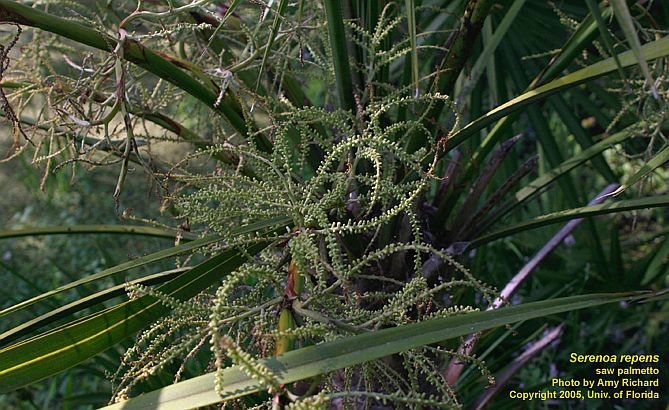
Photo: plants.ifas.ufl.edu

Photo: plants.ifas.ufl.edu

Photo: idtools.org

Photo: idtools.org

Serenoa repens adaxial hastula. Photo: idtools.org

Serenoa repens abaxial hastula of blue-green leaf. Photo: idtools.org

Photo: idtools.org

Photo: idtools.org

Photo: idtools.org

Photo: idtools.org

Photo: idtools.org

Serenoa repens abaxial hastula. Photo: idtools.org

Photo: idtools.org

Photo: idtools.org

Photo: idtools.org

Photo by Steven Foster

Photo by Steven Foster


Imagetext: avogel.ca

Imagetext: floridata.com

Imagetext: floridata.com

Imagetext: idtools.org

Imagetext: idtools.org

Imagetext:regonalconservation.org/

Imagetext:regonalconservation.org/

Imagetext:regonalconservation.org/

Imagetext:regonalconservation.org/

Indigenous region.


_in_Manatee_Springs_State_Park.jpg)
.jpg)
.jpg)
.jpg)


External Links
- Glossary of Palm Terms
- MODERN BOTANICAL LATIN
- "Just To Be Clear"
- http://www.ncbi.nlm.nih.gov/pubmed/12137626
- http://www.mayoclinic.com/health/saw-palmetto/NS_patient-sawpalmetto
References
Phonetic spelling of Latin names by edric.
Special thanks to Geoff Stein, (Palmbob) for his hundreds of photos.
Special thanks to Palmweb.org, Dr. John Dransfield, Dr. Bill Baker & team, for their volumes of information and photos.
Glossary of Palm Terms; Based on the glossary in Dransfield, J., N.W. Uhl, C.B. Asmussen-Lange, W.J. Baker, M.M. Harley & C.E. Lewis. 2008. Genera Palmarum - Evolution and Classification of the Palms. Royal Botanic Gardens, Kew. All images copyright of the artists and photographers (see images for credits).
Many Special Thanks to Ed Vaile for his long hours of tireless editing and numerous contributions.