Difference between revisions of "Lytocaryum hoehnei"
| (44 intermediate revisions by 2 users not shown) | |||
| Line 1: | Line 1: | ||
__noeditsection__ | __noeditsection__ | ||
| − | |||
| − | |||
{{Palmbox | {{Palmbox | ||
| − | |image= | + | |image=aef9c3.jpg |
| − | |image_caption= | + | |image_caption=Hawaii. Garden of Bill Austin. Photo by Geoff Stein. |
| − | |genus=Lytocaryum | + | |genus=Lytocaryum (ligh-toh-KAR-yuhm) |
| − | |species=<br>hoehnei ( | + | |species=<br>hoehnei (hoy'-neh) |
|subspecies= | |subspecies= | ||
|variety= | |variety= | ||
| Line 22: | Line 20: | ||
|common_names=Hoehne's Miniature Coconut Palm | |common_names=Hoehne's Miniature Coconut Palm | ||
}} | }} | ||
| − | |||
==Habitat and Distribution== | ==Habitat and Distribution== | ||
| − | Brazil - São Paulo, on the Atlantic plateau. In southern Brazil, L. hoehnei is confined to a patch of mountainous forest between 800 and 975 m of elevation, in nearly year-round rain; there it is almost extinct. L. weddellianum is found on Brazil's southeastern coast where development has also caused it to become endangered. It grows in rain forest to 900 m in elevation; both are restricted to filtered light and humus-rich soil. | + | Brazil - São Paulo, on the Atlantic plateau. [[File:post-90-12736127966317.jpg|thumb|left|500px|Harri Lorenzi's PLANTARUM, Instituto Plantarum de Estudos da Flora LTDA. Nova Odessa, Campinas, Brazil. Photo by Al in Kona.]]In southern Brazil, L. hoehnei is confined to a patch of mountainous forest between 800 and 975 m of elevation, in nearly year-round rain; there it is almost extinct. L. weddellianum is found on Brazil's southeastern coast where development has also caused it to become endangered. It grows in rain forest to 900 m in elevation; both are restricted to filtered light and humus-rich soil. |
==Description== | ==Description== | ||
| − | Solitary, pinnate palm, closely ringed and retain leaf sheaths at the top of the stem. The trunks reach 15 cm in diameter to 5 m (16 ft.) in height, but are usually just half that in cultivation. The spherical leaf crown consists of numerous pinnate leaves to 75 cm long on hairy, 30 cm petioles. The pinnae are 12 cm long, closely and regularly arranged along the rachis, in the same plane, green on top with gray, glaucous undersides. The inflorescence is interfoliar and once branched, covered in brown hair, [[monoecious]] (flowers of both sexes). The female flowers are twice as big as the male's, both with three sepals and three petals. The fruit is globose to ellipsoidal, pink to red, with one seed. | + | Solitary, pinnate palm, closely ringed and retain leaf sheaths at the top of the stem. The trunks reach 15 cm in diameter to 5 m (16 ft.) in height, but are usually just half that in cultivation. The spherical leaf crown consists of numerous pinnate leaves to 75 cm long on hairy, 30 cm petioles. The pinnae are 12 cm long, closely and regularly arranged along the rachis, in the same plane, green on top with gray, glaucous undersides. The inflorescence is interfoliar and once branched, covered in brown hair, [[monoecious]] (flowers of both sexes). The female flowers are twice as big as the male's, both with three sepals and three petals. The fruit is globose to ellipsoidal, pink to red, with one seed. Editing by edric. |
==Culture== | ==Culture== | ||
| − | I have grown this palm in San Jose, CA for nearly 6 years and no matter how low the temperature has been, close to 24F one year, not even a spot. One plant grows up against the house, (too close). Never any damage. Two other plants grow well away from the house under 50% shade cloth and never is there even a spot on them in the winter. Any new ones I get will be placed in higher light conditions as I think they want more light then I'm giving them. I saw a nearly full grown specimine on the Island of Maui and it was in near full sun and it was beautiful. (SanJoseDaveforPalms) | + | I have grown this palm in San Jose, CA for nearly 6 years and no matter how low the temperature has been, close to 24F one year, not even a spot. One plant grows up against the house, (too close). Never any damage. Two other plants grow well away from the house under 50% shade cloth and never is there even a spot on them in the winter. Any new ones I get will be placed in higher light conditions as I think they want more light then I'm giving them. I saw a nearly full grown specimine on the Island of Maui and it was in near full sun and it was beautiful. (SanJoseDaveforPalms) |
==Comments and Curiosities== | ==Comments and Curiosities== | ||
| − | Etymology:The genus name is Greek for "loose" and "nut". The ephitaph named after Brazilian botanist of the 20th century, Frederick C. Hoehne (1882-1959). | + | Etymology:The genus name is Greek for "loose" and "nut". The specific ephitaph named after Brazilian botanist of the 20th century, Frederick C. Hoehne (1882-1959). |
| − | + | {{read more top}} | |
Endemic to Brazil, where a total of four species are known. Palms once classified as Microcoelum are herein included; the genus is closely related to Syagrus, from which it is differentiated only by abundant tomentum, strongly versatile anthers, and slight epicarp, mesocarp, and endocarp differences. Both species are solitary trunked, | Endemic to Brazil, where a total of four species are known. Palms once classified as Microcoelum are herein included; the genus is closely related to Syagrus, from which it is differentiated only by abundant tomentum, strongly versatile anthers, and slight epicarp, mesocarp, and endocarp differences. Both species are solitary trunked, | ||
L. weddellianum is a commonly potted plant throughout Europe which may save it from extinction, but L. hoehnei is essentially unknown in cultivation. The former demands shade and rich, friable, quickly draining soil with some acidity; the latter would likely require the same if cultivated. | L. weddellianum is a commonly potted plant throughout Europe which may save it from extinction, but L. hoehnei is essentially unknown in cultivation. The former demands shade and rich, friable, quickly draining soil with some acidity; the latter would likely require the same if cultivated. | ||
| − | This slightly larger and more robust cousin of the popular Lytocaryum weddellianum is native to montane forests in São Paulo State in Brazil. It has a slender trunk that can reach about 5 m (16 ft.) tall, topped by a crown of elegant, feathery leaves. The leaflets are distinclty wider than in L. weddellianum and the seeds have a harder shell, more like a Syagrus. It is highly threatened with extinction by destruction of its forest habitat and even in cultivation it is extremely rare, apart from a handful of plants in a few enthusiasts' collections. L. hoehnei does best in mild, humid subtropical or cool subtropical climates. (RPS.com), | + | This slightly larger and more robust cousin of the popular Lytocaryum weddellianum is native to montane forests in São Paulo State in Brazil. It has a slender trunk that can reach about 5 m (16 ft.) tall, topped by a crown of elegant, feathery leaves. The leaflets are distinclty wider than in L. weddellianum and the seeds have a harder shell, more like a Syagrus. It is highly threatened with extinction by destruction of its forest habitat and even in cultivation it is extremely rare, apart from a handful of plants in a few enthusiasts' collections. L. hoehnei does best in mild, humid subtropical or cool subtropical climates. (RPS.com) |
| + | |||
| + | "This is a lesser known palm in this genus. This is a wonderful and tough little palm for being so tropical looking. It actually can end up not so little, being able to get as tall as 15 feet in height. Jeff in Modesto has one of these and it even bloomed the Winter before last. Maybe he can post a picture. This palm did fine through the chilly Central Valley Winters. I have several of these and they seem to not only grow well in cooler weather, but they can take quite a bit of drought. I've had pots dry out completely with no harm done to this palm. I would almost call it a mini-parajubaea, as the leaflet undersides are white like a parajubaea or a ceroxylon." (Dr. Axel Kratel) | ||
| + | {{read more bottom}} | ||
| + | |||
| + | <br clear="all"> | ||
| + | {{#Widget:AdResban}} | ||
| + | <center><gallery caption="IMAGE GALLERY" perrow="" widths="" heights=""> | ||
| + | image:Lh2788595.jpg|Sao Paulo, Brazil. Photo by Dr. Andrew J. Henderson/Palmweb. | ||
| + | image:Lh8746577981_dd1d5a1764_o.jpg|Corupá, Santa Catarina, Brazil. Photo by Gilio Giacomozzi | ||
| + | image:Lh8746577311_b468fa2b0e_o.jpg|Corupá, Santa Catarina, Brazil. Photo by Gilio Giacomozzi | ||
| + | image:Lh8747697610_40014404b3_o.jpg|Corupá, Santa Catarina, Brazil. Photo by Gilio Giacomozzi | ||
| + | image:Lh8747699764_0bcb6eb058_o.jpg|Corupá, Santa Catarina, Brazil. Photo by Gilio Giacomozzi | ||
| + | image:Lh8747699156_cc0f28c186_o.jpg|Corupá, Santa Catarina, Brazil. Photo by Gilio Giacomozzi | ||
| + | image:Lh8747697088_dfc11bd7a6_o.jpg|Corupá, Santa Catarina, Brazil. Photo by Gilio Giacomozzi | ||
| + | image:Lh8746575803_b4cef298aa_o.jpg|Corupá, Santa Catarina, Brazil. Photo by Gilio Giacomozzi | ||
| + | image:Lhpost-465-001387100_1315169681.jpg|Carambeí-second tableland of the state of Paraná-south Brazil. Photo by Alberto Leonardo Barkema | ||
| + | image:Lhpost-465-072800300_1315169591.jpg|Carambeí-second tableland of the state of Paraná-south Brazil. Photo by Alberto Leonardo Barkema | ||
| + | File:PROD981864.jpg|Photo-rosesementes.com.br | ||
| + | image:Lytocaryum_hoehnei1.jpg|São Paulo, Brazil. Photo-Flora Mata Atlântica | ||
| + | image:Lytocaryum_hoehnei2.jpg|São Paulo, Brazil. Photo-Flora Mata Atlântica | ||
| + | image:Lytocaryum_hoehnei3.jpg|São Paulo, Brazil. Photo-Flora Mata Atlântica | ||
| + | image:Lhpost-4755-0-09408800-1379313011.jpg|Hawaii. Photo by Bill Austin | ||
| + | image:Lhpost-4755-0-47955100-1379312982.jpg|Hawaii. Photo by Bill Austin | ||
| + | Image:Lytocaryum hoenei P.jpg|So. California. | ||
| + | File:f0846b.jpg|Ventura, CA. Pauleen Sullivan Collection, Photo by Geoff Stein. | ||
| + | File:b59ac2.jpg|Hawaii. Garden of Bill Austin. Photo by Geoff Stein. | ||
| + | File:aef9c3.jpg|Hawaii. Garden of Bill Austin. Photo by Geoff Stein. | ||
| + | File:8cdd68.jpg|So Cal. Photo by Geoff Stein. | ||
| + | File:lhDSC_0062.jpg|Seaarle Brothers Nursery Florida. Photo by Ryan D. Gallivan. | ||
| + | File:lhDSC_0063.jpg|Seaarle Brothers Nursery Florida. Photo by Ryan D. Gallivan. | ||
| + | File:RDG2010-02-26_12-09-32.jpg|Seaarle Brothers Nursery Florida. Photo by Ryan D. Gallivan. | ||
| + | File:post-426-1243521479.jpg|Ventura, CA. Pauleen Sullivan Collection, Photo by Geoff Stein. | ||
| + | File:lhIMG_8573.jpg|El Hierro, Canary Islands, Spain. Photo by Carlos Simon. | ||
| + | File:lhIMG_8574.jpg|El Hierro, Canary Islands, Spain. Photo by Carlos Simon. | ||
| + | File:lhIMG_8679.jpg|El Hierro, Canary Islands, Spain. Photo by Carlos Simon. | ||
| + | File:lhIMG_8680.jpg|El Hierro, Canary Islands, Spain. Photo by Carlos Simon. | ||
| + | File:lhIMG_8579.jpg|El Hierro, Canary Islands, Spain. Photo by Carlos Simon. | ||
| + | File:post-90-1216076515.jpg| L. weddelianum right and L. hoehnei left. Hawaii. Photo by Al in Kona. | ||
| + | File:6373577931_a055319a86_o.jpg|Miami, FL. Phoyo by Kyle Wicomb. | ||
| + | File:post-1050-1242078669.jpg|The Netherlands. Photo by Kai. | ||
| + | File:post-90-12736127966317.jpg|Harri Lorenzi's PLANTARUM, Instituto Plantarum de Estudos da Flora LTDA. Nova Odessa, Campinas, Brazil. Photo by Al in Kona. | ||
| + | File:post-116-0-33483300-1379211588.jpg|Modesto, CA. Photo by Jeff in Modesto. | ||
| + | File:post-90-1208207371.jpg|Lytocaryun weddellianum on left, Lytocaryum hoehnei on right. Photo by Al in Kona. | ||
| + | File:100_1613.jpg|Carlsbad, CA. Photo by deezpalms. | ||
| + | File:100_1611.jpg|Carlsbad, CA. Photo by deezpalms. | ||
| + | File:post-376-1176063962.jpg|Central Valley, CA. Photo by Perry Glenn. | ||
| + | File:lh1122665670948522.JPG|Photo by Dr. Larry R. Noblick. | ||
| + | File:post-4755-0-14712700-1367736979.jpg|Hawaii. Photo by Bill Austin. | ||
| + | File:17145864129_e7a6ac476e_o.jpg|Syagrus (Lytocaryum) hoehnei in natural habitat / Mogi das Cruzes, SP Pencil sketch after a photo taken by Mauro Peixoto. Photo by Research Work Editor, Pal Meir. | ||
| + | File:lh675438904421.JPG|Syagrus (Lytocaryum) hoehnei in natural habitat / Mogi das Cruzes, SP (©Mauro Peixoto) by palMeir | ||
| + | File:9788345516_02cf5afa5b_o.jpg|Syagrus (Lytocaryum) hoehnei, ½ year old seedlings (2003-12-28) The soil mixture used here in 2003 was not adaquate: It was too humus-rich, and the drainage was too bad. Photo by Research Work Editor, Pal Meir. | ||
| + | File:lytocaryum_hoehmei_001.jpg|SoCal. Photo-Jungle Music Palms & Cycads.com | ||
| + | File:LytHoe.jpg|Photo-Rare Palm Seeds.com | ||
| + | File:LytHoe2.jpg|Photo-Rare Palm Seeds.com | ||
| + | File:lh66884532098012.JPG|Photo by Dr. Larry R. Noblick. | ||
| + | File:lh44229906893410.JPG|Photo by Dr. Larry R. Noblick. | ||
| + | image:Lh9788171332_79479868b7_o.jpg|Seeds on the left are without endocarp. – The nuts resemble very much L. weddellianum and L. insigne, but the endocarp is definitely stronger. Photo by Research Work Editor Pal Meir | ||
| + | File:20160627_171151.jpg.921553218dd4f401a6b70099b859b3ad.jpg|Notations by Research Work Editor Pal Meir. Photo by Pal Meir. | ||
| + | File:5772976ca91ed_Lytocaryumhoehnei20160627_171151.jpg.a82476b3e665b0c556b9f8481ec35741.jpg|Notations by Research Work Editor Pal Meir. Photo by Pal Meir. | ||
| + | File:57a3984b9b332_Syagrushoehnei2016-08-04IMG_887469.jpg.e6f25e4304d6dfc3b0bc9e2d966d67e2.jpg|Notations by Research Work Editor Pal Meir. Photo by Pal Meir. | ||
| + | |||
| + | File:lh102159.jpg|Fairchild Tropical Botanic Garden pressed specimens. | ||
| + | File:lh490173791234.JPG|Image Text: brazilplants.com | ||
| + | </gallery></center> | ||
==External Links== | ==External Links== | ||
*[http://eunops.org/content/glossary-palm-terms Glossary of Palm Terms] | *[http://eunops.org/content/glossary-palm-terms Glossary of Palm Terms] | ||
*[http://www.calflora.net/botanicalnames/pronunciation.html MODERN BOTANICAL LATIN] | *[http://www.calflora.net/botanicalnames/pronunciation.html MODERN BOTANICAL LATIN] | ||
*[http://www.jlhudsonseeds.net/Pronunciation.htm "Just To Be Clear"] | *[http://www.jlhudsonseeds.net/Pronunciation.htm "Just To Be Clear"] | ||
| − | |||
==References== | ==References== | ||
Phonetic spelling of Latin names by edric. | Phonetic spelling of Latin names by edric. | ||
| − | Special thanks to Geoff Stein, (Palmbob) for his hundreds of photos | + | Special thanks to Geoff Stein, (Palmbob) for his hundreds of photos. |
| − | Special thanks to [http://palmweb.org/?q=node/2 Palmweb.org], Dr. John Dransfield, Dr. Bill Baker & team, for their volumes of information and photos | + | Special thanks to [http://palmweb.org/?q=node/2 Palmweb.org], Dr. John Dransfield, Dr. Bill Baker & team, for their volumes of information and photos. |
Glossary of Palm Terms; Based on the glossary in Dransfield, J., N.W. Uhl, C.B. Asmussen-Lange, W.J. Baker, M.M. Harley & C.E. Lewis. 2008. Genera Palmarum - Evolution and Classification of the Palms. Royal Botanic Gardens, Kew. All images copyright of the artists and photographers (see images for credits). | Glossary of Palm Terms; Based on the glossary in Dransfield, J., N.W. Uhl, C.B. Asmussen-Lange, W.J. Baker, M.M. Harley & C.E. Lewis. 2008. Genera Palmarum - Evolution and Classification of the Palms. Royal Botanic Gardens, Kew. All images copyright of the artists and photographers (see images for credits). | ||
| − | |||
| − | |||
| − | |||
| − | |||
| − | |||
| − | |||
| − | |||
| − | |||
| − | |||
| − | |||
| − | |||
| − | |||
| − | |||
| − | |||
| − | |||
| − | |||
| − | |||
| − | |||
| − | |||
| − | |||
| − | |||
| − | |||
| − | |||
| − | |||
| − | |||
| − | |||
| − | |||
| − | |||
| − | |||
| − | |||
| − | |||
| − | |||
| − | |||
| − | |||
| − | |||
| − | |||
| − | |||
| − | |||
| − | |||
{{SpeciesListBackLink}} | {{SpeciesListBackLink}} | ||
[[Category:LYTOCARYUM|hoehnei]] | [[Category:LYTOCARYUM|hoehnei]] | ||
Latest revision as of 21:16, 8 November 2017
| Lytocaryum (ligh-toh-KAR-yuhm) hoehnei (hoy'-neh) | |||||||
|---|---|---|---|---|---|---|---|
 Hawaii. Garden of Bill Austin. Photo by Geoff Stein. | |||||||
| Scientific Classification | |||||||
| |||||||
| Synonyms | |||||||
|
| |||||||
| Native Continent | |||||||
 | |||||||
| Morphology | |||||||
| |||||||
| Culture | |||||||
|
| |||||||
| Survivability index | |||||||
|
| |||||||
| Common names | |||||||
|
| |||||||
Contents
Habitat and Distribution
Brazil - São Paulo, on the Atlantic plateau.
Description
Solitary, pinnate palm, closely ringed and retain leaf sheaths at the top of the stem. The trunks reach 15 cm in diameter to 5 m (16 ft.) in height, but are usually just half that in cultivation. The spherical leaf crown consists of numerous pinnate leaves to 75 cm long on hairy, 30 cm petioles. The pinnae are 12 cm long, closely and regularly arranged along the rachis, in the same plane, green on top with gray, glaucous undersides. The inflorescence is interfoliar and once branched, covered in brown hair, monoecious (flowers of both sexes). The female flowers are twice as big as the male's, both with three sepals and three petals. The fruit is globose to ellipsoidal, pink to red, with one seed. Editing by edric.
Culture
I have grown this palm in San Jose, CA for nearly 6 years and no matter how low the temperature has been, close to 24F one year, not even a spot. One plant grows up against the house, (too close). Never any damage. Two other plants grow well away from the house under 50% shade cloth and never is there even a spot on them in the winter. Any new ones I get will be placed in higher light conditions as I think they want more light then I'm giving them. I saw a nearly full grown specimine on the Island of Maui and it was in near full sun and it was beautiful. (SanJoseDaveforPalms)
Comments and Curiosities
Etymology:The genus name is Greek for "loose" and "nut". The specific ephitaph named after Brazilian botanist of the 20th century, Frederick C. Hoehne (1882-1959).
| read more |
|---|
|
Endemic to Brazil, where a total of four species are known. Palms once classified as Microcoelum are herein included; the genus is closely related to Syagrus, from which it is differentiated only by abundant tomentum, strongly versatile anthers, and slight epicarp, mesocarp, and endocarp differences. Both species are solitary trunked, L. weddellianum is a commonly potted plant throughout Europe which may save it from extinction, but L. hoehnei is essentially unknown in cultivation. The former demands shade and rich, friable, quickly draining soil with some acidity; the latter would likely require the same if cultivated. This slightly larger and more robust cousin of the popular Lytocaryum weddellianum is native to montane forests in São Paulo State in Brazil. It has a slender trunk that can reach about 5 m (16 ft.) tall, topped by a crown of elegant, feathery leaves. The leaflets are distinclty wider than in L. weddellianum and the seeds have a harder shell, more like a Syagrus. It is highly threatened with extinction by destruction of its forest habitat and even in cultivation it is extremely rare, apart from a handful of plants in a few enthusiasts' collections. L. hoehnei does best in mild, humid subtropical or cool subtropical climates. (RPS.com) "This is a lesser known palm in this genus. This is a wonderful and tough little palm for being so tropical looking. It actually can end up not so little, being able to get as tall as 15 feet in height. Jeff in Modesto has one of these and it even bloomed the Winter before last. Maybe he can post a picture. This palm did fine through the chilly Central Valley Winters. I have several of these and they seem to not only grow well in cooler weather, but they can take quite a bit of drought. I've had pots dry out completely with no harm done to this palm. I would almost call it a mini-parajubaea, as the leaflet undersides are white like a parajubaea or a ceroxylon." (Dr. Axel Kratel) |
- IMAGE GALLERY

Sao Paulo, Brazil. Photo by Dr. Andrew J. Henderson/Palmweb.

Corupá, Santa Catarina, Brazil. Photo by Gilio Giacomozzi

Corupá, Santa Catarina, Brazil. Photo by Gilio Giacomozzi

Corupá, Santa Catarina, Brazil. Photo by Gilio Giacomozzi

Corupá, Santa Catarina, Brazil. Photo by Gilio Giacomozzi

Corupá, Santa Catarina, Brazil. Photo by Gilio Giacomozzi

Corupá, Santa Catarina, Brazil. Photo by Gilio Giacomozzi

Corupá, Santa Catarina, Brazil. Photo by Gilio Giacomozzi

Carambeí-second tableland of the state of Paraná-south Brazil. Photo by Alberto Leonardo Barkema

Carambeí-second tableland of the state of Paraná-south Brazil. Photo by Alberto Leonardo Barkema
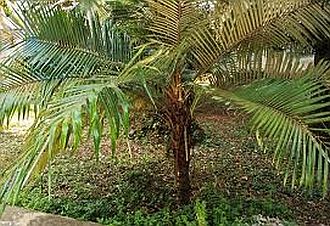
Photo-rosesementes.com.br

São Paulo, Brazil. Photo-Flora Mata Atlântica

São Paulo, Brazil. Photo-Flora Mata Atlântica

São Paulo, Brazil. Photo-Flora Mata Atlântica

Hawaii. Photo by Bill Austin

Hawaii. Photo by Bill Austin

So. California.

Ventura, CA. Pauleen Sullivan Collection, Photo by Geoff Stein.

Hawaii. Garden of Bill Austin. Photo by Geoff Stein.

Hawaii. Garden of Bill Austin. Photo by Geoff Stein.

So Cal. Photo by Geoff Stein.

Seaarle Brothers Nursery Florida. Photo by Ryan D. Gallivan.

Seaarle Brothers Nursery Florida. Photo by Ryan D. Gallivan.

Seaarle Brothers Nursery Florida. Photo by Ryan D. Gallivan.

Ventura, CA. Pauleen Sullivan Collection, Photo by Geoff Stein.

El Hierro, Canary Islands, Spain. Photo by Carlos Simon.

El Hierro, Canary Islands, Spain. Photo by Carlos Simon.

El Hierro, Canary Islands, Spain. Photo by Carlos Simon.

El Hierro, Canary Islands, Spain. Photo by Carlos Simon.

El Hierro, Canary Islands, Spain. Photo by Carlos Simon.

L. weddelianum right and L. hoehnei left. Hawaii. Photo by Al in Kona.

Miami, FL. Phoyo by Kyle Wicomb.

The Netherlands. Photo by Kai.

Harri Lorenzi's PLANTARUM, Instituto Plantarum de Estudos da Flora LTDA. Nova Odessa, Campinas, Brazil. Photo by Al in Kona.

Modesto, CA. Photo by Jeff in Modesto.

Lytocaryun weddellianum on left, Lytocaryum hoehnei on right. Photo by Al in Kona.

Carlsbad, CA. Photo by deezpalms.

Carlsbad, CA. Photo by deezpalms.

Central Valley, CA. Photo by Perry Glenn.

Photo by Dr. Larry R. Noblick.

Hawaii. Photo by Bill Austin.

Syagrus (Lytocaryum) hoehnei in natural habitat / Mogi das Cruzes, SP Pencil sketch after a photo taken by Mauro Peixoto. Photo by Research Work Editor, Pal Meir.

Syagrus (Lytocaryum) hoehnei in natural habitat / Mogi das Cruzes, SP (©Mauro Peixoto) by palMeir

Syagrus (Lytocaryum) hoehnei, ½ year old seedlings (2003-12-28) The soil mixture used here in 2003 was not adaquate: It was too humus-rich, and the drainage was too bad. Photo by Research Work Editor, Pal Meir.

SoCal. Photo-Jungle Music Palms & Cycads.com

Photo-Rare Palm Seeds.com

Photo-Rare Palm Seeds.com
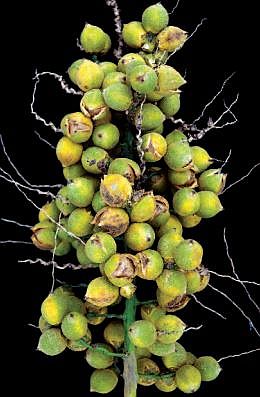
Photo by Dr. Larry R. Noblick.

Photo by Dr. Larry R. Noblick.

Seeds on the left are without endocarp. – The nuts resemble very much L. weddellianum and L. insigne, but the endocarp is definitely stronger. Photo by Research Work Editor Pal Meir

Notations by Research Work Editor Pal Meir. Photo by Pal Meir.

Notations by Research Work Editor Pal Meir. Photo by Pal Meir.

Notations by Research Work Editor Pal Meir. Photo by Pal Meir.

Fairchild Tropical Botanic Garden pressed specimens.

Image Text: brazilplants.com


External Links
References
Phonetic spelling of Latin names by edric.
Special thanks to Geoff Stein, (Palmbob) for his hundreds of photos.
Special thanks to Palmweb.org, Dr. John Dransfield, Dr. Bill Baker & team, for their volumes of information and photos.
Glossary of Palm Terms; Based on the glossary in Dransfield, J., N.W. Uhl, C.B. Asmussen-Lange, W.J. Baker, M.M. Harley & C.E. Lewis. 2008. Genera Palmarum - Evolution and Classification of the Palms. Royal Botanic Gardens, Kew. All images copyright of the artists and photographers (see images for credits).
Many Special Thanks to Ed Vaile for his long hours of tireless editing and numerous contributions.