Difference between revisions of "Rhapidophyllum hystrix"
| (29 intermediate revisions by one user not shown) | |||
| Line 1: | Line 1: | ||
__noeditsection__ | __noeditsection__ | ||
{{Palmbox | {{Palmbox | ||
| − | |image= | + | |image=rhhy_004_pvp.jpg |
| − | |image_caption= | + | |image_caption=Photo: USDA.com |
|genus=Rhapidophyllum <br>(rahp-ih-DOH-fee-luhm) | |genus=Rhapidophyllum <br>(rahp-ih-DOH-fee-luhm) | ||
|species=<br>hystrix (HISS-triks) | |species=<br>hystrix (HISS-triks) | ||
| Line 13: | Line 13: | ||
|watering= | |watering= | ||
|soil_type= | |soil_type= | ||
| − | |common_names=Needle Palm | + | |common_names=Needle Palm, Blue palmetto |
|synonyms= | |synonyms= | ||
}} | }} | ||
==Habitat and Distribution== | ==Habitat and Distribution== | ||
| − | Native to southeastern United States, central Florida to Georgia, [[image:Rhystrix20081026-01.jpg|thumb|left|370px|Bowie, MD. This palm has withstood temperatures down to -8.4F. Photo by Tom | + | Native to southeastern United States, central Florida to Georgia, [[image:Rhystrix20081026-01.jpg|thumb|left|370px|Bowie, MD. This palm has withstood temperatures down to -8.4F. Photo by Tom Walters.]]Mississippi, South Carolina and Alabama. |
==Description== | ==Description== | ||
A palmate palm with a short, dense clustered base eventually to 1-1.2 m tall, covered in dense long needle-like spines from the leaf bases. Editing by edric. | A palmate palm with a short, dense clustered base eventually to 1-1.2 m tall, covered in dense long needle-like spines from the leaf bases. Editing by edric. | ||
| Line 25: | Line 25: | ||
The species is dioecious, with separate male and female trees. The fruit is dark brown when ripe, oval, about 2 cm long, with a single seed. They are produced on densely branched panicles. | The species is dioecious, with separate male and female trees. The fruit is dark brown when ripe, oval, about 2 cm long, with a single seed. They are produced on densely branched panicles. | ||
| − | Needle palm is a shrubby, clustering (soboliferous), nearly trunkless, fan palm that grows to 3-6’ tall and as wide. It is native to moist to wet woodlands, slopes, ravines and stream bottomland in the southeastern U. S. (South Carolina, Georgia, Florida, Alabama and Mississippi). It is one of the hardiest if not the hardiest of the palms. It is noted for its large, palmate, glossy green leaves that grow on long upright petioles (to 30” long). Each deeply divided leaf (almost to the base) is fan-shaped (to 30 inches across) with 5-12 narrow segments (each to 20” long). Leaves are evergreen. Genus name is from Greek meaning sharp (rhapis) and leaf (phylum). The specific epithet (from Greek meaning porcupine) and the common name of needle palm are both in reference to the long, stiff, sharply-pointed, needle-like, black spines (to 6” long) that project from the leaf sheaths. Spines make the clumps impenetrable to most wildlife. Three-petaled, yellow-brown flowers in small dense clusters bloom in early summer among the leaf sheaths. Flowers are usually hidden by the foliage. Fruit is a reddish brown drupe. (missouribotanicalgarden.org) | + | Needle palm is a shrubby, clustering (soboliferous), nearly trunkless, fan palm that grows to 3-6’ tall and as wide. It is native to moist to wet woodlands, slopes, ravines and stream bottomland in the southeastern U. S. (South Carolina, Georgia, Florida, Alabama and Mississippi). It is one of the hardiest if not the hardiest of the palms. It is noted for its large, palmate, glossy green leaves that grow on long upright petioles (to 30” long). Each deeply divided leaf (almost to the base) is fan-shaped (to 30 inches across) with 5-12 narrow segments (each to 20” long). Leaves are evergreen. Genus name is from Greek meaning sharp (rhapis) and leaf (phylum). The specific epithet (from Greek meaning porcupine) and the common name of needle palm are both in reference to the long, stiff, sharply-pointed, needle-like, black spines (to 6” long) that project from the leaf sheaths. Spines make the clumps impenetrable to most wildlife. Three-petaled, yellow-brown flowers in small dense clusters bloom in early summer among the leaf sheaths. Flowers are usually hidden by the foliage. Fruit is a reddish brown drupe. (missouribotanicalgarden.org) Editing by edric. |
==Culture== | ==Culture== | ||
| − | ''Rhapidophyllum hystrix'' is likely the hardiest palm known, tolerating winter temperatures down to about -20°C but unlike ''[[Trachycarpus fortunei]]'', the hardiest large trunk-forming palm, it demands a hot summer continental climate with long periods over 30°C. Winter temperatures below -20°C will cut this palm to the ground, but as it is a suckering palm, it may come back from freezes that kill the foliage. The length of the freeze is important, though, and any prolonged freeze that low will freeze the soil will kill the palm. | + | ''Rhapidophyllum hystrix'' is likely the hardiest palm known, tolerating winter temperatures down to about -20°C but unlike ''[[Trachycarpus fortunei]]'', the hardiest large trunk-forming palm, it demands a hot summer continental climate with long periods over 30°C. Winter temperatures below -20°C will cut this palm to the ground, but as it is a suckering palm, it may come back from freezes that kill the foliage. The length of the freeze is important, though, and any prolonged freeze that low will freeze the soil will kill the palm.{{read more top}} |
Needle palm is noted for its excellent winter hardiness. In a protected location, it is considered to be winter hardy to USDA Zone 6b. It is typically grown in organically rich, evenly moist, well-drained soils in full sun to part shade. Best performance is in part-shade. Site in protected locations that are sheltered from winter winds. Mature plants will often survive some winter temperatures to -5 degrees F. Mulch around the base of the plant in winter. Plants will sucker along the stems, sometimes profusely, to form dense clumps. Propagate from suckers or from seed. | Needle palm is noted for its excellent winter hardiness. In a protected location, it is considered to be winter hardy to USDA Zone 6b. It is typically grown in organically rich, evenly moist, well-drained soils in full sun to part shade. Best performance is in part-shade. Site in protected locations that are sheltered from winter winds. Mature plants will often survive some winter temperatures to -5 degrees F. Mulch around the base of the plant in winter. Plants will sucker along the stems, sometimes profusely, to form dense clumps. Propagate from suckers or from seed. | ||
In the eastern United States, successful outdoor cultivation has been reported as far north as New York. | In the eastern United States, successful outdoor cultivation has been reported as far north as New York. | ||
| + | |||
| + | The needle palm is quite cold hardy to zero degrees F. This palm produces 4-10" spines on the trunk. It does not have a typical palm trunk but the crown elongates and produces a big crown of fan-shaped fronds and become thicketlike where conditions are favorable. Suckering is common around the base of a well established specimen. This palm tolerates a wide range of growing conditions related to soils and light exposure. (onlineplantguide.com) | ||
Because of its need for hot summers, cultivation in more northern areas like most of Europe, and the Pacific Northwest of North America, has not been successful even where winters are mild. | Because of its need for hot summers, cultivation in more northern areas like most of Europe, and the Pacific Northwest of North America, has not been successful even where winters are mild. | ||
| + | |||
| + | This shrubby, trunkless palm's moniker comes from the vicious needles arising from the fiber at the bases of the leaves. It is probably the cold-hardiest palm and has reportedly survived temperatures as low as -20°F. The needle palm prefers a moist position in sun or shade, but generally requires more sun as latitude increases. They look best, however, when situated in partial shade. When grown in full sun the crown tends to become rather compact and the leaves lose their dark green color. Native to the southeastern US, it is found growing wild from the southern tip of South Carolina to central Florida, and west to southern Mississippi in wooded, swampy areas. Unfortunately, due to habitat distruction and collection of wild specimens coupled with a seed germination time of up to two years and an extremely slow growth rate, this palm is becoming quite rare. (T.J. Walters) | ||
| + | {{read more bottom}} | ||
<center> | <center> | ||
[[{{PFC}}http://www.palmpedia.net/palmsforcal/index.php5/Rhapidophyllum_histrix]] | [[{{PFC}}http://www.palmpedia.net/palmsforcal/index.php5/Rhapidophyllum_histrix]] | ||
| Line 62: | Line 67: | ||
image:Re872834427_f3de8007e2_o.jpg|Sydney, Australia. Photo by Dr. Tony Rodd. | image:Re872834427_f3de8007e2_o.jpg|Sydney, Australia. Photo by Dr. Tony Rodd. | ||
image:rh2786091.jpg|Fairchild Tropical Botanic Garden, Florida. Photo by Dr. John Dransfield, Royal Botanic Gardens, Kew/Palmweb. | image:rh2786091.jpg|Fairchild Tropical Botanic Garden, Florida. Photo by Dr. John Dransfield, Royal Botanic Gardens, Kew/Palmweb. | ||
| − | image:Rhystrix20081026-01.jpg|Bowie, MD. This palm has withstood temperatures down to -8.4F. Photo by Tom | + | image:Rhystrix20081026-01.jpg|Bowie, MD. This palm has withstood temperatures down to -8.4F. Photo by Tom Walters. |
File:rhhy_005_php.jpg|Photo: USDA.com | File:rhhy_005_php.jpg|Photo: USDA.com | ||
File:rhhy_003_pvp.jpg|Photo: USDA.com | File:rhhy_003_pvp.jpg|Photo: USDA.com | ||
| Line 68: | Line 73: | ||
File:rhapidophyllum_hystrix_2898.jpg|Photo: yuccado.com | File:rhapidophyllum_hystrix_2898.jpg|Photo: yuccado.com | ||
File:rhapidophyllum_hystrix_2901.jpg|Photo: yuccado.com | File:rhapidophyllum_hystrix_2901.jpg|Photo: yuccado.com | ||
| + | File:8706c5.jpg|"Here is a well pruned plant in Florida showing the needles around the base and lack of suckers (been cut off)". Photo by Geoff Stein. | ||
| + | File:8c9f75.jpg|"This is what a frugally pruned plant looks like- still tidy but with the suckers still on". Photo by Geoff Stein. | ||
| + | File:f5a073.jpg|"Close up of spines around trunk. The Huntington, Pasadena California." Photo by Geoff Stein. | ||
| + | File:7166df.jpg|Average specimen found in the Bond Swamp National Wildlife Refuge @ ten miles southeast of Macon, Georgia. Photo by Alan_Taylor. | ||
| + | File:23e04e.jpg | ||
| + | File:74f6f6.jpg|"Seedling in my yard, southern California". Photo by Geoff Stein. | ||
| + | File:481190.jpg|Havana, Florida. Photo by davidmacmanus. | ||
| + | File:fc6a9b.jpg|Havana, Florida. Photo by davidmacmanus | ||
| + | File:04b2ac.jpg|"Enormous, very old plant in southern California. well groomed to display nearly 4' of full trunk". Photo by Geoff Stein. | ||
| + | File:666135.jpg|"Enormous, very old plant in southern California. well groomed to display nearly 4' of full trunk". Photo by Geoff Stein. | ||
| + | File:63cd20.jpg|"Enormous, very old plant in southern California. well groomed to display nearly 4' of full trunk". Photo by Geoff Stein. | ||
| + | File:b87d0c.jpg|"University of California Botanical Garden at Berkeley". Photo by growin. | ||
| + | File:be10df.jpg|"University of California Botanical Garden at Berkeley". Photo by growin. | ||
| + | File:fac9f2.jpg|The Huntington Botanical Gardens. Photo by growin. | ||
| + | File:b79167.jpg|The Huntington Botanical Gardens. Photo by growin. | ||
| + | File:3b882f.jpg|The Huntington Botanical Gardens. Photo by growin. | ||
| + | File:rhimg_0302.jpg|"Here at Leu Gardens we have dozens of mature Rhapidophyllum hystrix, Needle Palm specimens. Recently we have gone through and trimmed them up as they are getting infested with the horribly invasive Skunk Vine, Paederia foetida. I discovered one of the Needle Palms had very distorted growth and kept a watch on it. It now appears to be branching and has at least 5 seperate growing points! A multiheaded Rhapidophyllum hystrix" !!! Photo by H.P. Leu Gardens Botonist Eric S. | ||
| + | File:rhimg_0301.jpg|"Here at Leu Gardens we have dozens of mature Rhapidophyllum hystrix, Needle Palm specimens. Recently we have gone through and trimmed them up as they are getting infested with the horribly invasive Skunk Vine, Paederia foetida. I discovered one of the Needle Palms had very distorted growth and kept a watch on it. It now appears to be branching and has at least 5 seperate growing points! A multiheaded Rhapidophyllum hystrix" !!! Photo by H.P. Leu Gardens Botonist Eric S. | ||
| + | File:rhimg_0300.jpg|"Here at Leu Gardens we have dozens of mature Rhapidophyllum hystrix, Needle Palm specimens. Recently we have gone through and trimmed them up as they are getting infested with the horribly invasive Skunk Vine, Paederia foetida. I discovered one of the Needle Palms had very distorted growth and kept a watch on it. It now appears to be branching and has at least 5 seperate growing points! A multiheaded Rhapidophyllum hystrix" !!! Photo by H.P. Leu Gardens Botonist Eric S. | ||
| + | File:rhapidophyllum_hystrix001DC.jpg|Phjoto Jungle Music Palms & Cycads.com | ||
| + | File:Rhystrix03.jpg|Bowie, MD. Photo by T.J. Walters. | ||
| + | File:SAW_03120.JPG|Houston, TX. Photo by Wasowski, Sally and Andy. | ||
| + | File:A_C_IMG4348.JPG|Laurens Co., GA. Oconee River Floodplain, River Bend Wildlife Management Area. Close-up of a staminate inflorescence. Photo by Cressler, Alan. | ||
| + | File:A_C_IMG4361.JPG|Laurens Co., GA. Oconee River Floodplain, River Bend Wildlife Management Area. Close-up of a staminate inflorescence. Photo by Cressler, Alan. | ||
| + | File:A_C_IMG1742.JPG|Laurens Co., GA. Oconee River Floodplain, River Bend Wildlife Management Area. Close-up of a staminate inflorescence. Photo by Cressler, Alan. | ||
| + | File:A_C_IMG1741.JPG|Close-up of an inflorescence at anthesis. Photographer's Note: "I collected seedling needle palm trees in the late 1990's from one of my work sites in south Georgia. They have been with me ever since. They even lived for three years in Tucson, Arizona. Two of them finally bloomed this year.." Photo by Cressler, Alan. | ||
| + | File:A_C_IMG4360.JPG|Laurens Co., GA. Oconee River Floodplain, River Bend Wildlife Management Area. Close-up of a staminate inflorescence. Photo by Cressler, Alan. | ||
| + | File:A_C_IMG1325.JPG|Twiggs Co., GA. Needle palm fruits turn red and the fuzz falls off when they are ripe. There were hundreds of needle palms on the floodplain we were surveying. This was the only fruit bearing female we could find. Either female plants are rare or they reluctantly produce fruit." | ||
| + | File:rh6767.jpg|Hammond, LA. Photo: onlineplantguide.com | ||
| + | File:rh6769.jpg|Hammond, LA. Photo: onlineplantguide.com | ||
| + | File:Rhapidophyllumhystrix2_zps.jpg|Gainesville, FL. Female. Photo by Frank. | ||
| + | File:Rhapidophyllumhystrix1_zps4e08.jpg|Gainesville, FL. Female. Photo by Frank. | ||
| + | File:needle4_zps6e677.jpg|H.P. Leu Gardens, Orlando, FL. 2004. Photo by Frank. | ||
| + | File:needle3_zpsd22.jpg|H.P. Leu Gardens, Orlando, FL. 2004. Photo by Frank. | ||
| + | File:needle2_zps0a255.jpg|H.P. Leu Gardens, Orlando, FL. 2004. Photo by Frank. | ||
| + | File:needle1_zps0b905111.jpg|H.P. Leu Gardens, Orlando, FL. 2004. Photo by Frank. | ||
| + | File:rhimg_0298.jpg|Macon, GA. Photo by Frank. | ||
| + | File:rhimg_0303.jpg|Macon, GA. Frank 6'7" for scale. "Last foot of trunk under water". Photo by Frank. | ||
| + | File:117_1760_zps0d007.jpg|H.P. Leu Gardens, Orlando, FL. 2004. Photo by Frank. | ||
| + | File:Singletrunkancientneedle_zps5b333.jpg|Gainesville, FL. "A foot or more of trunk lying on the ground". Photo by Frank. | ||
| − | + | File:58ee38b9404da_RhapidophyllumhystrixIMG_2438.jpg.26bfcdbd52dbff9f8a0bb8287730b6ff.jpg|Notations by Research Work Editor Pal Meir. Photo by Pal Meir. | |
File:rh0854760234.jpg|Philadelphia, PA. Photo by Mark Glicksman. | File:rh0854760234.jpg|Philadelphia, PA. Photo by Mark Glicksman. | ||
File:bigneedl.jpg|North FL. Photo by Mark Glicksman. | File:bigneedl.jpg|North FL. Photo by Mark Glicksman. | ||
Latest revision as of 22:34, 9 November 2017
| Rhapidophyllum (rahp-ih-DOH-fee-luhm) hystrix (HISS-triks) | |||||||
|---|---|---|---|---|---|---|---|
 Photo: USDA.com | |||||||
| Scientific Classification | |||||||
| |||||||
| Synonyms | |||||||
|
| |||||||
| Native Continent | |||||||
 | |||||||
| Morphology | |||||||
| |||||||
| Culture | |||||||
| |||||||
| Survivability index | |||||||
|
| |||||||
| Common names | |||||||
|
| |||||||
Contents
Habitat and Distribution
Native to southeastern United States, central Florida to Georgia,
Description
A palmate palm with a short, dense clustered base eventually to 1-1.2 m tall, covered in dense long needle-like spines from the leaf bases. Editing by edric.
Old specimens have a rounded crown up to 3 m tall, of dark green palmate leaves 1-2 m long, with 8-16 leaflets, these 60-80 cm long, arranged in an open fan at the end of a 60-120 cm petiole.
The species is dioecious, with separate male and female trees. The fruit is dark brown when ripe, oval, about 2 cm long, with a single seed. They are produced on densely branched panicles.
Needle palm is a shrubby, clustering (soboliferous), nearly trunkless, fan palm that grows to 3-6’ tall and as wide. It is native to moist to wet woodlands, slopes, ravines and stream bottomland in the southeastern U. S. (South Carolina, Georgia, Florida, Alabama and Mississippi). It is one of the hardiest if not the hardiest of the palms. It is noted for its large, palmate, glossy green leaves that grow on long upright petioles (to 30” long). Each deeply divided leaf (almost to the base) is fan-shaped (to 30 inches across) with 5-12 narrow segments (each to 20” long). Leaves are evergreen. Genus name is from Greek meaning sharp (rhapis) and leaf (phylum). The specific epithet (from Greek meaning porcupine) and the common name of needle palm are both in reference to the long, stiff, sharply-pointed, needle-like, black spines (to 6” long) that project from the leaf sheaths. Spines make the clumps impenetrable to most wildlife. Three-petaled, yellow-brown flowers in small dense clusters bloom in early summer among the leaf sheaths. Flowers are usually hidden by the foliage. Fruit is a reddish brown drupe. (missouribotanicalgarden.org) Editing by edric.
Culture
Rhapidophyllum hystrix is likely the hardiest palm known, tolerating winter temperatures down to about -20°C but unlike Trachycarpus fortunei, the hardiest large trunk-forming palm, it demands a hot summer continental climate with long periods over 30°C. Winter temperatures below -20°C will cut this palm to the ground, but as it is a suckering palm, it may come back from freezes that kill the foliage. The length of the freeze is important, though, and any prolonged freeze that low will freeze the soil will kill the palm.| read more |
|---|
|
Needle palm is noted for its excellent winter hardiness. In a protected location, it is considered to be winter hardy to USDA Zone 6b. It is typically grown in organically rich, evenly moist, well-drained soils in full sun to part shade. Best performance is in part-shade. Site in protected locations that are sheltered from winter winds. Mature plants will often survive some winter temperatures to -5 degrees F. Mulch around the base of the plant in winter. Plants will sucker along the stems, sometimes profusely, to form dense clumps. Propagate from suckers or from seed. In the eastern United States, successful outdoor cultivation has been reported as far north as New York. The needle palm is quite cold hardy to zero degrees F. This palm produces 4-10" spines on the trunk. It does not have a typical palm trunk but the crown elongates and produces a big crown of fan-shaped fronds and become thicketlike where conditions are favorable. Suckering is common around the base of a well established specimen. This palm tolerates a wide range of growing conditions related to soils and light exposure. (onlineplantguide.com) Because of its need for hot summers, cultivation in more northern areas like most of Europe, and the Pacific Northwest of North America, has not been successful even where winters are mild. This shrubby, trunkless palm's moniker comes from the vicious needles arising from the fiber at the bases of the leaves. It is probably the cold-hardiest palm and has reportedly survived temperatures as low as -20°F. The needle palm prefers a moist position in sun or shade, but generally requires more sun as latitude increases. They look best, however, when situated in partial shade. When grown in full sun the crown tends to become rather compact and the leaves lose their dark green color. Native to the southeastern US, it is found growing wild from the southern tip of South Carolina to central Florida, and west to southern Mississippi in wooded, swampy areas. Unfortunately, due to habitat distruction and collection of wild specimens coupled with a seed germination time of up to two years and an extremely slow growth rate, this palm is becoming quite rare. (T.J. Walters) |

Comments and Curiosities
Etymology: The specific epithet from the latin, literally; 'porcupine'
This is a monotypic genus.
- IMAGE GALLERY

"Devil's Millhopper in Gainesville, FL. This is a natural sinkhole 120 feet deep. This photo was taken along the descent." Photo by Kyle Wicomb

"Devil's Millhopper in Gainesville, FL." Photo by Kyle Wicomb

"Growing at the bottom of a ravine in Mike Roess Gold Head Branch State Park. This is southwest of Jacksonville, FL. It seemed to display a trunk." Photo by Kyle Wicomb

"Growing at the bottom of a ravine in Mike Roess Gold Head Branch State Park. This is southwest of Jacksonville, FL." Photo by Kyle Wicomb

"Growing at the bottom of a ravine in Mike Roess Gold Head Branch State Park. This is southwest of Jacksonville, FL." Photo by Kyle Wicomb

"Growing at the bottom of a ravine in Mike Roess Gold Head Branch State Park. This is southwest of Jacksonville, FL." Photo by Kyle Wicomb

"Growing at the bottom of a ravine in Mike Roess Gold Head Branch State Park. This is southwest of Jacksonville, FL." Photo by Kyle Wicomb

"Growing at the bottom of a ravine in Mike Roess Gold Head Branch State Park. This is southwest of Jacksonville, FL. Look closely, you can see the needles." Photo by Kyle Wicomb

"Growing at the bottom of a ravine in Mike Roess Gold Head Branch State Park. This is southwest of Jacksonville, FL. This particular palm had shorter leaflets than the others." Photo by Kyle Wicomb

"Growing at the bottom of a ravine in Mike Roess Gold Head Branch State Park. This is southwest of Jacksonville, FL. This one is growing right in the water." Photo by Kyle Wicomb

"Growing at the bottom of a ravine in Mike Roess Gold Head Branch State Park. This is southwest of Jacksonville, FL. This one is growing right in the water." Photo by Kyle Wicomb

"Growing at the bottom of a ravine in Mike Roess Gold Head Branch State Park. This is southwest of Jacksonville, FL. This one is growing right in the water." Photo by Kyle Wicomb

"Growing at the bottom of a ravine in Mike Roess Gold Head Branch State Park. This is southwest of Jacksonville, FL." Photo by Kyle Wicomb

"Growing at the bottom of a ravine in Mike Roess Gold Head Branch State Park. This is southwest of Jacksonville, FL." Photo by Kyle Wicomb

"Here's a pic of R. hystrix in USDA Zone 6B where the average lowest temps of the year are between 0 and -5F (-18 to -20C). This plant has been in the ground for 5 winters and never been protected. It was transplanted from a 5 gallon (20L) pot. It has been covered with snow and ice for up to a month at a time but I cannot say the lowest temperature its experienced. Its in my parent's garden in Smithton IL, a suburb of St Louis MO." (Keith in Sojax)

Sydney, Australia. Photo by Dr. Tony Rodd.

Fairchild Tropical Botanic Garden, Florida. Photo by Dr. John Dransfield, Royal Botanic Gardens, Kew/Palmweb.

Bowie, MD. This palm has withstood temperatures down to -8.4F. Photo by Tom Walters.

Photo: USDA.com

Photo: USDA.com

Photo: USDA.com

Photo: yuccado.com

Photo: yuccado.com

"Here is a well pruned plant in Florida showing the needles around the base and lack of suckers (been cut off)". Photo by Geoff Stein.

"This is what a frugally pruned plant looks like- still tidy but with the suckers still on". Photo by Geoff Stein.

"Close up of spines around trunk. The Huntington, Pasadena California." Photo by Geoff Stein.

Average specimen found in the Bond Swamp National Wildlife Refuge @ ten miles southeast of Macon, Georgia. Photo by Alan_Taylor.


"Seedling in my yard, southern California". Photo by Geoff Stein.

Havana, Florida. Photo by davidmacmanus.

Havana, Florida. Photo by davidmacmanus

"Enormous, very old plant in southern California. well groomed to display nearly 4' of full trunk". Photo by Geoff Stein.

"Enormous, very old plant in southern California. well groomed to display nearly 4' of full trunk". Photo by Geoff Stein.

"Enormous, very old plant in southern California. well groomed to display nearly 4' of full trunk". Photo by Geoff Stein.

"University of California Botanical Garden at Berkeley". Photo by growin.

"University of California Botanical Garden at Berkeley". Photo by growin.

The Huntington Botanical Gardens. Photo by growin.

The Huntington Botanical Gardens. Photo by growin.

The Huntington Botanical Gardens. Photo by growin.

"Here at Leu Gardens we have dozens of mature Rhapidophyllum hystrix, Needle Palm specimens. Recently we have gone through and trimmed them up as they are getting infested with the horribly invasive Skunk Vine, Paederia foetida. I discovered one of the Needle Palms had very distorted growth and kept a watch on it. It now appears to be branching and has at least 5 seperate growing points! A multiheaded Rhapidophyllum hystrix" !!! Photo by H.P. Leu Gardens Botonist Eric S.

"Here at Leu Gardens we have dozens of mature Rhapidophyllum hystrix, Needle Palm specimens. Recently we have gone through and trimmed them up as they are getting infested with the horribly invasive Skunk Vine, Paederia foetida. I discovered one of the Needle Palms had very distorted growth and kept a watch on it. It now appears to be branching and has at least 5 seperate growing points! A multiheaded Rhapidophyllum hystrix" !!! Photo by H.P. Leu Gardens Botonist Eric S.

"Here at Leu Gardens we have dozens of mature Rhapidophyllum hystrix, Needle Palm specimens. Recently we have gone through and trimmed them up as they are getting infested with the horribly invasive Skunk Vine, Paederia foetida. I discovered one of the Needle Palms had very distorted growth and kept a watch on it. It now appears to be branching and has at least 5 seperate growing points! A multiheaded Rhapidophyllum hystrix" !!! Photo by H.P. Leu Gardens Botonist Eric S.

Phjoto Jungle Music Palms & Cycads.com

Bowie, MD. Photo by T.J. Walters.

Houston, TX. Photo by Wasowski, Sally and Andy.
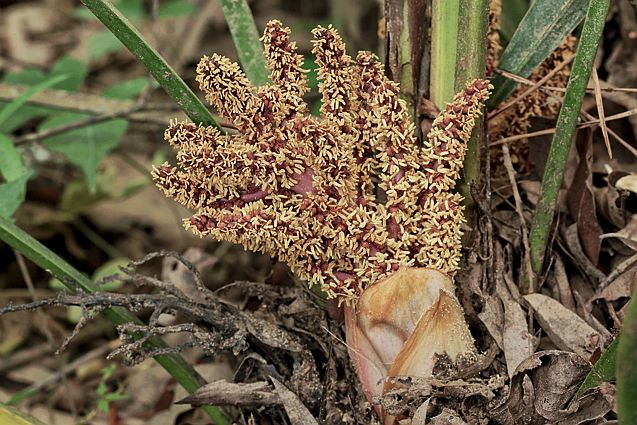
Laurens Co., GA. Oconee River Floodplain, River Bend Wildlife Management Area. Close-up of a staminate inflorescence. Photo by Cressler, Alan.

Laurens Co., GA. Oconee River Floodplain, River Bend Wildlife Management Area. Close-up of a staminate inflorescence. Photo by Cressler, Alan.

Laurens Co., GA. Oconee River Floodplain, River Bend Wildlife Management Area. Close-up of a staminate inflorescence. Photo by Cressler, Alan.

Close-up of an inflorescence at anthesis. Photographer's Note: "I collected seedling needle palm trees in the late 1990's from one of my work sites in south Georgia. They have been with me ever since. They even lived for three years in Tucson, Arizona. Two of them finally bloomed this year.." Photo by Cressler, Alan.
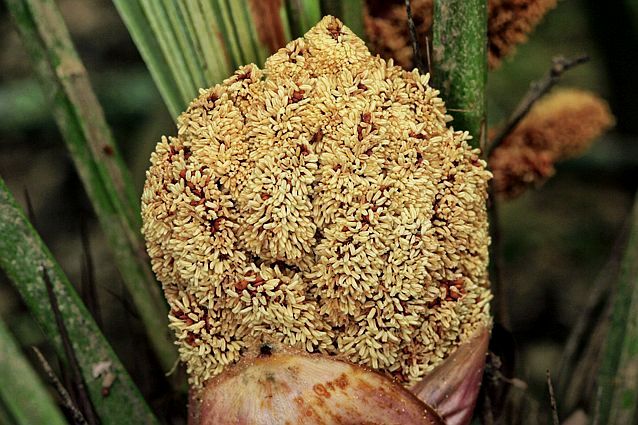
Laurens Co., GA. Oconee River Floodplain, River Bend Wildlife Management Area. Close-up of a staminate inflorescence. Photo by Cressler, Alan.

Twiggs Co., GA. Needle palm fruits turn red and the fuzz falls off when they are ripe. There were hundreds of needle palms on the floodplain we were surveying. This was the only fruit bearing female we could find. Either female plants are rare or they reluctantly produce fruit."

Hammond, LA. Photo: onlineplantguide.com

Hammond, LA. Photo: onlineplantguide.com

Gainesville, FL. Female. Photo by Frank.

Gainesville, FL. Female. Photo by Frank.

H.P. Leu Gardens, Orlando, FL. 2004. Photo by Frank.

H.P. Leu Gardens, Orlando, FL. 2004. Photo by Frank.

H.P. Leu Gardens, Orlando, FL. 2004. Photo by Frank.

H.P. Leu Gardens, Orlando, FL. 2004. Photo by Frank.

Macon, GA. Photo by Frank.

Macon, GA. Frank 6'7" for scale. "Last foot of trunk under water". Photo by Frank.

H.P. Leu Gardens, Orlando, FL. 2004. Photo by Frank.

Gainesville, FL. "A foot or more of trunk lying on the ground". Photo by Frank.

Notations by Research Work Editor Pal Meir. Photo by Pal Meir.

Philadelphia, PA. Photo by Mark Glicksman.
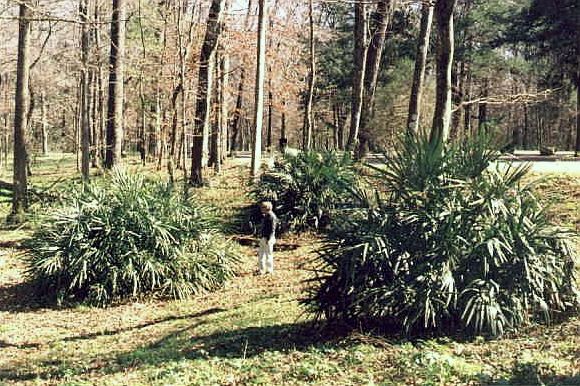
North FL. Photo by Mark Glicksman.

North FL. Photo by Mark Glicksman.

North FL. Photo by Mark Glicksman.

Image Text: Mark Glicksman.
Image Text: Mark Glicksman.

Image Text: Mark Glicksman.

Image Text: floridata.com

Image Text: floridata.com

Image Text: floridata.com


External Links
- Glossary of Palm Terms
- MODERN BOTANICAL LATIN
- "Just To Be Clear"
- https://www.palms.org/principes/1956/v1n1p5-7.pdf
- https://www.youtube.com/watch?v=Od6pXRiGig8
- https://youtu.be/FlKiM52VkwM
References
Phonetic spelling of Latin names by edric.
Special thanks to Geoff Stein, (Palmbob) for his hundreds of photos.
Special thanks to Palmweb.org, Dr. John Dransfield, Dr. Bill Baker & team, for their volumes of information and photos.
Glossary of Palm Terms; Based on the glossary in Dransfield, J., N.W. Uhl, C.B. Asmussen-Lange, W.J. Baker, M.M. Harley & C.E. Lewis. 2008. Genera Palmarum - Evolution and Classification of the Palms. Royal Botanic Gardens, Kew. All images copyright of the artists and photographers (see images for credits).
Many Special Thanks to Ed Vaile for his long hours of tireless editing and numerous contributions.