Difference between revisions of "Roystonea regia"
| (6 intermediate revisions by one user not shown) | |||
| Line 3: | Line 3: | ||
|image=Roystonea_elata_7.jpg | |image=Roystonea_elata_7.jpg | ||
|image_caption=Growing in habitat at the Fakahatchee Strand in the Everglades. | |image_caption=Growing in habitat at the Fakahatchee Strand in the Everglades. | ||
| − | |genus=Roystonea (roy- | + | |genus=Roystonea (roy-ston-EH-ah) |
|species=<br>regia (reh-JEE-ah) | |species=<br>regia (reh-JEE-ah) | ||
|subspecies= | |subspecies= | ||
| Line 42: | Line 42: | ||
</center> | </center> | ||
==Comments and Curiosities== | ==Comments and Curiosities== | ||
| − | |||
Uses: It is used in Cuba for timber, thatch, and hog feed. It is very popular as a cultivated ornamental. (Zona S.)/Palmweb. | Uses: It is used in Cuba for timber, thatch, and hog feed. It is very popular as a cultivated ornamental. (Zona S.)/Palmweb. | ||
In Peru the leaf is used in preparing a decoction, for Medicinal and Veterinary purposes, in treating the Nervous system and mental health, and also as a aid to treat the Digestive system. | In Peru the leaf is used in preparing a decoction, for Medicinal and Veterinary purposes, in treating the Nervous system and mental health, and also as a aid to treat the Digestive system. | ||
| − | + | {{read more top}} | |
Phenology: Flowering from winter--through summer (Jan--Jul). | Phenology: Flowering from winter--through summer (Jan--Jul). | ||
| Line 64: | Line 63: | ||
"There are much more striking and impressive/beautiful palms for avenue planting in the tropics, but for the mainland US, this is probably the best avenue palm there is (for those few areas in which it can survive). Their straight, cement-pole like trunks are striking, and the deep green crownshafts make for a very tropical, elegant look." (Geoff Stein) | "There are much more striking and impressive/beautiful palms for avenue planting in the tropics, but for the mainland US, this is probably the best avenue palm there is (for those few areas in which it can survive). Their straight, cement-pole like trunks are striking, and the deep green crownshafts make for a very tropical, elegant look." (Geoff Stein) | ||
{{read more bottom}} | {{read more bottom}} | ||
| + | <br style="clear:both;"/> | ||
| + | {{#Widget:AdResban}} | ||
<center><gallery caption="IMAGE GALLERY" perrow="" widths="" heights=""> | <center><gallery caption="IMAGE GALLERY" perrow="" widths="" heights=""> | ||
| − | |||
image:Roystonea_elata_2.jpeg|Growing in habitat at the Fakahatchee Strand in the Everglades. Found while hiking the K-2 trail. - Keith Zimmerman | image:Roystonea_elata_2.jpeg|Growing in habitat at the Fakahatchee Strand in the Everglades. Found while hiking the K-2 trail. - Keith Zimmerman | ||
image:Roystonea_elata_6.jpeg|Growing in habitat at the Fakahatchee Strand in the Everglades with a native Encyclia tampensis growing epiphytically on the trunk. Found while hiking the K-2 trail. - Keith Zimmerman | image:Roystonea_elata_6.jpeg|Growing in habitat at the Fakahatchee Strand in the Everglades with a native Encyclia tampensis growing epiphytically on the trunk. Found while hiking the K-2 trail. - Keith Zimmerman | ||
| Line 124: | Line 124: | ||
Image:IMG_4992.jpg|11 months after 25 degrees, Venezia, on Quay Assisi, New Smyrna Bch, FL. | Image:IMG_4992.jpg|11 months after 25 degrees, Venezia, on Quay Assisi, New Smyrna Bch, FL. | ||
image:Roystonea-regia87.jpg|Hawaiian Tropical Botanical Garden | image:Roystonea-regia87.jpg|Hawaiian Tropical Botanical Garden | ||
| − | image:208148_10151253246859434_1723818171_n.jpg|Royal on far left. Medellin, | + | image:208148_10151253246859434_1723818171_n.jpg|Royal on far left. Medellin, Colombia. (1,500 Mts. or 5,000 feet above see level), Photo by Jeff Anderson. |
| − | image:581459_10151253340879434_521465353_n.jpg|Medellin, | + | image:581459_10151253340879434_521465353_n.jpg|Medellin, Colombia. (1,500 Mts. or 5,000 feet above see level), Photo by Jeff Anderson. |
image:post-747-086594700 1327009461.jpg|Jamaica. Photo by Jeff Anderson. | image:post-747-086594700 1327009461.jpg|Jamaica. Photo by Jeff Anderson. | ||
image:RrIMG_20130701_115827.jpg|Athens, Greece. Photo by Manolis. | image:RrIMG_20130701_115827.jpg|Athens, Greece. Photo by Manolis. | ||
| Line 179: | Line 179: | ||
image:IMG_6922.jpg|There are a large number of Roystonea regia naturalizing at the Emerson Point Preserve in Palmetto, Florida. - Keith Zimmerman | image:IMG_6922.jpg|There are a large number of Roystonea regia naturalizing at the Emerson Point Preserve in Palmetto, Florida. - Keith Zimmerman | ||
| − | |||
| − | |||
| + | File:rr996345510978443.JPG|Image Text: palmco.com | ||
| + | File:rr330805189655.JPG|Image Text: floridata.com | ||
| + | File:rr4408917699.JPG|Image Text: floridata.com | ||
| + | File:rr44190792711.JPG|Image Text: floridata.com | ||
| + | File:rr660281449087.JPG|Image Text: junglemusic.net | ||
| + | File:rr885091523766.JPG|Image Text: junglemusic.net | ||
</gallery></center> | </gallery></center> | ||
==External Links== | ==External Links== | ||
Latest revision as of 10:15, 15 February 2019
| Roystonea (roy-ston-EH-ah) regia (reh-JEE-ah) | |||||||
|---|---|---|---|---|---|---|---|
 Growing in habitat at the Fakahatchee Strand in the Everglades. | |||||||
| Scientific Classification | |||||||
| |||||||
| Synonyms | |||||||
|
| |||||||
| Native Continent | |||||||
 | |||||||
| Morphology | |||||||
| |||||||
| Culture | |||||||
|
| |||||||
| Survivability index | |||||||
|
| |||||||
| Common names | |||||||
|
| |||||||
Contents
Habitat and Distribution
Roystonea regia is found in; Bahamas, Belize, Cayman Is., Cuba, Florida, Honduras, Mexico Gulf,
Description
Trunk gray-white, to 20(-30) m tall, 37-57.5 cm in diam. Leaves about 15 in the crown, lowest leaves hanging below the horizontal; crownshaft about 2 m long; rachis about 4 m long; middle segments 63- 119 cm long and 2.5-4.6 cm wide. Inflorescence about 1 m long and 1 m wide; prophyll about 36 cm long and 7.3 cm wide; peduncular bract 0.8-1 .6 m long and 9.8-13 cm wide, widest at the middle, apex acuminate; rachillae 11-31 cm long and 0.9-2.3 mm in diam. Staminate flowers white; sepals triangular, 0.8-1.4 mm long and 0.9-2 mm wide; petals elliptical 10 ovate, 3.5-6.4 mm long and 2.2-3.5 mm wide; stamens 6-9, 3.2-7.5 mm long; filaments awl-shaped, 2.3-5.6 mm long; anthers 2.4-4.5 mm long; pistillode minute. Pistillate flowers white,2-4.5 per cm; sepals reniform, 0.7-1 .8 mm long and 1.8-3.4 mm wide; petals ovate, 2.7-3.7 mm long mm; gynoecium 1.1-3.5 mm long and 0.9-2.6 mm in diam. Fruits spheroid to ellipsoid, somewhat dorsiventrally compressed, 8.9-15.1 mm long, 6.9-11.2 mm dorsiventral thickness, and 7-10.9 mm wide; epicarp purplish black, stigmatic scar plain; endocarp ellipsoid, 7.5-11.1 mm long, 6-7.7 mm dorsi ventral thickness, and 5.8-7.9 mm wide; seed ellipsoid, somewhat dorsiventrally compressed, 5.5-9.7 mm long, 4-6.3 mm dorsiventral thickness, and 5.1-7.2 mm wide; raphe circular. Eophyll linear-lanceolate, 13.5-19 cm long and 1.3-1.5 cm wide, exstipitate, weakly costate. n = 18 (Sharma & Sarkar, 1957). (Zona S.)/Palmweb. Editing by edric.
| read more |
|---|
|
The nomenclature of the Cuban royal palm is fraught with enough synonyms and inadequate descriptions to confound and bewilder those unfamiliar with the long history of this species. The most significant controversy involves the populations of this species that occur in southern Florida, U.S.A., which have over the years been assigned either to R. regia or R. elata. I have been unable to discern any morphological differences between palms representing the Floridian R. elata and those representing the Cuban R. regia. For this reason they are recognized as a single taxon; regrettably, the lesser-known name (R. etala) has nomenclatural priority. Because of the cultural and horticultural importance of this species, long known as R. regia, a proposal has been made to conserve the name R. regia over R. etala (Zona, 1994). The historical distribution of this species in the United States-far north of is present range in what is now Putnam, Lake, and Volusia Counties, Florida was discussed by Small ( 1937). Cooper (1861) believed that severe winter weather in 1835 may have extirpated more northerly populations. Small (1937) added that freezes in 1894-1895 as well as exploitation of palm wood for the manufacture of walking sticks eliminated Roystonea from north-central Florida. Central American populations of R. regia, long known as R. regia var. hondurensis, do not differ substantially from the Cuban populations. Central American populations may have somewhat shorter peduncular bracts, but this structure is not often collected, and what few collections exist overlap in size to the extent that two populations cannot be reliably discerned. The Mexican and Central American populations seem to have a slightly elongated fruit, more elongated than the Cuban populations and approaching R. dunlapiana with which it overlaps in range, but the two can immediately be distinguished by their peduncular bracts. A conservative taxonomy is adopted here, and the Central American and Mexican variety is not recognized as distinct. Roystonea jenmanii is represented by two original collections, each bearing Jenman's number 2057, but one was collected in 1884 and is annotated " Euterpe sp. nov.?" while the other was collected in June 1899 and is annotated "Euterpe jenmanii." Oddly enough, the two collections appear to represent two species. The 1884 specimen is designated as the lectotype; it matches Raystonea regia , hence R. jenmanii is synonymized here. The second collection, from June 1899, appears to be R. borinquena on the bas is of noral density on the rachillae. Although the jenmanii epithet predates Cook's R. borinquena, the latter name stands as the result of the lectotypi fication and synonymization based on the 1884 specimen. This is the most commonly encountered taxon in cultivation. Cultivated individuals and their descendants have been mistaken for indigenous populations in Panama (e.g., Beccari , 1912), Costa Rica, Guyana, and elsewhere. (Zona S.)/Palmweb. Royal Palm is a truly aristocratic palm which makes a memorable impression wherever it is grown. Massive and symmetrical with a smoothly sculpted trunk this palm looks almost artificial. Eight inch long leaflets are arranged in rows along the 10' length of bright green pinnate leaves. Composed of 15 - 20 leaves, the canopy sits atop the crown shaft - a smooth, glossy extension of the trunk composed of the overlapping bases of the leaves. The crownshaft looks really smooth green. The trunk of the Royal Palm is swollen at the base. It constricts about halfway up and then bulges again just below the crownshaft creating a dramatic profile. The trunk is a smooth light gray that looks as if it had been cast from concrete. Royal palm produce a large 3' to 4' inflorescense on which both male and female flowers are borne, just at the base of the green crownshaft. Royal palm is native to cuba. (Flowers of India) |
Culture
"We have some FL royals grown from wild collected seed. They don't show any less or more hardiness than R. regia. In fact several Roystonea we are growing have had the same hardiness; borinquena, "eleata", regia, princeps and violacea. R. oleracea is more tender." (Eric S., botanist; H.P. Leu Gardens, Orlando, FL.)
"If you have trouble keeping it green, water it more, and give it fertilizer with a lot of manganese potassium and definatley nitrogen. These palms love it, and unfortunatley, southern California does not really have the right soil for it, but there are great specimens there as you can see." (Kyle Wicomb)
The Royal Palms are not particular about soil. Light: High light requirements. Likes bright sunny conditions. Moisture: Royals like water and look their best when given adequate amounts. At home in cypress swamps, the Florida Royal Palm tolerates occasional flooding. Cold Hardiness Zone:9b. Well establihed survives 25 degrees F. -5 degrees C.

Comments and Curiosities
Uses: It is used in Cuba for timber, thatch, and hog feed. It is very popular as a cultivated ornamental. (Zona S.)/Palmweb.
In Peru the leaf is used in preparing a decoction, for Medicinal and Veterinary purposes, in treating the Nervous system and mental health, and also as a aid to treat the Digestive system.
| read more |
|---|
|
Phenology: Flowering from winter--through summer (Jan--Jul). The Florida populations, once known as Roystonea elata, are conspecific with the Cuban R. regia (S. Zona 1996, 1997). A proposal to conserve Oreodoxa regia over Palma elata W. Bartram, the older basionym, has been accepted, because the name R. regia is so widely used (R. K. Brummitt 1996; S. Zona 1994). Hardiness:USDA Zones 10-11. Can survive cold spells down to 28 F if short in duration. Propagation: Grow from the 1/4" purple seeds (the Cuban's tend to be oblong, the Florida Royal's are spherical). Roystonea attracted the attention of William Bartram (1791), who described the palm growing near Lake Dexter, along the St. Johns River in what areis now Lake and Volusia counties. That this palm naturally grew so far north of its present range in historical times is an intriguing puzzle. J. G. Cooper (1861) believed that Tthe severe freeze of 1835 may have extirpated the northern populations (J. G. Cooper 1861). . O. F. Cook (1936) suggested that Perhaps fires used by early settlers to clear land reduced the number of Roystonea palms in northern and central Florida (.O. F. Cook 1936). J. K. Small (1937) suggested that Or, in addition to freezes in 1835 and 1894--95, overexploitation by humans may have extirpated the palms (J. K. Small 1937); Smallhe reported that a factory in the vicinity of Bartram’s population turned out walking sticks made of palm wood. Whatever the historical reason for their decline, indigenous populations of R. regia are now found only in Collier and Dade counties. Flowers of Roystonea attract numerous bees and are probably insect pollinated. The fruits, available April through October, are eaten by birds and bats, which are the likely dispersers of the seeds (S. Zona and A. Henderson 1989). "The true species name for this palm is actually Roystonea regia - R. elata is a defunct synonym. This is also turning out to be a great street palm in warmer areas of Southern California, though getting it to the 'hardy' size requires an excellent climate. Usually they are grown up large in San Diego County, and then moved north when they have several feet of trunk at least. They tend to move pretty well for large palms." (Geoff Stein) "These are truly heat loving palms. They can survive in climates that are cooler, but they rarely do very well. They love humidity, too, but surprisingly seem to do pretty well in the desert climates (thanks to the high heat) though at risk of looking bad if dry winds kick up, or a cold snap hits. These palms really do best in hot, humid tropical climates and that is what one sees them all over southern Florida, but rarely in southern California. But they perform better than most have expected in California so they will probably become more popular over the years." (Geoff Stein) "This is a fast growing palm, one of the fastest there are. But in cooler climates the rate is not quite so impressive. In southern California it is considered a moderately fast palm, but grows about 10x slower than it does in Florida (almost everything grows faster in that sort of climate)." (Geoff Stein) "There are much more striking and impressive/beautiful palms for avenue planting in the tropics, but for the mainland US, this is probably the best avenue palm there is (for those few areas in which it can survive). Their straight, cement-pole like trunks are striking, and the deep green crownshafts make for a very tropical, elegant look." (Geoff Stein) |
- IMAGE GALLERY

Growing in habitat at the Fakahatchee Strand in the Everglades. Found while hiking the K-2 trail. - Keith Zimmerman

Growing in habitat at the Fakahatchee Strand in the Everglades with a native Encyclia tampensis growing epiphytically on the trunk. Found while hiking the K-2 trail. - Keith Zimmerman

Growing in habitat at the Fakahatchee Strand in the Everglades. Found while hiking the East-Main trail. - Keith Zimmerman

Growing in habitat at the Fakahatchee Strand in the Everglades. This is the parking lot on the Janes Memorial Scenic Drive where the entrances for the K-2 and East Main trail are. - Keith Zimmerman

Growing in habitat at the Fakahatchee Strand in the Everglades. This is the parking lot on the Janes Memorial Scenic Drive where the entrances for the K-2 and East Main trail are. - Keith Zimmerman

Growing in habitat at the Fakahatchee Strand in the Everglades. This is the parking lot on the Janes Memorial Scenic Drive where the entrances for the K-2 and East Main trail are. - Keith Zimmerman

"I thought it was incongruent to see liquidambar styraciflua and roystonea regia side by side along SR 29. This is actually the first group of palms you see as you're driving south to the everglades!" Photo by Kyle Wicomb

"Here are some cold damaged Roystonea regia (2010), growing in the Fakahatchee Strand in the Florida Everglades. Janes Memorial Scenic Drive." Photo by Kyle Wicomb

"Here are some cold damaged Roystonea regia (2010), growing in the Fakahatchee Strand in the Florida Everglades. Janes Memorial Scenic Drive." Photo by Kyle Wicomb

Fakahatchee Swamp, Florida. Photo by Dr. P. Cribb

"I had to climb into a Live Oak to take this photo! Matheson Hammock in Miami-Dade County in Coral Gables." Photo by Kyle Wicomb

"These are some of the tallest ones I have ever seen! Matheson Hammock in Miami-Dade County in Coral Gables." Photo by Kyle Wicomb

"Matheson Hammock in Miami-Dade County in Coral Gables." Photo by Kyle Wicomb

Florida. Photo by Dr. John Dransfield, Royal Botanic Gardens, Kew/Palmweb.

Guantanamo province, Cuba. Photo by Jason Schoneman

A Coconut on either side. Guantanamo province, Cuba. Photo by Jason Schoneman

Guantanamo province, Cuba. Photo by Jason Schoneman

Guantanamo province, Cuba. Photo by Jason Schoneman

Guantanamo province, Cuba. Photo by Jason Schoneman

Guantanamo province, Cuba. Photo by Jason Schoneman

Guantanamo province, Cuba. Photo by Jason Schoneman

Sancti Spiritus province, Cuba. Photo by Jason Schoneman

Pinar del Rio, Cuba. Photo by Jason Schoneman

"A wild roystonea forest, Yumuri Valley, Cuba (1999)." Photo by basilio.

"Roystoneas in thick jungle habitat. Yumuri Valley, Cuba (1999)." Photo by basilio.

"Genuine roystonea forest, Baracoa region, eastern Cuba." Photo by basilio.

"Sunset over royal palms, Baracoa's forest, eastern Cuba." Photo by basilio.

"Row of huge roystoneas on the outskirts of Havana, Cuba (1999)." Photo by basilio.

Probably R. regia, the two short ones, front left, and far right are Cocos nucifera. Cienfuegos Botanical Garden, Cuba. Photo by Jason Schoneman.

Roystonea regia flowering in Spring Valley, CA.

In habitat.

"These 2 Roystonea regia (R. elata), Florida Royal Palms, often show color on the crownshafts after an old frond has fallen away. They were grown from seed collected in the Collier-Seminole State Park south of Naples, FL." - Eric in Orlando

"Roystonea regia" Rare red crownshaft, Junta del Puerto - Santa Cruz de Tenerife, Canary Islands. Photo by Carlo Morici.

"Roystonea regia" Rare red crownshaft, Junta del Puerto - Santa Cruz de Tenerife, Canary Islands. Photo by Carlo Morici.

"Roystonea regia" Rare red crownshaft, Junta del Puerto - Santa Cruz de Tenerife, Canary Islands. Photo by Carlo Morici.

"A line of four Roystonea planted in the year 2000, by the Post office main building, in Santa Cruz. Three “reds” in a row. Junta del Puerto - Santa Cruz de Tenerife, Canary Islands. Photo by Carlo Morici.

"Roystonea regia" Rare red crownshaft, Junta del Puerto - Santa Cruz de Tenerife, Canary Islands. Photo by Carlo Morici.

"Roystonea regia" Rare red crownshaft, Junta del Puerto - Santa Cruz de Tenerife, Canary Islands. Photo by Carlo Morici.

"Roystonea regia" Rare red crownshaft, Junta del Puerto - Santa Cruz de Tenerife, Canary Islands. Photo by Carlo Morici.

"These two may give a heart attack to some collectors. They are – let’s say - pinangously burgundy. They are in a highway intersection in La Orotava." Santa Cruz de Tenerife, Canary Islands. Photo by Carlo Morici.

"This one grows by the former two, but this leafsheath is reall about to fall, so I don’t know if this “counts” La Orotava." Santa Cruz de Tenerife, Canary Islands. Photo by Carlo Morici.

"These are the ones in the little "Plaza San Antonio de Texas" (San Antonio was founded by Canarian inmigrants). They are usually on the red side, but this time they looked darker than usual, chocolate-brown." San Antonio, TX. Photo by Carlo Morici.

"These are the ones in the little "Plaza San Antonio de Texas" (San Antonio was founded by Canarian inmigrants). They are usually on the red side, but this time they looked darker than usual, chocolate-brown." San Antonio, TX. Photo by Carlo Morici.

"This was in a pot in a nursery in La Orotava, and shows some lime-yellow. Also the youngest internode is more colourful than the usual brown. This is not uncommon and there are one or two plants at the palmetum which have even some pink or orange in their lime-green crownshafts." Junta del Puerto - Santa Cruz de Tenerife, Canary Islands. Photo by Carlo Morici.

"A crownshaft with rust-red scales. About one third of the Royals grown here look like this." Junta del Puerto - Santa Cruz de Tenerife, Canary Islands. Photo by Carlo Morici.

"Roystonea regia" Rare purple crownshaft, Junta del Puerto - Santa Cruz de Tenerife, Canary Islands. Photo by Carlo Morici.

"The "twin" roystonea of Argual, on the island of La Palma, Canary Islands." Photo by Carlo Morici.

"The "twin" roystonea of Argual, on the island of La Palma, Canary Islands." Photo by Carlo Morici.

"The "twin" roystonea of Argual, on the island of La Palma, Canary Islands." Photo by Carlo Morici.

"The "twin" roystonea of Argual, on the island of La Palma, Canary Islands." Photo by Carlo Morici.

Junta del Puerto - Santa Cruz de Tenerife, Canary Islands. Photo by Corey Lucas-Divers.

Junta del Puerto - Santa Cruz de Tenerife, Canary Islands. Photo by Corey Lucas-Divers.

Gold Coast Hinterland, Queensland, Australia. Photo by Daryl O'Connor.

"Roystonea regia" Rare variegated crownshaft, Cape Coaral, Florida.

"Roystonea regia" Rare variegated crownshaft, Cape Coral, Florida.
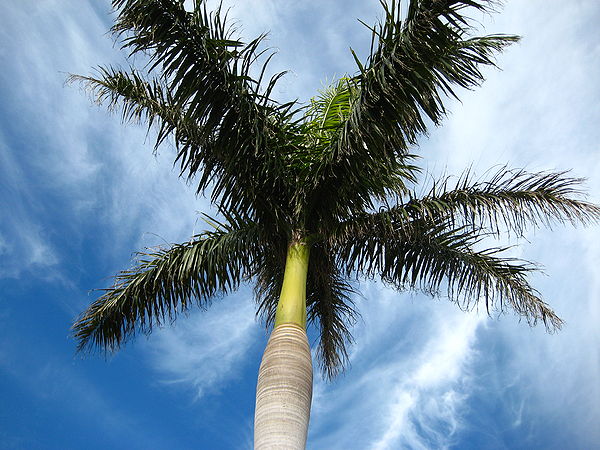
"Roystonea regia" At my brothers house. Via Benevento, On the Island of Venezia, New Smyrna Beach, Florida. edric.

11 months after 25 degrees, Venezia, on Quay Assisi, New Smyrna Bch, FL.

Hawaiian Tropical Botanical Garden

Royal on far left. Medellin, Colombia. (1,500 Mts. or 5,000 feet above see level), Photo by Jeff Anderson.

Medellin, Colombia. (1,500 Mts. or 5,000 feet above see level), Photo by Jeff Anderson.

Jamaica. Photo by Jeff Anderson.

Athens, Greece. Photo by Manolis.

Athens, Greece. Photo by Manolis.

Athens, Greece. Photo by Manolis.

Athens, Greece. Photo by Manolis.

Athens, Greece. Photo by Manolis.

India. Photo by Kumar.

Aswan Botanical Garden - on Kitchener's Island in the Nile, Aswan - Egypt. Photo by Karelj.

La Habra, California. Photo by Geoff Stein.

Orange County, California. Photo by Geoff Stein.

Westminster, California. Photo by Geoff Stein.

Huntington Gardens, Pasadena, California. Photo by Geoff Stein.

SoCal. Photo by Geoff Stein.

"In a humongous indoor greenhouse-convention center in Orlando, Florida (called Gaylord Palms)." Photo by Geoff Stein.

"Honolulu with crownshafts wrapped for saftey (a leaf can weigh over 50 lbs and kill someone below)." Note: the skinny trunk area just below the crown is called "pencil necking", from removing the petiole bases too early, instead of letting them fall off naturally. Photo by Geoff Stein.

SoCal. Photo by Geoff Stein.

"Nicely planted R. Regias very elegant, but not so common on Mauritius as the R. Oleraceas." Photo by timrann.

"Roystoneas in thick jungle habitat. Yumuri Valley, Cuba (1999)." Photo by basilio.

Photo by timrann.

Brownsville, Texas. Photo by broforest.

"one growing next to a king palm for comparison, San Diego Zoo, California." Photo by Geoff Stein.

Habitat.

Photo by mustangman.

Photo by mustangman.

Photo by mustangman.

Photo by mustangman.

Photo by mustangman.

Photo by mustangman.

Photo by mustangman.

Photo by mustangman.

Photo by mustangman.

Photo-Kew

"I saw quite a few Royals naturalizing along the Loxahatchee River in Jonathan Dickinson State Park, west of Jupiter. They were growing in the parts of the river were it was brackish, where you started seeing Mangroves mixed with Taxodium." Photo by Eric S., botanist; H.P. Leu Gardens, Orlando, FL.)

"I saw quite a few Royals naturalizing along the Loxahatchee River in Jonathan Dickinson State Park, west of Jupiter. They were growing in the parts of the river were it was brackish, where you started seeing Mangroves mixed with Taxodium." Photo by Eric S., botanist; H.P. Leu Gardens, Orlando, FL.)

"I saw quite a few Royals naturalizing along the Loxahatchee River in Jonathan Dickinson State Park, west of Jupiter. They were growing in the parts of the river were it was brackish, where you started seeing Mangroves mixed with Taxodium." Photo by Eric S., botanist; H.P. Leu Gardens, Orlando, FL.)

"In Homestead, Florida. I think this one is wild." Photo by Kyle Wicomb

South FL. "This is along the anthropogenic canal along SR 29 through the everglades." Photo by Kyle Wicomb

South FL. "This is along the anthropogenic canal along SR 29 through the everglades." Photo by Kyle Wicomb

South FL. "This is along the anthropogenic canal along SR 29 through the everglades." Photo by Kyle Wicomb

South FL. "This is along the anthropogenic canal along SR 29 through the everglades." Photo by Kyle Wicomb

South FL. "This is along the anthropogenic canal along SR 29 through the everglades." Photo by Kyle Wicomb

Group of Roystonea regia along McGregor Boulevard in Fort Myers, Florida. The tallest ones were planted by Thomas Edison in 1901. - Keith Zimmerman

Group of Roystonea regia in front of the old Manatee River Hotel in Bradenton, Florida. Planted in 1926. - Keith Zimmerman

Group of Roystonea regia at the Haley House in Palmetto, Florida. Planted in 1909. - Keith Zimmerman

Four Roystonea regia planted in 1910 at Emerson Point Preserve in Palmetto, Florida. Their seedlings are now naturalizing throughout the park. - Keith Zimmerman

There are a large number of Roystonea regia naturalizing at the Emerson Point Preserve in Palmetto, Florida. - Keith Zimmerman

There are a large number of Roystonea regia naturalizing at the Emerson Point Preserve in Palmetto, Florida. - Keith Zimmerman

There are a large number of Roystonea regia naturalizing at the Emerson Point Preserve in Palmetto, Florida. - Keith Zimmerman

There are a large number of Roystonea regia naturalizing at the Emerson Point Preserve in Palmetto, Florida. - Keith Zimmerman

Image Text: palmco.com

Image Text: floridata.com
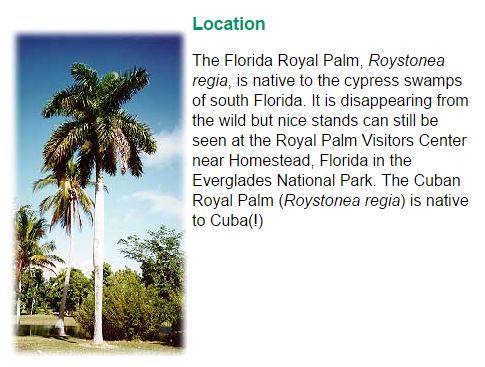
Image Text: floridata.com

Image Text: floridata.com

Image Text: junglemusic.net

Image Text: junglemusic.net


External Links
- Glossary of Palm Terms
- MODERN BOTANICAL LATIN
- "Just To Be Clear"
- http://southeastgarden.com/cuba.html
- http://www.geographylists.com/brazil_rio_botanical.html
- http://www.youtube.com/watch?v=MXaiJc5enDg
- http://www.palmtalk.org/forum/index.php?/topic/460-roystonea-regia-with-colourful-crownshafts/
References
Phonetic spelling of Latin names by edric.
Special thanks to Geoff Stein, (Palmbob) for his hundreds of photos.
Special thanks to Palmweb.org, Dr. John Dransfield, Dr. Bill Baker & team, for their volumes of information and photos.
Glossary of Palm Terms; Based on the glossary in Dransfield, J., N.W. Uhl, C.B. Asmussen-Lange, W.J. Baker, M.M. Harley & C.E. Lewis. 2008. Genera Palmarum - Evolution and Classification of the Palms. Royal Botanic Gardens, Kew. All images copyright of the artists and photographers (see images for credits).
Zona S.Roystonea.(Arecaceae: Arecoideae).
Many Special Thanks to Ed Vaile for his long hours of tireless editing and numerous contributions.