Difference between revisions of "Colpothrinax cookii"
| Line 1: | Line 1: | ||
__noeditsection__ | __noeditsection__ | ||
<google>CH02</google> | <google>CH02</google> | ||
| − | [[Image:Colpothrinax cookii large Ho.jpg|thumb|left| | + | [[Image:Colpothrinax cookii large Ho.jpg|thumb|left|400px|Ho'omaluhia, Hawaii]] |
{{Palmbox | {{Palmbox | ||
|image=1f2642.jpg | |image=1f2642.jpg | ||
| Line 31: | Line 31: | ||
Named Colpothrinax cookii in honor of Orator Fuller Cook, who, along with R. F. Griggs, first collected this species, and also first recognized that it represented a new taxon. The leaves of C. cookii, are sometimes used for thatching, and for making brooms. Local people in Honduras and Belize, have admitted to setting fire, to the mat of highly flammable leaf-sheath fibers, enclosing the trunks of some individuals, merely for the pyrotechnic display. | Named Colpothrinax cookii in honor of Orator Fuller Cook, who, along with R. F. Griggs, first collected this species, and also first recognized that it represented a new taxon. The leaves of C. cookii, are sometimes used for thatching, and for making brooms. Local people in Honduras and Belize, have admitted to setting fire, to the mat of highly flammable leaf-sheath fibers, enclosing the trunks of some individuals, merely for the pyrotechnic display. | ||
==External Links== | ==External Links== | ||
| + | *[http://eunops.org/content/glossary-palm-terms Glossary of Palm Terms] | ||
| + | *[http://www.plantapalm.com/wianame.htm Pronunciation Key] | ||
*http://www.lundkvistpalmgarden.com/Colpothrinax.html | *http://www.lundkvistpalmgarden.com/Colpothrinax.html | ||
==References== | ==References== | ||
Revision as of 03:47, 21 August 2012
<google>CH02</google>

| Colpothrinax cookii | |||||||
|---|---|---|---|---|---|---|---|
 | |||||||
| Scientific Classification | |||||||
| |||||||
| Synonyms | |||||||
|
| |||||||
| Native Continent | |||||||
 | |||||||
| Morphology | |||||||
| |||||||
| Culture | |||||||
|
| |||||||
| Survivability index | |||||||
|
| |||||||
| Common names | |||||||
|
| |||||||
Contents
Habitat and Distribution
Belize, Guatemala, and Honduras, 700-1,200(-1,600) m; typically in premontane, sometimes lower montane, wet forests on the Caribbean slope. Colpothrinax cookii, is restricted to the upper slopes and crests, of ridges of premontane wet forests, above 700 m elevation and, like C. aphanopetala, often occurs in association with Euterpe precatoria. Both staminate and pistillate anthesis in the strong-smelling, creamy yellow flowers of C. cookii, appear to occur while the reproductive parts, are still enclosed within the unopened corollas, suggesting beetle pollination.
Description
Colpothrinax cookii, differs from C. wrightii, in its cylindrical, non-swollen trunk, larger fruits, and seeds, and more persistent corolla lobes, which do not have a basal line of abscission. Its large, fleshy, yellow petals, and yellow higher-order inflorescence branches, differentiate it from C. aphanopetala. Colpothrinax cookii, cannot however, be differentiated from C. aphanopetala when sterile. Although C. cookii, often has larger leaves (blades and petioles), than C. aphanopetala, this tendency is not useful for identification purposes. Trunk (5-)10-20 m tall, erect, 15-25 cm dbh, columnar, usually naked, sometimes, particularly in closed forest, upper portion partially or completely enclosed in a mat of persistent leafsheath fibers; trunks of juveniles less than ca. 6-8 m tall usually completely enclosed in this mat; mat, when present, usually 20-30 cm thick. Leaves IS-ca. 30; petiole (1-)1.5-2.5(-3) m long, 2.3-3.4 cm wide at attachment to blade; sheath tomentose, the trichomes of two intermixed types: 1) soft, stellate trichomes, ca. 0.5 mm long, basally ferruginous, with free, white distal ends and 2) coarser, longer, wavy, twisted, compressed trichomes, these larger trichomes sparsest, shortest (ca. 1.5 mm long), and lightest in color (± tannish) on the basal portion of the sheath, becoming progressively denser, longer (to 9 mm long), and darker (rufous) distally; sheath disintegrating and fraying into fine, loosely woven, pendulous, filiform.
Culture
Shaded, moist, but well drained position. Quite slow growing.
Curiosities
Named Colpothrinax cookii in honor of Orator Fuller Cook, who, along with R. F. Griggs, first collected this species, and also first recognized that it represented a new taxon. The leaves of C. cookii, are sometimes used for thatching, and for making brooms. Local people in Honduras and Belize, have admitted to setting fire, to the mat of highly flammable leaf-sheath fibers, enclosing the trunks of some individuals, merely for the pyrotechnic display.
External Links
References
Special thanks to Geoff Stein, (Palmbob) for his hundreds of photos, edric.
- IMAGE GALLERY

Ho'omaluhia, Hawaii

Trunk Detail


Photo by Bo-Gran Lundkvist, edric.

Photo by Bo-Gran Lundkvist, edric.
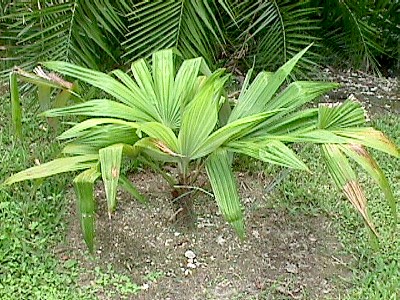


Photo by Bo-Gran Lundkvist, edric.

Photo by Bo-Gran Lundkvist, edric.

Photo by Bo-Gran Lundkvist, edric.

Photo by Bob Weas, edric.

Photo by Bob Weas, edric.


Many Special Thanks to Ed Vaile for his long hours of tireless editing and numerous contributions.