Difference between revisions of "Chamaedorea oreophila"
| Line 5: | Line 5: | ||
|image=Chamore0002.jpg | |image=Chamore0002.jpg | ||
|image_caption= | |image_caption= | ||
| − | |genus=Chamaedorea (kam-eh-DOR-eh-ah) | + | |genus=Chamaedorea <br>(kam-eh-DOR-eh-ah) |
|species=oreophila (or-eh-oh-FILL-ah) | |species=oreophila (or-eh-oh-FILL-ah) | ||
|subspecies= | |subspecies= | ||
| Line 27: | Line 27: | ||
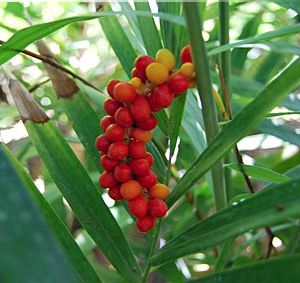
It differs from most Chamaedorea, as it sends out multiple bloom spikes from the same node on the trunk, long, ascending, unbranched inflorescences that reach well beyond the leaves. Most only send out one. It also has beautiful orange/red fruit which will remain on the plant for a long time before they fall off. The male plant has attractive cream/yellow "catkins" that hang down. | It differs from most Chamaedorea, as it sends out multiple bloom spikes from the same node on the trunk, long, ascending, unbranched inflorescences that reach well beyond the leaves. Most only send out one. It also has beautiful orange/red fruit which will remain on the plant for a long time before they fall off. The male plant has attractive cream/yellow "catkins" that hang down. | ||
| − | Habit: solitary, erect, 1-3 m tall. Stem: 0.6-2 cm in diam., green, minutely but conspicuously whites-potted, prominently ringed, internodes 1-6 cm long. Leaves: 5-13 per crown, erect-spreading, pinnate; sheath 10-25 cm long, fibrous, light green, densely white-spotted, white-margined, longitudinally green-striate-nerved, drying brown, durable, and ± persistent; petiole 7-35 cm long, light green with granulated white spots, slightly grooved above, rounded and pale green below; rachis 40-80 cm long, obtusely angled and light green above, rounded and pale green below; pinnae 14-25 on each side of rachis, 16-35 x 1.5-4 cm, narrowly lanceolate, falcate or slightly sigmoid, ± stiff and not drooping, acuminate apically, oblique basally, alternate or sub-alternate, 1.5 cm apart, dark lustrous green, prominent yellowish central midrib and 2 primary nerves on each side of this. Inflorescences: interfoliar, erect, spicate, long-pedunculate, exceeding leaves, very slender; peduncles 60-140 em long; bracts 6-10, upper one the largest and exceeding peduncle, to 37 cm long, slightly membranous or fibrous, acuminate, green in flower, green or brown in fruit. Staminate 4-8 per node; rachis or flower-bearing portion 10-30 cm long, 1 cm wide, pendulous, light yellow. Pistillate solitary at a node; rachis or flower-bearing portion 10-30 cm long, erect or horizontal in flower, becoming pendulous in fruit. Flowers: Staminate up to 300 per inflorescence, in dense spirals, contiguous, to 2.5-3 x 3.5 mm, ± deppressed-globose, irregularly angled by mutual pressure, slightly aromatic, yellow in bud, yellow to white at anthesis, ageing to brownish white; calyx 1-1.5 x 2.5-3.5 mm, lobed, membranous, green, brown-margined, sepals connate and/or imbricate basally rounded apically; petals 2-3 x 2-2.5 mm, oblong-obovate, valvate, connate basally, free apically, thin, slightly fleshy apically, slightly nerved on inside; stamens exceeding petals, filaments 2-3 mm high, cylindric, elongate, connate basally, pale yellow to greenish-orange, anthers 0.75-1 mm long, yellow; pistillode 2-2.5 mm high, slender, equalling stamens, 3-lobed apically. Pistillate up to 200 per inflorescence in dense spirals, crowded and nearly contiguous, 1-1.5 x 3 mm, flattened-globose to conic, light yellow; calyx 0.5 x 3 mm, deeply lobed, pale to light green, sepals connate and/or imbricate briefly basally, straight or broadly rounded apically; petals 1.5-2.25 x 2-4 mm, broadly triangular, briefly connate basally, imbricate nearly to apex, straight apically, fleshy, thick, slightly nerved on inside; pistil 1.5 x 2.53 mm, depressed-globose, yellowish to greenish with white spots, styles short or lacking, stigma lobes separated, angled, erect, exceeding petals, sometimes slightly recurved, pale or clear-colored. Fruits: 0.6-1.3 x 4-8 mm, ovoid-ellipsoid, greenish yellow changing to orange and then red when completely ripe, at times 2-3 adherent to one perianth, epicarp thin, slightly transparent, mesocarp thin, yellow-orange, endocarp slightly membranous, nerved; seeds 5.5-10 x 3.5-6.5 mm, ellipsoid | + | Habit: solitary, erect, 1-3 m tall. Stem: 0.6-2 cm in diam., green, minutely but conspicuously whites-potted, prominently ringed, internodes 1-6 cm long. Leaves: 5-13 per crown, erect-spreading, pinnate; sheath 10-25 cm long, fibrous, light green, densely white-spotted, white-margined, longitudinally green-striate-nerved, drying brown, durable, and ± persistent; petiole 7-35 cm long, light green with granulated white spots, slightly grooved above, rounded and pale green below; rachis 40-80 cm long, obtusely angled and light green above, rounded and pale green below; pinnae 14-25 on each side of rachis, 16-35 x 1.5-4 cm, narrowly lanceolate, falcate or slightly sigmoid, ± stiff and not drooping, acuminate apically, oblique basally, alternate or sub-alternate, 1.5 cm apart, dark lustrous green, prominent yellowish central midrib and 2 primary nerves on each side of this. Inflorescences: interfoliar, erect, spicate, long-pedunculate, exceeding leaves, very slender; peduncles 60-140 em long; bracts 6-10, upper one the largest and exceeding peduncle, to 37 cm long, slightly membranous or fibrous, acuminate, green in flower, green or brown in fruit. Staminate 4-8 per node; rachis or flower-bearing portion 10-30 cm long, 1 cm wide, pendulous, light yellow. Pistillate solitary at a node; rachis or flower-bearing portion 10-30 cm long, erect or horizontal in flower, becoming pendulous in fruit. Flowers: Staminate up to 300 per inflorescence, in dense spirals, contiguous, to 2.5-3 x 3.5 mm, ± deppressed-globose, irregularly angled by mutual pressure, slightly aromatic, yellow in bud, yellow to white at anthesis, ageing to brownish white; calyx 1-1.5 x 2.5-3.5 mm, lobed, membranous, green, brown-margined, sepals connate and/or imbricate basally rounded apically; petals 2-3 x 2-2.5 mm, oblong-obovate, valvate, connate basally, free apically, thin, slightly fleshy apically, slightly nerved on inside; stamens exceeding petals, filaments 2-3 mm high, cylindric, elongate, connate basally, pale yellow to greenish-orange, anthers 0.75-1 mm long, yellow; pistillode 2-2.5 mm high, slender, equalling stamens, 3-lobed apically. Pistillate up to 200 per inflorescence in dense spirals, crowded and nearly contiguous, 1-1.5 x 3 mm, flattened-globose to conic, light yellow; calyx 0.5 x 3 mm, deeply lobed, pale to light green, sepals connate and/or imbricate briefly basally, straight or broadly rounded apically; petals 1.5-2.25 x 2-4 mm, broadly triangular, briefly connate basally, imbricate nearly to apex, straight apically, fleshy, thick, slightly nerved on inside; pistil 1.5 x 2.53 mm, depressed-globose, yellowish to greenish with white spots, styles short or lacking, stigma lobes separated, angled, erect, exceeding petals, sometimes slightly recurved, pale or clear-colored. Fruits: 0.6-1.3 x 4-8 mm, ovoid-ellipsoid, greenish yellow changing to orange and then red when completely ripe, at times 2-3 adherent to one perianth, epicarp thin, slightly transparent, mesocarp thin, yellow-orange, endocarp slightly membranous, nerved; seeds 5.5-10 x 3.5-6.5 mm, ellipsoid. (Hodel, D.R. 1992) Editing by edric. |
Long-pedunculate inflorescences, erect and arching well beyond the leaves, and the pendulous flower-bearing spike with either densely packed, yellow to whitish flowers or showy red fruits easily distinguish C. oreophila. | Long-pedunculate inflorescences, erect and arching well beyond the leaves, and the pendulous flower-bearing spike with either densely packed, yellow to whitish flowers or showy red fruits easily distinguish C. oreophila. | ||
Revision as of 09:57, 6 March 2013
<google>CH02</google>

| Chamaedorea (kam-eh-DOR-eh-ah) oreophila (or-eh-oh-FILL-ah) | |||||||
|---|---|---|---|---|---|---|---|
 | |||||||
| Scientific Classification | |||||||
| |||||||
| Synonyms | |||||||
|
| |||||||
| Native Continent | |||||||
 | |||||||
| Morphology | |||||||
| |||||||
| Culture | |||||||
|
| |||||||
| Survivability index | |||||||
|
| |||||||
| Common names | |||||||
|
| |||||||
Contents
Habitat and Distribution
Mexico Gulf, Mexico Southwest. MEXICO. Veracruz. Oaxaca. Wet forest on the Atlantic slope; alt. 1,000-1,500 m elevation; often on limestone.
Description
It differs from most Chamaedorea, as it sends out multiple bloom spikes from the same node on the trunk, long, ascending, unbranched inflorescences that reach well beyond the leaves. Most only send out one. It also has beautiful orange/red fruit which will remain on the plant for a long time before they fall off. The male plant has attractive cream/yellow "catkins" that hang down.
Habit: solitary, erect, 1-3 m tall. Stem: 0.6-2 cm in diam., green, minutely but conspicuously whites-potted, prominently ringed, internodes 1-6 cm long. Leaves: 5-13 per crown, erect-spreading, pinnate; sheath 10-25 cm long, fibrous, light green, densely white-spotted, white-margined, longitudinally green-striate-nerved, drying brown, durable, and ± persistent; petiole 7-35 cm long, light green with granulated white spots, slightly grooved above, rounded and pale green below; rachis 40-80 cm long, obtusely angled and light green above, rounded and pale green below; pinnae 14-25 on each side of rachis, 16-35 x 1.5-4 cm, narrowly lanceolate, falcate or slightly sigmoid, ± stiff and not drooping, acuminate apically, oblique basally, alternate or sub-alternate, 1.5 cm apart, dark lustrous green, prominent yellowish central midrib and 2 primary nerves on each side of this. Inflorescences: interfoliar, erect, spicate, long-pedunculate, exceeding leaves, very slender; peduncles 60-140 em long; bracts 6-10, upper one the largest and exceeding peduncle, to 37 cm long, slightly membranous or fibrous, acuminate, green in flower, green or brown in fruit. Staminate 4-8 per node; rachis or flower-bearing portion 10-30 cm long, 1 cm wide, pendulous, light yellow. Pistillate solitary at a node; rachis or flower-bearing portion 10-30 cm long, erect or horizontal in flower, becoming pendulous in fruit. Flowers: Staminate up to 300 per inflorescence, in dense spirals, contiguous, to 2.5-3 x 3.5 mm, ± deppressed-globose, irregularly angled by mutual pressure, slightly aromatic, yellow in bud, yellow to white at anthesis, ageing to brownish white; calyx 1-1.5 x 2.5-3.5 mm, lobed, membranous, green, brown-margined, sepals connate and/or imbricate basally rounded apically; petals 2-3 x 2-2.5 mm, oblong-obovate, valvate, connate basally, free apically, thin, slightly fleshy apically, slightly nerved on inside; stamens exceeding petals, filaments 2-3 mm high, cylindric, elongate, connate basally, pale yellow to greenish-orange, anthers 0.75-1 mm long, yellow; pistillode 2-2.5 mm high, slender, equalling stamens, 3-lobed apically. Pistillate up to 200 per inflorescence in dense spirals, crowded and nearly contiguous, 1-1.5 x 3 mm, flattened-globose to conic, light yellow; calyx 0.5 x 3 mm, deeply lobed, pale to light green, sepals connate and/or imbricate briefly basally, straight or broadly rounded apically; petals 1.5-2.25 x 2-4 mm, broadly triangular, briefly connate basally, imbricate nearly to apex, straight apically, fleshy, thick, slightly nerved on inside; pistil 1.5 x 2.53 mm, depressed-globose, yellowish to greenish with white spots, styles short or lacking, stigma lobes separated, angled, erect, exceeding petals, sometimes slightly recurved, pale or clear-colored. Fruits: 0.6-1.3 x 4-8 mm, ovoid-ellipsoid, greenish yellow changing to orange and then red when completely ripe, at times 2-3 adherent to one perianth, epicarp thin, slightly transparent, mesocarp thin, yellow-orange, endocarp slightly membranous, nerved; seeds 5.5-10 x 3.5-6.5 mm, ellipsoid. (Hodel, D.R. 1992) Editing by edric.
Long-pedunculate inflorescences, erect and arching well beyond the leaves, and the pendulous flower-bearing spike with either densely packed, yellow to whitish flowers or showy red fruits easily distinguish C. oreophila. Martius described and named C. oreophila from material that Liebmann had collected in the 1840s in Oaxaca, Mexico. Liebmann (1846) had suggested the name Stachyophorbe montana for this material. However, Martius (1849) felt that Stachyophorbe was simply the same as Chamaedorea and, accordingly, used this latter name. Martius was precluded from using the epithet montana since, in the same paper, he had already used it for another Liebmann collection from Oaxaca. Martius did, though, respect Liebmann's intent for the epithet montana since he replaced it with oreophila, derived from a Greek word meaning mountain-loving. Oersted (1859) continued to maintain Stachyophorbe separate from Chamaedorea. Long-pedunculate inflorescences, erect and arching well beyond the leaves, and the pendulous flower-bearing spike with either densely packed, yellow to whitish flowers or showy red fruits easily distinguish C. oreophila.? Martius described and named C. oreophila from material that Liebmann had collected in the 1840s in Oaxaca, Mexico. Liebmann (1846) had suggested the name Stachyophorbe montana for this material. However, Martius (1849) felt that Stachyophorbe was simply the same as Chamaedorea and, accordingly, used this latter name. Martius was precluded from using the epithet montana since, in the same paper, he had already used it for another Liebmann collection from Oaxaca. Martius did, though, respect Liebmann's intent for the epithet montana since he replaced it with oreophila, derived from a Greek word meaning mountain-loving. Oersted (1859) continued to maintain Stachyophorbe separate from Chamaedorea. Later, Burret (1933a) described and named C. monostachys, based on collections of Seier and Galeotti in Veracruz, Mexico. In an earlier paper (Hodel 1990d), I treated C. monostachys as a synonym of C. oreophila, a possibility to which Burret, himself, alluded. Some material of C. oreophila in cultivation is erroneously referred to as C. cataractarum or, more infrequently, C. atrovirens. Krempin (1990, p. 93) illustrated C. elegans at Fairchild Tropical Garden in Miami, Florida but erroneously captioned the photograph as C. monostachys. Fairly common in cultivation, C. oreophila appears in gardens and collections in Hawaii, California, Florida, and Australia. It is somewhat susceptible to infestation of thrips, especially on undersides of pinnae near the new, emerging leaf. Severe infestations result in defoliation and, in some instances, death of the plant. (Hodel, D.R. 1992)
Culture
Requirements: Full shade to filtered light when young, filtered light to partial shade when mature. Consistently moist soil, well drained position. Often planted in groupings. Cold hardy to below 25`F. with cover. It makes a pretty potted plant and does well outside under some canopy in the warm temperate garden. Likes it very humid.
Comments and Curiosities
Chamaedorea are dioecious, male, and female flowers, on separate plants.
Etymology: From the Greek oreophilus meaning mountain-loving, in reference to the habitat.
External Links
References
Phonetic spelling of Latin names by edric.
Special thanks to Geoff Stein, (Palmbob) for his hundreds of photos, edric.
Special thanks to palmweb.org, Dr. John Dransfield, Dr. Bill Baker & team, for their volumes of information and photos, edric.
- IMAGE GALLERY


So. California. Chamaedorea oreophila (pinnate) with Chamaedorea nubium (bifid).




Male flower.

Male flower.

Male flower.

Photo by Colin Wilson, edric.

Photo by Colin Wilson, edric.

So. California. Chamaedorea oreophila (pinnate) with Chamaedorea nubium (bifid).


Many Special Thanks to Ed Vaile for his long hours of tireless editing and numerous contributions.