Difference between revisions of "Chuniophoenix hainanensis"
| Line 25: | Line 25: | ||
It is found only in the Sub-tropical rainforest on Hainan Island, Southern China.. Its natural habitats are subtropical or tropical moist lowland forests and subtropical or tropical moist montane forests. It is threatened by habitat loss. | It is found only in the Sub-tropical rainforest on Hainan Island, Southern China.. Its natural habitats are subtropical or tropical moist lowland forests and subtropical or tropical moist montane forests. It is threatened by habitat loss. | ||
==Description== | ==Description== | ||
| − | Very ornamental clustering palmate palm, with remarkably white petioles and undersides of leaves. stems up to 4m tall and 15cm in diameter, and with large, deeply cut leaves up to 120cm across. leaves are much more divided and spread out than in the other Chuniophoenix: nana. No spines are sharp edges on this plant. Stems are about 4-5cm in diameter. This palm grows to well over 10' tall in a tropical climate, but it is unknown how tall it can grow in a Mediterranean climate such as Southern California, where its growth rate is a tiny fraction of what it is in the tropics.[[User:Palmbob|Palmbob]] 17:52, 18 September 2007 (PDT) Editing by edric. | + | Very ornamental clustering palmate palm, with remarkably white petioles and undersides of leaves. stems up to 4m tall and 15cm in diameter, and with large, deeply cut leaves up to 120cm across. leaves are much more divided and spread out than in the other Chuniophoenix: nana. No spines are sharp edges on this plant. Stems are about 4-5cm in diameter. This palm grows to well over 10' tall in a tropical climate, but it is unknown how tall it can grow in a Mediterranean climate such as Southern California, where its growth rate is a tiny fraction of what it is in the tropics. [[User:Palmbob|Palmbob]] 17:52, 18 September 2007 (PDT) Editing by edric. |
==Culture== | ==Culture== | ||
Southern California experience: | Southern California experience: | ||
Revision as of 00:41, 1 May 2013
<google>CH02</google>

| Chuniophoenix (choo-nee-oh-FEE-niks) hainanensis (hy-nahn-EN-sis) | |||||||
|---|---|---|---|---|---|---|---|
 Big Island, Hawaii. | |||||||
| Scientific Classification | |||||||
| |||||||
| Synonyms | |||||||
|
| |||||||
| Native Continent | |||||||
 | |||||||
| Morphology | |||||||
| |||||||
| Culture | |||||||
|
| |||||||
| Survivability index | |||||||
|
| |||||||
| Common names | |||||||
|
| |||||||
Contents
Habitat and Distribution
It is found only in the Sub-tropical rainforest on Hainan Island, Southern China.. Its natural habitats are subtropical or tropical moist lowland forests and subtropical or tropical moist montane forests. It is threatened by habitat loss.
Description
Very ornamental clustering palmate palm, with remarkably white petioles and undersides of leaves. stems up to 4m tall and 15cm in diameter, and with large, deeply cut leaves up to 120cm across. leaves are much more divided and spread out than in the other Chuniophoenix: nana. No spines are sharp edges on this plant. Stems are about 4-5cm in diameter. This palm grows to well over 10' tall in a tropical climate, but it is unknown how tall it can grow in a Mediterranean climate such as Southern California, where its growth rate is a tiny fraction of what it is in the tropics. Palmbob 17:52, 18 September 2007 (PDT) Editing by edric.
Culture
Southern California experience: This is one of two species of Chuniophoenix, and though it is the larger one, it is by far the more slow-growing. Palms take many years to even reach 4' in height, which is only 1/2 or less of their potential height. It is surprisingly cold tolerant handling temps in the mid 20Fs for extended periods of time with little or no damage. I don't think the true low temp is known yet. It likes a lot of water, and is not too happy about full sun, particularly in inland climates. Wind shreds the leaves a bit, but it is surprisingly tolerant otherwise.Palmbob 17:49, 18 September 2007 (PDT)
Comments and Curiosities
A very special palm from Hainan Island, China which everyone will want to grow. It is probably one of the best palms for container growing and is excellent in the conservatory. In warm temperate to tropical areas, it makes a superb specimen palm and with its deeply cut fan-shaped leaves, it resembles nothing more than a huge Rhapis excelsa. However, in summer, large bunches of bright red, cherry-size fruits are produced, transforming it from the merely unusual to the frankly spectacular. Bushy in habit, its maximum height is only about 10-15 feet. (RPS.com). edric.
This is a tillering palm, it exhibits saxophone style root growth (it has a heel), keep top third of heel above soil elevation!
External Links
- Glossary of Palm Terms
- MODERN BOTANICAL LATIN
- "Just To Be Clear"
- http://www.palms.org/principes/1998/chuniophoenix.htm
- http://www.coldplant.com/plantlist.asp?ArticleID=92
- THE SAXOPHONE STYLE ROOT GROWTH (HEEL)
References
Phonetic spelling of Latin names by, edric.
Special thanks to Geoff Stein, (Palmbob) for his hundreds of photos, edric.
Special thanks to palmweb.org, Dr. John Dransfield, Dr. Bill Baker & team, for their volumes of information and photos, edric.
- IMAGE GALLERY

South China Botanic Garden, China. Photo by Dr. John Dransfield, edric.

Guangzhou, China. Photo by Dr. John Dransfield, edric.

Base of leaf showing lack of hastula. Guangzhou, China. Photo by Dr. John Dransfield, edric.

Guangzhou, China. Photo by Dr. John Dransfield, edric.

Big Island, Hawaii.

Big Island, Hawaii.

Big Island, Hawaii.

Big Island, Hawaii.

Sullivan Garden, Photo JD Andersen.


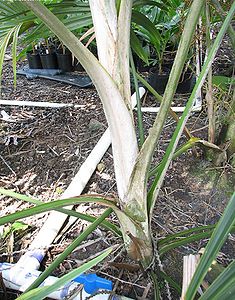


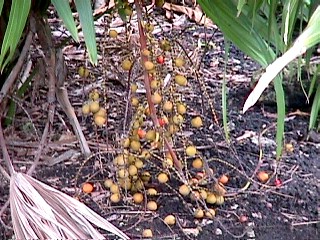


Photo by Luke Nancarrow.


Many Special Thanks to Ed Vaile for his long hours of tireless editing and numerous contributions.