Difference between revisions of "Roystonea regia"
| Line 109: | Line 109: | ||
Glossary of Palm Terms; Based on the glossary in Dransfield, J., N.W. Uhl, C.B. Asmussen-Lange, W.J. Baker, M.M. Harley & C.E. Lewis. 2008. Genera Palmarum - Evolution and Classification of the Palms. Royal Botanic Gardens, Kew. All images copyright of the artists and photographers (see images for credits). | Glossary of Palm Terms; Based on the glossary in Dransfield, J., N.W. Uhl, C.B. Asmussen-Lange, W.J. Baker, M.M. Harley & C.E. Lewis. 2008. Genera Palmarum - Evolution and Classification of the Palms. Royal Botanic Gardens, Kew. All images copyright of the artists and photographers (see images for credits). | ||
| + | |||
| + | Zona S.Roystonea.(Arecaceae: Arecoideae). | ||
{{SpeciesListBackLink}} | {{SpeciesListBackLink}} | ||
[[Category:ROYSTONEA|regia]] | [[Category:ROYSTONEA|regia]] | ||
Revision as of 02:02, 16 May 2014
Cuban Royal Palm, Royal Palm
| Roystonea (roy-STOHN-eh-ah) regia (reh-GEE-ah) | |||||||
|---|---|---|---|---|---|---|---|
 "Roystonea regia" Rare purple crownshaft, Junta del Puerto - Santa Cruz de Tenerife, Spain. Photo - Carlo Morici. edric. | |||||||
| Scientific Classification | |||||||
| |||||||
| Synonyms | |||||||
|
| |||||||
| Native Continent | |||||||
 | |||||||
| Morphology | |||||||
| |||||||
| Culture | |||||||
|
| |||||||
| Survivability index | |||||||
|
| |||||||
| Common names | |||||||
|
| |||||||
Contents
Habitat and Distribution
Roystonea regia is found in; Bahamas, Belize, Cayman Is., Cuba, Florida, Honduras, Mexico Gulf, Mexico Southeast, Panamá (World Checklist of Monocotyledons) Abundantly distributed throughout the hillsides and valleys of Cuba and the hammocks of the Everglades in Collier, Dade, and Monroe Counties, Florida, U.S.A. (Small, 1928; Austin et al., 1980; Jones, 1983). Also present in the Yucatan Peninsula and Gulf Coastal Mexico, Belize, and Honduras. Indigenous populations also exist in the Cayman Islands. This species appears to be the palm found by Gillis et a1. (1975) in the Bahamas. This taxon is very commonly cultivated throughout the tropics and subtropics and apparently naturalizes with ease. (Zona S.)/Palmweb.

Description
Trunk gray-white, to 20(-30) m tall, 37-57.5 cm in diam. Leaves about 15 in the crown, lowest leaves hanging below the horizontal; crownshaft about 2 m long; rachis about 4 m long; middle segments 63- 119 cm long and 2.5-4.6 cm wide. Inflorescence about 1 m long and 1 m wide; prophyll about 36 cm long and 7.3 cm wide; peduncular bract 0.8-1 .6 m long and 9.8-13 cm wide, widest at the middle, apex acuminate; rachillae 11-31 cm long and 0.9-2.3 mm in diam. Staminate flowers white; sepals triangular, 0.8-1.4 mm long and 0.9-2 mm wide; petals elliptical 10 ovate, 3.5-6.4 mm long and 2.2-3.5 mm wide; stamens 6-9, 3.2-7.5 mm long; filaments awl-shaped, 2.3-5.6 mm long; anthers 2.4-4.5 mm long; pistillode minute. Pistillate flowers white,2-4.5 per cm; sepals reniform, 0.7-1 .8 mm long and 1.8-3.4 mm wide; petals ovate, 2.7-3.7 mm long mm; gynoecium 1.1-3.5 mm long and 0.9-2.6 mm in diam. Fruits spheroid to ellipsoid, somewhat dorsiventrally compressed, 8.9-15.1 mm long, 6.9-11.2 mm dorsiventral thickness, and 7-10.9 mm wide; epicarp purplish black, stigmatic scar plain; endocarp ellipsoid, 7.5-11.1 mm long, 6-7.7 mm dorsi ventral thickness, and 5.8-7.9 mm wide; seed ellipsoid, somewhat dorsiventrally compressed, 5.5-9.7 mm long, 4-6.3 mm dorsiventral thickness, and 5.1-7.2 mm wide; raphe circular. Eophyll linear-lanceolate, 13.5-19 cm long and 1.3-1.5 cm wide, exstipitate, weakly costate. n = 18 (Sharma & Sarkar, 1957). (Zona S.)/Palmweb. Editing by edric.
| read more |
|---|
|
The nomenclature of the Cuban royal palm is fraught with enough synonyms and inadequate descriptions to confound and bewilder those unfamiliar with the long history of this species. The most significant controversy involves the populations of this species that occur in southern Florida, U.S.A., which have over the years been assigned either to R. regia or R. elata. I have been unable to discern any morphological differences between palms representing the Floridian R. elata and those representing the Cuban R. regia. For this reason they are recognized as a single taxon; regrettably, the lesser-known name (R. etala) has nomenclatural priority. Because of the cultural and horticultural importance of this species, long known as R. regia, a proposal has been made to conserve the name R. regia over R. etala (Zona, 1994). The historical distribution of this species in the United States-far north of is present range in what is now Putnam, Lake, and Volusia Counties, Florida was discussed by Small ( 1937). Cooper (1861) believed that severe winter weather in 1835 may have extirpated more northerly populations. Small (1937) added that freezes in 1894-1895 as well as exploitation of palm wood for the manufacture of walking sticks eliminated Roystonea from north-central Florida. Central American populations of R. regia, long known as R. regia var. hondurensis, do not differ substantially from the Cuban populations. Central American populations may have somewhat shorter peduncular bracts, but this structure is not often collected, and what few collections exist overlap in size to the extent that two populations cannot be reliably discerned. The Mexican and Central American populations seem to have a slightly elongated fruit, more elongated than the Cuban populations and approaching R. dunlapiana with which it overlaps in range, but the two can immediately be distinguished by their peduncular bracts. A conservative taxonomy is adopted here, and the Central American and Mexican variety is not recognized as distinct. Roystonea jenmanii is represented by two original collections, each bearing Jenman's number 2057, but one was collected in 1884 and is annotated " Euterpe sp. nov.?" while the other was collected in June 1899 and is annotated "Euterpe jenmanii." Oddly enough, the two collections appear to represent two species. The 1884 specimen is designated as the lectotype; it matches Raystonea regia , hence R. jenmanii is synonymized here. The second collection, from June 1899, appears to be R. borinquena on the bas is of noral density on the rachillae. Although the jenmanii epithet predates Cook's R. borinquena, the latter name stands as the result of the lectotypi fication and synonymization based on the 1884 specimen. This is the most commonly encountered taxon in cultivation. Cultivated individuals and their descendants have been mistaken for indigenous populations in Panama (e.g., Beccari , 1912), Costa Rica, Guyana, and elsewhere. (Zona S.)/Palmweb. |
Culture
"We have some FL royals grown from wild collected seed. They don't show any less or more hardiness than R. regia. In fact several Roystonea we are growing have had the same hardiness; borinquena, "eleata", regia, princeps and violacea. R. oleracea is more tender." (Eric S., botanist; H.P. Leu Gardens, Orlando, FL.), edric.
Curiosities
Uses: It is used in Cuba for timber, thatch, and hog feed. It is very popular as a cultivated ornamental. (Zona S.)/Palmweb.
In Peru the leaf is used in preparing a decoction, for Medicinal and Veterinary purposes, in treating the Nervous system and mental health, and also as a aid to treat the Digestive system.
- IMAGE GALLERY

Roystonea regia flowering in Spring Valley, CA.

In habitat.

"Roystonea regia" Rare red crownshaft, Junta del Puerto - Santa Cruz de Tenerife, Spain. Photo by Carlo Morici. edric.

"Roystonea regia" Rare purple crownshaft, Junta del Puerto - Santa Cruz de Tenerife, Spain. Photo by Carlo Morici. edric.

"Roystonea regia" Rare variegated crownshaft, Cape Coaral, Florida.

"Roystonea regia" Rare variegated crownshaft, Cape Coral, Florida.
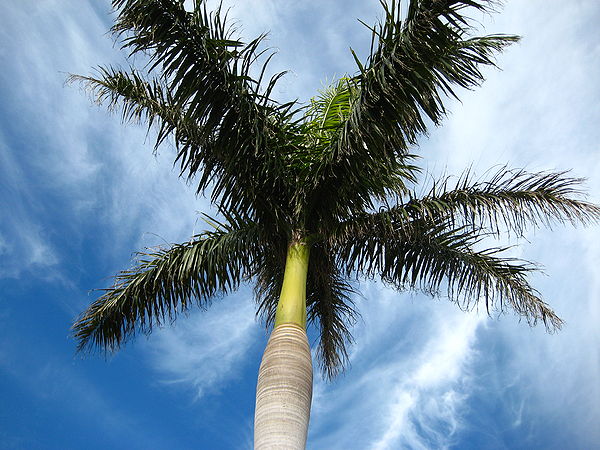
"Roystonea regia" At my brothers house. Via Benevento, On the Island of Venezia, New Smyrna Beach, Florida. edric.

11 months after 25 degrees, Venezia, on Quay Assisi, New Smyrna Bch, FL. edric.

11 months after 25 degrees, Venezia, on Quay Assisi, New Smyrna Bch, FL. edric.

11 months after 25 degrees, Venezia, on Quay Assisi, New Smyrna Bch, FL. edric.

11 months after 25 degrees, Venezia, on Quay Assisi, New Smyrna Bch, FL. edric.

Florida. Photo by Dr. John Dransfield, edric.

Fakahatchee Swamp, Florida. Photo by Dr. P. Cribb, edric.

Hawaiian Tropical Botanical Garden, edric.

Guantanamo province, Cuba. Photo by Jason Schoneman, edric.

A Coconut on either side. Guantanamo province, Cuba. Photo by Jason Schoneman, edric.

Guantanamo province, Cuba. Photo by Jason Schoneman, edric.

Guantanamo province, Cuba. Photo by Jason Schoneman, edric.

Guantanamo province, Cuba. Photo by Jason Schoneman, edric.

Guantanamo province, Cuba. Photo by Jason Schoneman, edric.

Guantanamo province, Cuba. Photo by Jason Schoneman, edric.

Sancti Spiritus province, Cuba. Photo by Jason Schoneman, edric.

Pinar del Rio, Cuba. Photo by Jason Schoneman, edric.

Probably R. regia, the two short ones, front left, and far right are Cocos nucifera. Cienfuegos Botanical Garden, Cuba. Photo by Jason Schoneman, edric.

Royal on far left. Medellin, Columbia. (1,500 Mts. or 5,000 feet above see level), Photo by Jeff Anderson, edric.

Medellin, Columbia. (1,500 Mts. or 5,000 feet above see level), Photo by Jeff Anderson, edric.

Jamaica. Photo by Jeff Anderson, edric.

Athens, Greece. Photo by Manolis, edric.

Athens, Greece. Photo by Manolis, edric.

Athens, Greece. Photo by Manolis, edric.

Athens, Greece. Photo by Manolis, edric.

Athens, Greece. Photo by Manolis, edric.

Harold L. Lyon Arboretum, a 200-acre arboretum in Mānoa Valley, Honolulu, Oahu, Hawaii. "Kim giving scale." Photo by BGL, edric.

Harold L. Lyon Arboretum, a 200-acre arboretum in Mānoa Valley, Honolulu, Oahu, Hawaii. Photo by BGL, edric.

Harold L. Lyon Arboretum, a 200-acre arboretum in Mānoa Valley, Honolulu, Oahu, Hawaii. Photo by BGL, edric.

"I saw quite a few Royals naturalizing along the Loxahatchee River in Jonathan Dickinson State Park, west of Jupiter. They were growing in the parts of the river were it was brackish, where you started seeing Mangroves mixed with Taxodium." Photo by Eric S., botanist; H.P. Leu Gardens, Orlando, FL.), edric.

"I saw quite a few Royals naturalizing along the Loxahatchee River in Jonathan Dickinson State Park, west of Jupiter. They were growing in the parts of the river were it was brackish, where you started seeing Mangroves mixed with Taxodium." Photo by Eric S., botanist; H.P. Leu Gardens, Orlando, FL.), edric.

"I saw quite a few Royals naturalizing along the Loxahatchee River in Jonathan Dickinson State Park, west of Jupiter. They were growing in the parts of the river were it was brackish, where you started seeing Mangroves mixed with Taxodium." Photo by Eric S., botanist; H.P. Leu Gardens, Orlando, FL.), edric.

South FL. "This is along the anthropogenic canal along SR 29 through the everglades." Photo by Kyle Wicomb, edric.

South FL. "This is along the anthropogenic canal along SR 29 through the everglades." Photo by Kyle Wicomb, edric.

South FL. "This is along the anthropogenic canal along SR 29 through the everglades." Photo by Kyle Wicomb, edric.

"I had to climb into a Live Oak to take this photo! Matheson Hammock in Miami-Dade County in Coral Gables." Photo by Kyle Wicomb, edric.

"These are some of the tallest ones I have ever seen! Matheson Hammock in Miami-Dade County in Coral Gables." Photo by Kyle Wicomb, edric.

"Matheson Hammock in Miami-Dade County in Coral Gables." Photo by Kyle Wicomb, edric.

South FL. "This is along the anthropogenic canal along SR 29 through the everglades." Photo by Kyle Wicomb, edric.

South FL. "This is along the anthropogenic canal along SR 29 through the everglades." Photo by Kyle Wicomb, edric.

"I thought it was incongruent to see liquidambar styraciflua and roystonea regia side by side along SR 29. This is actually the first group of palms you see as you're driving south to the everglades!" Photo by Kyle Wicomb, edric.

"Here are some cold damaged Roystonea regia (2010), growing in the Fakahatchee Strand in the Florida Everglades. Janes Memorial Scenic Drive." Photo by Kyle Wicomb, edric.

"Here are some cold damaged Roystonea regia (2010), growing in the Fakahatchee Strand in the Florida Everglades. Janes Memorial Scenic Drive." Photo by Kyle Wicomb, edric.

"In Homestead, Florida. I think this one is wild." Photo by Kyle Wicomb, edric.

Photo-Kew, edric.


External Links
- Glossary of Palm Terms
- MODERN BOTANICAL LATIN
- "Just To Be Clear"
- http://southeastgarden.com/cuba.html
- http://www.geographylists.com/brazil_rio_botanical.html
References
Phonetic spelling of Latin names by edric.
Special thanks to Geoff Stein, (Palmbob) for his hundreds of photos.
Special thanks to Palmweb.org, Dr. John Dransfield, Dr. Bill Baker & team, for their volumes of information and photos.
Glossary of Palm Terms; Based on the glossary in Dransfield, J., N.W. Uhl, C.B. Asmussen-Lange, W.J. Baker, M.M. Harley & C.E. Lewis. 2008. Genera Palmarum - Evolution and Classification of the Palms. Royal Botanic Gardens, Kew. All images copyright of the artists and photographers (see images for credits).
Zona S.Roystonea.(Arecaceae: Arecoideae).
Many Special Thanks to Ed Vaile for his long hours of tireless editing and numerous contributions.