Difference between revisions of "Chamaedorea elegans"
| Line 24: | Line 24: | ||
==Description== | ==Description== | ||
Habit: solitary, slender, erect or infrequently decumbent, to 2 m tall or more but flowering when very small and less than 30 cm tall, then appearing stemless. Stem: 0.8-1.5 cm in diam., green, densely ringed with prominent nodes, internodes 0.5-3 cm long. Leaves: 5-8 per crown, spreading, pinnate; sheath 8-20 cm long, very obliquely open nearly to base and tubular only in lower 1/3, short ligule apically on either side of petiole, margins brownish and ragged, light green or whitish below margin, longitudinally greenstriate-nerved; petiole 10-40 cm long, slender, grooved and green above, rounded and pale below; rachis 15-60 cm long, very slender, 4-sided, angled and green above, rounded below with narrow yellow band extending onto petiole; pinnae 11-21 on each side of rachis, 15-30 x 1-3 cm, linear to narrowly lanceolate, long-acuminate, contracted basally, thin, dark green, midrib prominent and pale, elevated or keeled above, 1-2 less prominent primary nerves on each side of midrib, secondaries numerous, faint. Inflorescences: interfoliar, erect, shorter than or equal to or greatly exceeding leaves; peduncles 15-90 cm long, 5-9 mm wide at base, ± flattened, 4-6 mm wide at apex, rounded, green where exposed in flower, red-orange in fruit. Staminate with 4-7 bracts, upper most exceeding peduncle, largest to 35 cm long, acuminate and bifid apically, fibrous or ± papery, longitudinally striate nerved, brown in flower; rachis 1.5-20 cm long, longitudinally ridged or angled, green; rachillae 5-35, lower ones the longest, these to 15 cm long, becoming progressively shorter toward apex of rachis, 2 mm in diam., spreading, simple or branched, sharply angled, green. Pistillate similar to that of staminate but with 6-10 bracts; rachis slightly shorter, flexuous, orange in fruit; rachillae fewer in number and shorter than those of staminate, to 10 cm long, ± stiff, green in flower, red-orange in fruit. Flowers: Staminate in remote to moderate spirals, 3 x 4 mm, depressed-globose, yellow, aromatic, nerved when dry, sessile or slightly sunken in elliptic depressions; calyx 0.75-1 x 2-2.5 mm, moderately lobed, green, sepals connate in basal '12, rounded apically; petals 2.5 x 2 mm, connate, corolla opening by a 3-angled pore apically, fleshy; stamens 1.5-2 mm long, filaments connate, whitish, anthers 0.75-1 mm long, entire, yellow; pistillode equal to or slightly exceeding corolla, 6-angled, flared slightly apically, pale yellow-green. Pistillate in remote spirals, 3 x 2.75 mm, globose, yellow, nerved when dry, slightly sunken in elliptic depressions 1-1.5 mm long; calyx 1 x 2 mm, deeply lobed, green, sepals connate in basal 1/3, rounded to acute apically; petals 2-2.5 x 1.5-2 mm, connate, corolla opening by a 3-angled pore apically, thick, fleshy; staminodes lacking; pistal 2 x 1-1.5 mm, depressed-globose, green; stigma lobes separated, sessile, blunt, clear-colored. Fruits: 4-7 mm in diam., globose, black; seeds 3-6 mm in diam., globose; eophyll pinnate. (Hodel, D.R. 1992)/Palmweb. Editing by edric. | Habit: solitary, slender, erect or infrequently decumbent, to 2 m tall or more but flowering when very small and less than 30 cm tall, then appearing stemless. Stem: 0.8-1.5 cm in diam., green, densely ringed with prominent nodes, internodes 0.5-3 cm long. Leaves: 5-8 per crown, spreading, pinnate; sheath 8-20 cm long, very obliquely open nearly to base and tubular only in lower 1/3, short ligule apically on either side of petiole, margins brownish and ragged, light green or whitish below margin, longitudinally greenstriate-nerved; petiole 10-40 cm long, slender, grooved and green above, rounded and pale below; rachis 15-60 cm long, very slender, 4-sided, angled and green above, rounded below with narrow yellow band extending onto petiole; pinnae 11-21 on each side of rachis, 15-30 x 1-3 cm, linear to narrowly lanceolate, long-acuminate, contracted basally, thin, dark green, midrib prominent and pale, elevated or keeled above, 1-2 less prominent primary nerves on each side of midrib, secondaries numerous, faint. Inflorescences: interfoliar, erect, shorter than or equal to or greatly exceeding leaves; peduncles 15-90 cm long, 5-9 mm wide at base, ± flattened, 4-6 mm wide at apex, rounded, green where exposed in flower, red-orange in fruit. Staminate with 4-7 bracts, upper most exceeding peduncle, largest to 35 cm long, acuminate and bifid apically, fibrous or ± papery, longitudinally striate nerved, brown in flower; rachis 1.5-20 cm long, longitudinally ridged or angled, green; rachillae 5-35, lower ones the longest, these to 15 cm long, becoming progressively shorter toward apex of rachis, 2 mm in diam., spreading, simple or branched, sharply angled, green. Pistillate similar to that of staminate but with 6-10 bracts; rachis slightly shorter, flexuous, orange in fruit; rachillae fewer in number and shorter than those of staminate, to 10 cm long, ± stiff, green in flower, red-orange in fruit. Flowers: Staminate in remote to moderate spirals, 3 x 4 mm, depressed-globose, yellow, aromatic, nerved when dry, sessile or slightly sunken in elliptic depressions; calyx 0.75-1 x 2-2.5 mm, moderately lobed, green, sepals connate in basal '12, rounded apically; petals 2.5 x 2 mm, connate, corolla opening by a 3-angled pore apically, fleshy; stamens 1.5-2 mm long, filaments connate, whitish, anthers 0.75-1 mm long, entire, yellow; pistillode equal to or slightly exceeding corolla, 6-angled, flared slightly apically, pale yellow-green. Pistillate in remote spirals, 3 x 2.75 mm, globose, yellow, nerved when dry, slightly sunken in elliptic depressions 1-1.5 mm long; calyx 1 x 2 mm, deeply lobed, green, sepals connate in basal 1/3, rounded to acute apically; petals 2-2.5 x 1.5-2 mm, connate, corolla opening by a 3-angled pore apically, thick, fleshy; staminodes lacking; pistal 2 x 1-1.5 mm, depressed-globose, green; stigma lobes separated, sessile, blunt, clear-colored. Fruits: 4-7 mm in diam., globose, black; seeds 3-6 mm in diam., globose; eophyll pinnate. (Hodel, D.R. 1992)/Palmweb. Editing by edric. | ||
| + | |||
<br> | <br> | ||
Revision as of 00:16, 18 June 2014
| Chamaedorea (kahm-eh-doh-REH-ah) elegans (el-eh-GANZ) | |||||||
|---|---|---|---|---|---|---|---|
 | |||||||
| Scientific Classification | |||||||
| |||||||
| Synonyms | |||||||
|
| |||||||
| Native Continent | |||||||
 | |||||||
| Morphology | |||||||
| |||||||
| Culture | |||||||
|
| |||||||
| Survivability index | |||||||
|
| |||||||
| Common names | |||||||
|
| |||||||
Contents
Habitat and Distribution
Chamaedorea elegans is found in Belize, Guatemala, Mexico Central, Mexico Gulf, Mexico Northeast, Mexico Southeast, and Mexico Southwest. MEXICO. Chiapas. Hidalgo. Oaxaca. Puebla. San Luis Potosi. Tabasco. Veracruz. GUATEMALA. Huehuetenango. Alta Verapaz. Peten. BELIZE. Cayo. Moist or wet, dense forest on the Atlantic slope; alt. to 1,400 m elevation; often on limestone.

Description
Habit: solitary, slender, erect or infrequently decumbent, to 2 m tall or more but flowering when very small and less than 30 cm tall, then appearing stemless. Stem: 0.8-1.5 cm in diam., green, densely ringed with prominent nodes, internodes 0.5-3 cm long. Leaves: 5-8 per crown, spreading, pinnate; sheath 8-20 cm long, very obliquely open nearly to base and tubular only in lower 1/3, short ligule apically on either side of petiole, margins brownish and ragged, light green or whitish below margin, longitudinally greenstriate-nerved; petiole 10-40 cm long, slender, grooved and green above, rounded and pale below; rachis 15-60 cm long, very slender, 4-sided, angled and green above, rounded below with narrow yellow band extending onto petiole; pinnae 11-21 on each side of rachis, 15-30 x 1-3 cm, linear to narrowly lanceolate, long-acuminate, contracted basally, thin, dark green, midrib prominent and pale, elevated or keeled above, 1-2 less prominent primary nerves on each side of midrib, secondaries numerous, faint. Inflorescences: interfoliar, erect, shorter than or equal to or greatly exceeding leaves; peduncles 15-90 cm long, 5-9 mm wide at base, ± flattened, 4-6 mm wide at apex, rounded, green where exposed in flower, red-orange in fruit. Staminate with 4-7 bracts, upper most exceeding peduncle, largest to 35 cm long, acuminate and bifid apically, fibrous or ± papery, longitudinally striate nerved, brown in flower; rachis 1.5-20 cm long, longitudinally ridged or angled, green; rachillae 5-35, lower ones the longest, these to 15 cm long, becoming progressively shorter toward apex of rachis, 2 mm in diam., spreading, simple or branched, sharply angled, green. Pistillate similar to that of staminate but with 6-10 bracts; rachis slightly shorter, flexuous, orange in fruit; rachillae fewer in number and shorter than those of staminate, to 10 cm long, ± stiff, green in flower, red-orange in fruit. Flowers: Staminate in remote to moderate spirals, 3 x 4 mm, depressed-globose, yellow, aromatic, nerved when dry, sessile or slightly sunken in elliptic depressions; calyx 0.75-1 x 2-2.5 mm, moderately lobed, green, sepals connate in basal '12, rounded apically; petals 2.5 x 2 mm, connate, corolla opening by a 3-angled pore apically, fleshy; stamens 1.5-2 mm long, filaments connate, whitish, anthers 0.75-1 mm long, entire, yellow; pistillode equal to or slightly exceeding corolla, 6-angled, flared slightly apically, pale yellow-green. Pistillate in remote spirals, 3 x 2.75 mm, globose, yellow, nerved when dry, slightly sunken in elliptic depressions 1-1.5 mm long; calyx 1 x 2 mm, deeply lobed, green, sepals connate in basal 1/3, rounded to acute apically; petals 2-2.5 x 1.5-2 mm, connate, corolla opening by a 3-angled pore apically, thick, fleshy; staminodes lacking; pistal 2 x 1-1.5 mm, depressed-globose, green; stigma lobes separated, sessile, blunt, clear-colored. Fruits: 4-7 mm in diam., globose, black; seeds 3-6 mm in diam., globose; eophyll pinnate. (Hodel, D.R. 1992)/Palmweb. Editing by edric.
| read more |
|---|
|
William Schiede discovered C. elegans in the Barranca de Tioselo, Veracruz, Mexico, and sent material to Martius (1830) who described and named it. Guillaumin (1923b) reported that Linden introduced it to European gardens in 1839, and it was cultivated at the Musee de Paris in France since then. C. elegans has been cultivated as early as 1900 in California (Reidel 1957). Moore (1976) considered Chamaedorea humilis to be a synonym of C. elegans. Liebmann (1846) first mentioned C. humilis by name only when he listed Collinia humilis in the account ofhis Mexican collections. Martius (1849) actually described it a few years later as Chamaedorea humilis and placed it in section Collinia. Oersted (1859) stated that C. humilis was similar to C. elegans but differed in the longer, narrower leaflets and simply branched inflorescences. He established Collinia as a separate genus from Chamaedorea. Oersted also stated that, contrary to Liebmann's description of the species as stemless, plants grown in the botanical garden in Denmark did form a short trunk to 50 cm tall with internodes 2.5 cm long. Later, Burret (1933a) stated, citing Liebmann and Galeotti collections from Oaxaca, that sometimes the rachillae of C. humilis are branched, as in C. elegans, and are not simple as originally described. Burret maintained Collinia as a separate genus from Chamaedorea but considered the species humilis to be in the latter genus. Chamaedorea elegans exhibits a wide degree of variability. Standley and Steyermark (1958) stated that it is difficult to find differences that are of specific significance when considering plants from the entire range. Cook (1937, 1943a) and Cook and Joyner (1938, 1939) considered the Guatemalan material distinct and referred to it under the invalid name Neanthe bella. In general, these appear to be more delicate, smaller, and of a more compact nature than plants from the northern part of the range in Mexico. Cook and Joyner (1939) referred to these latter plants from Mexico under the invalid name Neanthe elegans. Its more rapid rate of growth, generally larger size, and more open and rangy habit distinguish it. Contrary to this, commercial seedsmen use the name "neanthe bella" to refer to a form with broader leaflets from San Luis Potosi and Hidalgo near the northern end ofthe range in Mexico. They refer to Cook's Neanthe elegans and some similar forms of the Guatemalan material as "collinia." The length of the peduncles and shape of the leaflets exemplify well the variability in C. elegans. Hemsley (1904) named and illustrated a form in Curtis' Botanical Magazine that Linden collected in Mexico and introduced to European gardens in 1885. It has drooping linear leaflets and erect spadices with long peduncles up to a meter in length that greatly exceed the leaves. Hertrich (1951, p. 23) and McCurrach (1960, p. 43) have a photograph of a plant of this form taken at the Huntington Botanical Gardens in San Marino, California, erroneously captioned as C. graminifolia. A form with broader leaflets and with inflorescences not exceeding the leaves occurs in Mexico and a form with narrow leaflets and inflorescences again not exceeding the leaves grows in Guatemala. As one of the most popular and widely grown members of the genus, Chamaedorea elegans has been illustrated in the literature over the years, sometimes incorrectly. Bailey (1935, p. 732) and Garden & Forest (Anonymous, 1895) incorrectly illustrated and captioned C. elegans as C. glaucifolia. Nicholson (1900, p. 23, fig. 237) erroneously illustrated C. elegans as C. graminifolia. Krempin (1990, p. 93, 95) illustrated C. elegans but incorrectly captioned the photographs as C. monostachys and C. radicalis, respectively. Conversely, illustrations captioned as C. elegans (Hooker 1855c, Naudin 1858b) are actually C. sartorii. Hertrich (1951, p. 23) and Muirhead (1961, p. 49) have illustrations captioned as Collinia elegans at the Huntington Botanical Gardens in San Marino, California, but judging from the photographs and the accompanying descriptions in the text it is actually C. pochutlensis. In Everett (1981, p. 712)the names C. elegansand C. erumpens on the two bottom photos should be reversed.? Staminate and pistillate flowers of C. elegans are similar in size, shape, and color, and it is more difficult to distinguish the sexes than in other species of the genus. Both sexes have flowers with petals that are firmly united nearly to the top, resulting in a triangular opening at the apex of the corolla. In staminate flowers there is a large, greenish pistillode whose broadened tip obstructs and nearly closes the aperture. The sexes are easily confused since the pistillode is much larger and more prominent than the functional pistil of the pistillate flowers and a drop of nectar will often form at its tip. However, staminate flowers are generally more densely arranged on the rachillae, slightly larger, and a deeper shade of yellow. Also, the apical opening in the corolla of the pistillate flowers is not obstructed since the pistil is of a much smaller size. Cook (1937, 1943a) and Cook and Joyner (1938, 1939) gave admirable and well illustrated yet somewhat rambling accounts of various aspects of C. elegans and its several forms. They included such topics as ecology, hand-pollination, floral and foliar variation, seed and fruit production, propagation, and adaptation for use in the interiors of homes and offices. Unfortunately, their nomenclature was outmoded and invalid. Chamaedorea elegans is one of the most commonly cultivated palms in the world. Over 400 million seeds, nearly all from Mexico, are distributed annually throughout the world. It is a popular plant in the United States, Europe, Australia, and the Orient. It is commercially produced in vast numbers as a potted decorative item for indoor use in temperate regions or outdoors in subtropical areas. Slow growing and tolerant of relatively low light and dry air, it is well adapted for use in the interiors of homes and offices. While tough and durable, it maintains its slender, graceful, elegant habit for many years. In fact, Cook and Joyner (1939) and Cook (1943a) reported that specimens were kept in indoor situations for 40-50 years, flowering and fruiting regularly during that period and maintaining their vigor throughout. Since it is one of the few species of the genus with a pinnate eophyll, it is also extremely popular as a small seedling in dish gardens and terrariums. In commercial production, C. elegans is normally potted with 10-15 or even more plants to a container to give a full, bushy, multi-stemmed look. Since the plants grow at various rates, several plants of differing heights compose the final product. C. elegans is very effective as a mass planting, as singles in a formal border, a foreground planting, or a tropical accent in a container or the ground. It is somewhat susceptible to mites and thrips and is considered a prime host of several injurious nematodes. (Hodel, D.R. 1992)/Palmweb. |
Culture
Requirements: Full shade to heavily filtered light, consistently moist soil, well drained position, will tolerate extreme drought, often planted more than one to a container. Probably the most commonly grown indoor palm in the world. Very resiliant to low light, air-conditioning, drying out, and over watering (tho not necessarily enjoying any of them. Shaded, sheltered, and moist. Very good indoor plant. One of the best indoor Chamaedoreas, tolerating crowded roots and low light levels. Since lower leaves drop from the plant as it grows, older palms have all their foliage on top of the bright green, shiny stem. It grows five to eight feet tall but is usually kept smaller by pruning the stem back nearly to the ground. Growing very slowly, this pale green, single-stemmed palm is most effective when potted three or more to a container. It can also be an effective accent plant in a ground hugging ground cover in a small scale garden. While excellent when used for a house plant, Parlor Palm can also be used outdoors in a shady understory setting as an accent. The showy stems are bright green.
Comments and Curiosities
Chamaedorea are dioecious, male, and female flowers, on separate plants.
Etymology: From the Latin elegans meaning elegant.
The inflorescences have a slightly bitter taste, and are considered a delicacy in El Salvador and Guatemala. They are usually eaten in salads, or covered in egg batter and fried. The latter dish is called "rellenos de pacaya", and is often served with tomato sauce, like chiles rellenos.
External Links
- Glossary of Palm Terms
- MODERN BOTANICAL LATIN
- "Just To Be Clear"
- http://itp.lucidcentral.org/id/palms/palm-id/Chamaedorea_elegans.htm
References
Phonetic spelling of Latin names by edric.
Special thanks to Geoff Stein, (Palmbob) for his hundreds of photos.
Special thanks to Palmweb.org, Dr. John Dransfield, Dr. Bill Baker & team, for their volumes of information and photos.
Glossary of Palm Terms; Based on the glossary in Dransfield, J., N.W. Uhl, C.B. Asmussen-Lange, W.J. Baker, M.M. Harley & C.E. Lewis. 2008. Genera Palmarum - Evolution and Classification of the Palms. Royal Botanic Gardens, Kew. All images copyright of the artists and photographers (see images for credits).
Hodel, D.R.1992. Chamaedorea Palms, The Species and Their Cultivation. The International Palm Society.
- IMAGE GALLERY


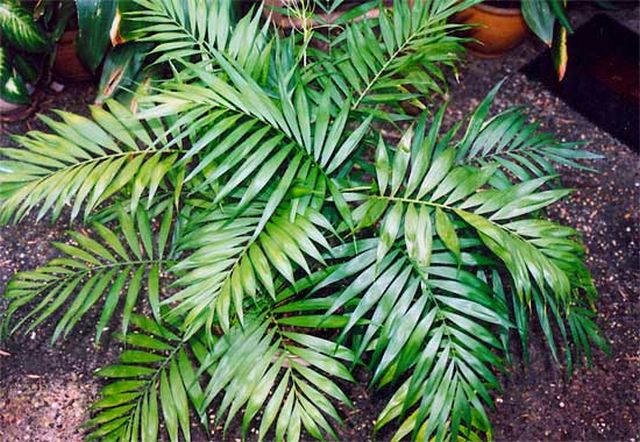

Female

Male

Female flower.

Female inflorescence.

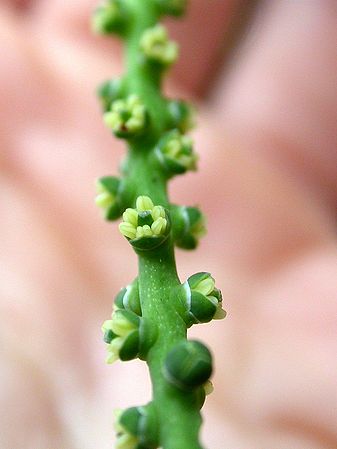
Male flower.

Male flower.


GUATEMALA: In forest at Tikal.

Hawaiian Tropical Botanical Garden.


Many Special Thanks to Ed Vaile for his long hours of tireless editing and numerous contributions.