Difference between revisions of "Livistona nitida"
(Created page with "__noeditsection__ <google>CH02</google> [[Image: {{Palmbox |image= |image_caption= |genus=Livistona (lih-vis-TOH-nuh) |species=nitida (nih-tih'-duh) |subspecies= |variety= |culti...") |
|||
| (88 intermediate revisions by 2 users not shown) | |||
| Line 1: | Line 1: | ||
__noeditsection__ | __noeditsection__ | ||
| − | |||
| − | |||
{{Palmbox | {{Palmbox | ||
| − | |image= | + | |image=Ln93034636.jpg |
| − | |image_caption= | + | |image_caption=alm shadow, Carnarvon National Park, QLD., Australia. (Sep. 1979) Photo by Paul Meir |
| − | |genus=Livistona (lih-vis-TOH- | + | |genus=Livistona (lih-vis-TOH-nah) |
| − | |species=nitida (nih-tih'- | + | |species=<br>nitida (nih-tih'-dah) |
|subspecies= | |subspecies= | ||
|variety= | |variety= | ||
| Line 13: | Line 11: | ||
|continent=oceania | |continent=oceania | ||
|habit=Solitary | |habit=Solitary | ||
| − | |leaf_type= | + | |leaf_type=Costapalmate |
|height= | |height= | ||
|trunk_diameter= | |trunk_diameter= | ||
| Line 20: | Line 18: | ||
|soil_type= | |soil_type= | ||
|msi= | |msi= | ||
| − | |common_names=Carnarvon Palm | + | |common_names=Carnarvon Palm, Carnarvon Gorge Cabbage Palm, Dawson River Fan-Palm. |
}} | }} | ||
| − | |||
==Habitat and Distribution== | ==Habitat and Distribution== | ||
| − | Carnarvon National Park in central Queensland, Australia. It is common in the Carnarvon and nearby Isla Gorges where it grows along stream banks and on rocky escarpments. eucalyptus forest areas at an elevation of about 3300 feet. | + | Australia. Queensland. In the catchments of the Dawson, Comet and Burnett Rivers, and Carnarvon Gorge. [[image:Ln79739706.jpg|thumb|left|400px|Carnarvon National Park, QLD., Australia. (Sep. 1979) Photo by Paul Meir]]Abundant along the margins of streams and flood plains, but also associated with sandstone cliffs and gorges, 100-650 m alt. (Dowe, J.L.)/Palmweb. |
| + | |||
| + | "Carnarvon National Park in central Queensland, Australia. It is common in the Carnarvon and nearby Isla Gorges where it grows along stream banks and on rocky escarpments. eucalyptus forest areas at an elevation of about 3300 feet." | ||
==Description== | ==Description== | ||
| − | A tall solitary fan palm to | + | "A tall solitary fan palm to 30 m (100ft), with bright green, deeply divided leaves, with long, drooping leaf tips, up to 4.5m (18ft) long, and which form an open crown. It has numerous glossy black fruits that are about 2 cm (0.8in) in diameter." |
| + | |||
| + | Functionally [[dioecious]] palm. Trunk to 35 m tall, 25-40 cm in diameter breast high, leaf scars raised; internodes narrow, grey; petiole stubs persistent in the basal 1 m or so, otherwise deciduous. Leaves 35-50 in a globose crown; petiole 170- 200 cm long, 20-26 mm wide, adaxially ridged, margins distally smooth, proximally with single, curved, dark red spines; leaf-base fibres moderately prominent, coarse, disintegrating; lamina costapalmate, regularly segmented, ± circular in outline, 160-190 cm long, coriaceous, adaxially dark green, glossy, abaxially lighter green; lamina divided for 63-70% of its length, with 68-80 segments, depth of apical cleft 60-73% of the segment length, apical lobes pendulous; parallel veins about 7 each side of midrib; transverse veins thinner than parallel veins. Inflorescences unbranched at the base, not sexually dimorphic, 150-200 cm long, not extending beyond the limit of the crown, branched to 4 orders; partial inflorescences 8-12; peduncular bract(s) lacking; rachis bracts loosely sheathing, densely scaly; rachillae 5-20 cm long, glabrous to papillose. Flowers solitary or in clusters of 2-5, funnel-shaped, 2-3.2 mm long, cream to yellow; sepals triangular, about 1.5 mm long, fleshy, subacute; petals broadly ovate, 2.0-2.2 mm long, thick, fleshy, acute; stamens about 1.6 mm long. Fruit globose, 13-20 mm in diam., glossy jet black; epicarp with scattered lenticellular pores, suture line extends for about ½ the length of the fruit, marked with lip-like structures; mesocarp fibrous, dry; endocarp thin, brittle; pedicel to 0.5 mm long. Seed globose, 10-12 mm wide. Eophyll 5-ribbed. (Dowe, J.L.)/Palmweb. Editimg by edric. | ||
| + | {{read more top}} | ||
| + | Livistona nitida was described by Rodd (1998) based on Rodd 3055 collected from Delusion Ck near Cracow, Queensland, and named for its highly glossy jet black fruits. The taxon had previously been informally known as the "Carnarvon Gorge Fan Palm" and "Livistona sp. Carnarvon" (Irvine, 1984; Jones, 1996). An early account was provided by Leichhardt (1847) during his transcontinental expedition of 1845, when near the Dawson R., Queensland, he wrote in his diary: "...a creek with Corypha palms, growing to a height of 25 or 30 feet" and "several rocky gullies were passed, that were full of palm trees. The valley of Palm-tree Creek extends about nineteen miles from west to east" and "the Corypha-palm provided a good supply of cabbage". Livistona nitida is a large canopy palm to 35 m tall; leaves are large and regularly segmented; segment apices are pendulous, and with a bifurcate cleft to 73% of the segment length; the inflorescence is unbranched, not extending beyond the limit of the crown, and with up to 12 partial inflorescences; bracts are loosely sheathing; flowers are cream to yellow; fruit are globose to 20 mm in diam., and glossy jet black at maturity. (Dowe, J.L.)/Palmweb. | ||
| + | {{read more bottom}} | ||
==Culture== | ==Culture== | ||
| − | "L. nitida has done very well in Augusta, GA. Grows much faster with ample water, but does fine without it. Two winters in a row, it was covered in snow for several days. There was some leaf damage, but the palm grew like crazy the following Spring with no spear pull. Lows that it has endured are in the | + | "L. nitida has done very well in Augusta, GA. Grows much faster with ample water, but does fine without it. Two winters in a row, it was covered in snow for several days. There was some leaf damage, but the palm grew like crazy the following Spring with no spear pull. Lows that it has endured are in the low 20's. The palm is 12' tall after six years from a 5-gal. container." (J. Levert) |
| + | |||
| + | Cold Hardiness Zone: 8a+ | ||
==Comments and Curiosities== | ==Comments and Curiosities== | ||
| − | + | Phenology: Flowers Sep-Dec; fruits Nov-Mar. | |
| − | "About 14 yrs ago I obtained some Livistona nitida seed. I had seen seedlings surviving under canopy in the Canberra Botanic gardens. A self-addressed envelope to the ranger at Isla Gorge National Park soon provided a packet of seed - all of which germnated. Shortly after we built a new house on a bare 1/4 acre block. Growth rates varied remarkably. The biggest is now about 4 metres with a well formed trunk. Others which are beyond the irrigation zone or met stiff competition are still barely ankle high. Noteworthy is their tolerance of frost and potentially speedy growth in our harsh climate. We get down to -8°C in Canberra and even seedlings will survive in the open. Growth rates are also much better in the open. They do better in this climate than L. australis , although the latter is still quite frost tolerant. L. nitida does not like to be transplanted but will eventually come good. Be prepared for all the leaves to die back. (I suspect they are adapted to drier climates than L. australis and have a spreading root system). (Ian Knight), | + | Conservation: Lower risk, conservation dependent. (Dowe, J.L.)/Palmweb. |
| + | |||
| + | Fastest growing of the Livistona, as well as the most cold hardy. | ||
| + | {{read more top}} | ||
| + | "Have a lot of experience with this exceptionally hardy Livistona species, only it's not that unique looking - in fact as a seedling up to a young adult, it can look a lot like a Washingtonia. Is one of the fastest growing Livistona species, and as adult, looks similar to Livistona australis- droopy, somewhat wide, deeply split fan leaves. As seedling, though, leaves fairly stiff and like a small Washingtonia, only with a slightly more costapalmate look (division down the middle where the leaflets divide from). Hard to kill this palm off- likes water, but if doesn't get any, doesn' care. Very cold hardy." (Geoff Stein) | ||
| + | |||
| + | "About 14 yrs ago I obtained some Livistona nitida seed. I had seen seedlings surviving under canopy in the Canberra Botanic gardens. A self-addressed envelope to the ranger at Isla Gorge National Park soon provided a packet of seed - all of which germnated. Shortly after we built a new house on a bare 1/4 acre block. Growth rates varied remarkably. The biggest is now about 4 metres with a well formed trunk. Others which are beyond the irrigation zone or met stiff competition are still barely ankle high. Noteworthy is their tolerance of frost and potentially speedy growth in our harsh climate. We get down to -8°C in Canberra and even seedlings will survive in the open. Growth rates are also much better in the open. They do better in this climate than L. australis , although the latter is still quite frost tolerant. L. nitida does not like to be transplanted but will eventually come good. Be prepared for all the leaves to die back. (I suspect they are adapted to drier climates than L. australis and have a spreading root system)". (Ian Knight) | ||
| + | |||
| + | This beautiful and stately palm is probably Australia's most attractive Livistona. It has moderately costapalmate, glossy, bright green fan leaves in a spherical, moderately dense crown. The leaf segments are lax and deeply divided and give the leaves a slightly weeping appearance. The ringed trunks can reach up to 25 or 30m (80 to 100ft) in height. L. nitida grows in the mountains of southern Queensland to an altitude of about 1000m, and, in cultivation, is fast growing, tolerant of drought and quite heavy frost, and easy to maintain. (RPS.com) | ||
| + | {{read more bottom}} | ||
| + | |||
| + | <br clear="all"> | ||
| + | {{#Widget:AdResban}} | ||
| + | <center><gallery caption="IMAGE GALLERY" perrow="" widths="" heights=""> | ||
| + | image:LnDSC_7747.jpg|A very large tree. Gold Coast, Queensland. Photo by Daryl O'Connor | ||
| + | image:LnDSC_7753.jpg|A very large tree. Gold Coast, Queensland. Photo by Daryl O'Connor | ||
| + | image:LnDSC_7756-1.jpg|W. robusta on left. Gold Coast, Queensland. Photo by Daryl O'Connor | ||
| + | image:Nitida09.jpg|Gold Coast, Queensland. Photo by Daryl O'Connor | ||
| + | image:Nitida00.jpg|Dawson River, Queensland. Photo by Mike Crisp | ||
| + | File:Nitida02.jpg|Dawson River, Queensland. Photo by Mike Crisp | ||
| + | image:Nitida03.jpg|Dawson River, Queensland. Photo by Mike Crisp | ||
| + | image:Nitida04.jpg|Dawson River, Queensland. Photo by Mike Crisp | ||
| + | image:5120453914_00c9b4c570_o.jpg|Botanic Gardens, Sydney. Photo by Dr. Tony Rodd | ||
| + | image:LnImmag001-1.jpg|Naples, Italy. Photo by Gyuseppe | ||
| + | image:Ln93034636.jpg|Palm shadow, Carnarvon National Park, QLD., Australia. (Sep. 1979) Photo by Paul Meir | ||
| + | image:Ln79739706.jpg|Carnarvon National Park, QLD., Australia. (Sep. 1979) Photo by Paul Meir | ||
| + | image:Ln79752317.jpg|Carnarvon National Park, QLD., Australia. The "guest" is a sand goanna (Varanus gouldii). – Scan from color slide (Sep. 1979) Photo by Paul Meir | ||
| + | File:post-10467-0-72148300-1435246541.jpg|Carnarvon National Park, QLD., Australia. The "guest" is a sand goanna (Varanus gouldii). – Scan from color slide (Sep. 1979) Photo by Paul Meir | ||
| + | image:Ln79752729.jpg|Carnarvon National Park, QLD., Australia. (Sep. 1979) Photo by Paul Meir | ||
| + | image:Ln79885087.jpg|Carnarvon Gorge, the habitat of Livistona nitida, Carnarvon National Park, QLD., Australia. (Sep. 1979) Photo by Paul Meir | ||
| + | image:Ln79903422.jpg|Carnarvon Gorge, the habitat of Livistona nitida, Carnarvon National Park, QLD., Australia. (Sep. 1979) Photo by Paul Meir | ||
| + | image:Ln81019603.jpg|Carnarvon Gorge, the habitat of Livistona nitida, Carnarvon National Park, QLD., Australia. A very tall Livistona (30 m?), This is a scan from the film negative, and not from a paper print. (Sep. 1979) Photo by Paul Meir | ||
| + | image:Ln81019570.jpg|Carnarvon Gorge, the habitat of Livistona nitida, Carnarvon National Park, QLD., Australia. Livistona nitida, endemic to Carnarvon Gorge and environment. This is a scan from the film negative, and not from a paper print. (Sep. 1979) Photo by Paul Meir | ||
| + | image:Ln81019552.jpg|Carnarvon Gorge, the habitat of Livistona nitida, Carnarvon National Park, QLD., Australia. Livistona nitida, endemic to Carnarvon Gorge and environment. Even the smallest ones, can withstand full sun. This is a scan from the film negative, and not from a paper print. (Sep. 1979) Photo by Paul Meir | ||
| + | image:Ln82528644.jpg|On the road to Carnarvon National Park, QLD., Australia. The Livistona palms were the only trees which withstood a heavy bushfire before (caused by deforestation); even the eucalyptus trees did not. This is a scan from the film negative, and not from a paper print. (Sep. 1979) Photo by Paul Meir | ||
| + | image:2191293240_be00740f33_o.jpg|Sydney Botanic Gardens. Photo by Dr. Tony Rodd | ||
| + | image:Ln8487525793_8fdfb3aaf1_o.jpg|Carnarvon Gorge (near the camp ground), north-west of Injune, Queensland, Australia. Photographed on 17 July 1975. Photo by Arthur Chapman | ||
| + | image:Ln8488622286_1a1c011b53_o.jpg|Carnarvon Gorge (near the camp ground), north-west of Injune, Queensland, Australia. Photographed on 17 July 1975. Photo by Arthur Chapman | ||
| + | image:Ozmay2006049.jpg|Dawson River, Carnarvon Range, eastern Queensland, Australia. Photo by Bruce Ironmonger | ||
| + | image:Ozmay2006055.jpg|Dawson River, Carnarvon Range, eastern Queensland, Australia. Photo by Bruce Ironmonger | ||
| + | image:Ozmay2006057-1.jpg|Dawson River, Carnarvon Range, eastern Queensland, Australia. Photo by Bruce Ironmonger | ||
| + | image:Ozmay2006046.jpg|Dawson River, Carnarvon Range, eastern Queensland, Australia. Photo by Bruce Ironmonger | ||
| + | image:Ozmay2006182-1.jpg|Near Taroom Village, along "Palm Creek", Dawson River, Carnarvon Range, eastern Queensland, Australia. Photo by Bruce Ironmonger | ||
| + | image:Ozmay2006185.jpg|Near Taroom Village, along "Palm Creek", Dawson River, Carnarvon Range, eastern Queensland, Australia. Photo by Bruce Ironmonger | ||
| + | image:Ozmay2006188.jpg|Near Taroom Village, along "Palm Creek", Dawson River, Carnarvon Range, eastern Queensland, Australia. Photo by Bruce Ironmonger | ||
| + | image:Ozmay2006189-1.jpg|Near Taroom Village, along "Palm Creek", Dawson River, Carnarvon Range, eastern Queensland, Australia. Photo by Bruce Ironmonger | ||
| + | File:post-4226-0-31577600-1435280724.jpg|Northern Territory, Australia. Photo by Zig. | ||
| + | File:post-4226-0-31480600-1435280693.jpg|Northern Territory, Australia. Photo by Zig. | ||
| + | |||
| + | |||
| + | image:Lnpost-418-1218928263.jpg|Corpus Christi, Texas. Photo by Jon Watson | ||
| + | image:post-42-0-18261200-1386586509.jpg|Cooran, northern end of the Sunshine Coast region, southeast Queensland, Australia. Garden of John and Jeanne Price. Photo by Daryl O'Connor | ||
| + | image:Ln121.jpg|Northeast Texas zone 8a. This palm has seen 19 F. two years in ground. Photo by James Carey | ||
| + | image:Lnpost-1270-1218840767.jpg|Corona, CA. Photo by Randy | ||
| + | image:201109231410400.Nov2010Nitidas.jpg|Hardee County, Florida. Photo-Fish Branch Tree Farm | ||
| + | image:201206071157430.LivistonaNitida.jpg|Hardee County, Florida. Photo-Fish Branch Tree Farm | ||
| + | image:201302270834490.Nitida.jpg|Hardee County, Florida. Photo-Fish Branch Tree Farm | ||
| + | image:Ln201302270837260.Dec2012.jpg|Hardee County, Florida. Photo-Fish Branch Tree Farm | ||
| + | image:89b167.jpg|Huntington Gardens, Pasadena California. Photo by Geoff Stein | ||
| + | image:D68b23.jpg|Riverside California. Photo by Geoff Stein | ||
| + | image:D16251.jpg|Huntington Gardens, Pasadena California. Photo by Geoff Stein | ||
| + | image:C1e219.jpg|Huntington Gardens, Pasadena California. Photo by Geoff Stein | ||
| + | image:38de64.jpg|Huntington Gardens, Pasadena California. Photo by Geoff Stein | ||
| + | image:70c2ec.jpg|SoCal. Photo by Geoff Stein | ||
| + | image:4710da.jpg|SoCal. Photo by Geoff Stein | ||
| + | image:26a7da.jpg|SoCal. Photo by Geoff Stein | ||
| + | image:5b3f43.jpg|SoCal. Photo by Geoff Stein | ||
| + | image:Ed8a72.jpg|SoCal. Photo by Geoff Stein | ||
| + | image:660239.jpg|SoCal. Photo by Geoff Stein | ||
| + | image:F0c506.jpg|Huntington Botanical Gardens, Pasadena California. Photo by growin | ||
| + | image:50c99a.jpg|Huntington Botanical Gardens, Pasadena California. Photo by growin | ||
| + | image:Fa0ed4.jpg|Huntington Botanical Gardens, Pasadena California. Photo by growin | ||
| + | File:img_2285_zps4qgwniel.jpg|Citrus Bowl, Orlando, FL. Photo by H.P. Leu Gardens Botanist Eric S. | ||
| + | File:img_2288_zpsw6r2ne6d.jpg|Citrus Bowl, Orlando, FL. Photo by H.P. Leu Gardens Botanist Eric S. | ||
| + | File:img_2286_zpsufaarvx9.jpg|Citrus Bowl, Orlando, FL. Photo by H.P. Leu Gardens Botanist Eric S. | ||
| + | File:img_2289_zpsrutsgxjo.jpg|Citrus Bowl, Orlando, FL. Photo by H.P. Leu Gardens Botanist Eric S. | ||
| + | File:img_2296_zps4bqueync.jpg|Citrus Bowl, Orlando, FL. Photo by H.P. Leu Gardens Botanist Eric S. | ||
| + | File:img_2302_zpspsvgzphi.jpg|Citrus Bowl, Orlando, FL. Photo by H.P. Leu Gardens Botanist Eric S. | ||
| + | File:img_2301_zpsnqlf2jmz.jpg|Citrus Bowl, Orlando, FL. Photo by H.P. Leu Gardens Botanist Eric S. | ||
| + | File:img_2295_zpsbdxox3nq.jpg|Citrus Bowl, Orlando, FL. Photo by H.P. Leu Gardens Botanist Eric S. | ||
| + | File:img_2292_zpsnebipxtq.jpg|Citrus Bowl, Orlando, FL. Photo by H.P. Leu Gardens Botanist Eric S. | ||
| + | File:img_2293_zpsv40qxvry.jpg|Citrus Bowl, Orlando, FL. Photo by H.P. Leu Gardens Botanist Eric S. | ||
| + | File:img_2294_zpsczivw3ft.jpg|Citrus Bowl, Orlando, FL. Photo by H.P. Leu Gardens Botanist Eric S. | ||
| + | File:post-42-0-47234200-1437139529.jpg|Brisbane Botanic Gardens, Mount Coot-tha, Brisbane, Australia. Photo by Daryl O'Connor. | ||
| + | File:post-42-0-59131600-1437139555.jpg|Brisbane Botanic Gardens, Mount Coot-tha, Brisbane, Australia. Livistona nitida and fulva transplants getting settled. Photo by Daryl O'Connor. | ||
| + | File:post-42-12775516163956.jpg|Brisbane Botanic Gardens, Mount Coot-tha, Brisbane, Australia. Livistona nitida var. 'Carnarvon' Photo by Daryl O'Connor. | ||
| + | |||
| + | |||
| + | File:7041760335_e00f1d260a_k.jpg|Carnarvon Gorge - Livistona nitida and Sandstone Cliffs near The Ampitheatre. Black Diamond Images. | ||
| + | File:6895668580_69264839e4_k.jpg|Carnarvon Gorge - Livistona nitida and Sandstone Cliffs near The Ampitheatre. Black Diamond Images. | ||
| + | File:6895658904_056eb79678_k.jpg|Carnarvon Gorge - Livistona nitida and Sandstone Cliffs near The Ampitheatre. Black Diamond Images. | ||
| + | File:4784117033_a7365e4a82_o.jpg|Carnarvon Range, eastern Queensland, Australia. Photo by Kristopher Kupsch. | ||
| + | File:2014-09-17_MG-5415.jpg|Carnarvon Range, eastern Queensland, Australia. Carnarvon Gorge is a stronghold for Carnarvon Fan Palms, a species which is endemic to the Dawson River catchment area. Photo by Ray Wilson. | ||
| + | File:2014-09-15_MG-4528.jpg|Carnarvon Range, eastern Queensland, Australia. Carnarvon Gorge is a stronghold for Carnarvon Fan Palms, a species which is endemic to the Dawson River catchment area. Photo by Ray Wilson. | ||
| + | File:2014-09-17_MG-5411.jpg|Carnarvon Range, eastern Queensland, Australia. Carnarvon Gorge is a stronghold for Carnarvon Fan Palms, a species which is endemic to the Dawson River catchment area. Photo by Ray Wilson. | ||
| + | |||
| + | |||
| + | </gallery></center> | ||
==External Links== | ==External Links== | ||
*[http://eunops.org/content/glossary-palm-terms Glossary of Palm Terms] | *[http://eunops.org/content/glossary-palm-terms Glossary of Palm Terms] | ||
| − | *[http://www. | + | *[http://www.calflora.net/botanicalnames/pronunciation.html MODERN BOTANICAL LATIN] |
| − | + | *[http://www.jlhudsonseeds.net/Pronunciation.htm "Just To Be Clear"] | |
| + | *[http://www.anbg.gov.au/images/photo_cd/index.html Click on Arecaceae, for list of photos] | ||
| + | *[http://rbgsyd.nsw.gov.au/__data/assets/pdf_file/0005/73166/Tel8Rod049.pdf Revision of Livistona (Arecaceae) in Australia, By Dr. A.N. Rodd] | ||
| + | *[http://baa.univpgri-palembang.ac.id/perpus-fkip/Perpustakaan/Geography/Biogeography/%5BJohn_Leslie_Dowe%5D_Australian_Palms_Biogeography,(BookFi.org).pdf Australian Palms, By John Leslie Dowe] | ||
==References== | ==References== | ||
Phonetic spelling of Latin names by edric. | Phonetic spelling of Latin names by edric. | ||
| − | Special thanks to Geoff Stein, (Palmbob) for his hundreds of photos | + | Special thanks to Geoff Stein, (Palmbob) for his hundreds of photos. |
| − | Special thanks to palmweb.org, Dr. John Dransfield, Dr. Bill Baker & team, for their volumes of information and photos, | + | Special thanks to [http://palmweb.org/?q=node/2 Palmweb.org], Dr. John Dransfield, Dr. Bill Baker & team, for their volumes of information and photos. |
| + | |||
| + | Glossary of Palm Terms; Based on the glossary in Dransfield, J., N.W. Uhl, C.B. Asmussen-Lange, W.J. Baker, M.M. Harley & C.E. Lewis. 2008. Genera Palmarum - Evolution and Classification of the Palms. Royal Botanic Gardens, Kew. All images copyright of the artists and photographers (see images for credits). | ||
| + | |||
| + | Dowe, J.L., A taxonomic account of Livistona R.Br. (Arecaceae). A taxonomic account of Livistona R.Br. (Arecaceae). | ||
| − | |||
| − | |||
| − | |||
| − | |||
| − | |||
| − | |||
| − | |||
| − | |||
| − | |||
| − | |||
| − | |||
| − | |||
| − | |||
| − | |||
| − | |||
| − | |||
| − | |||
{{SpeciesListBackLink}} | {{SpeciesListBackLink}} | ||
[[Category:LIVISTONA|nitida]] | [[Category:LIVISTONA|nitida]] | ||
Latest revision as of 23:54, 6 December 2015
| Livistona (lih-vis-TOH-nah) nitida (nih-tih'-dah) | |||||||
|---|---|---|---|---|---|---|---|
 alm shadow, Carnarvon National Park, QLD., Australia. (Sep. 1979) Photo by Paul Meir | |||||||
| Scientific Classification | |||||||
| |||||||
| Synonyms | |||||||
|
| |||||||
| Native Continent | |||||||
 | |||||||
| Morphology | |||||||
| |||||||
| Culture | |||||||
|
| |||||||
| Survivability index | |||||||
|
| |||||||
| Common names | |||||||
|
| |||||||
Contents
Habitat and Distribution
Australia. Queensland. In the catchments of the Dawson, Comet and Burnett Rivers, and Carnarvon Gorge.
"Carnarvon National Park in central Queensland, Australia. It is common in the Carnarvon and nearby Isla Gorges where it grows along stream banks and on rocky escarpments. eucalyptus forest areas at an elevation of about 3300 feet."
Description
"A tall solitary fan palm to 30 m (100ft), with bright green, deeply divided leaves, with long, drooping leaf tips, up to 4.5m (18ft) long, and which form an open crown. It has numerous glossy black fruits that are about 2 cm (0.8in) in diameter."
Functionally dioecious palm. Trunk to 35 m tall, 25-40 cm in diameter breast high, leaf scars raised; internodes narrow, grey; petiole stubs persistent in the basal 1 m or so, otherwise deciduous. Leaves 35-50 in a globose crown; petiole 170- 200 cm long, 20-26 mm wide, adaxially ridged, margins distally smooth, proximally with single, curved, dark red spines; leaf-base fibres moderately prominent, coarse, disintegrating; lamina costapalmate, regularly segmented, ± circular in outline, 160-190 cm long, coriaceous, adaxially dark green, glossy, abaxially lighter green; lamina divided for 63-70% of its length, with 68-80 segments, depth of apical cleft 60-73% of the segment length, apical lobes pendulous; parallel veins about 7 each side of midrib; transverse veins thinner than parallel veins. Inflorescences unbranched at the base, not sexually dimorphic, 150-200 cm long, not extending beyond the limit of the crown, branched to 4 orders; partial inflorescences 8-12; peduncular bract(s) lacking; rachis bracts loosely sheathing, densely scaly; rachillae 5-20 cm long, glabrous to papillose. Flowers solitary or in clusters of 2-5, funnel-shaped, 2-3.2 mm long, cream to yellow; sepals triangular, about 1.5 mm long, fleshy, subacute; petals broadly ovate, 2.0-2.2 mm long, thick, fleshy, acute; stamens about 1.6 mm long. Fruit globose, 13-20 mm in diam., glossy jet black; epicarp with scattered lenticellular pores, suture line extends for about ½ the length of the fruit, marked with lip-like structures; mesocarp fibrous, dry; endocarp thin, brittle; pedicel to 0.5 mm long. Seed globose, 10-12 mm wide. Eophyll 5-ribbed. (Dowe, J.L.)/Palmweb. Editimg by edric.
| read more |
|---|
|
Livistona nitida was described by Rodd (1998) based on Rodd 3055 collected from Delusion Ck near Cracow, Queensland, and named for its highly glossy jet black fruits. The taxon had previously been informally known as the "Carnarvon Gorge Fan Palm" and "Livistona sp. Carnarvon" (Irvine, 1984; Jones, 1996). An early account was provided by Leichhardt (1847) during his transcontinental expedition of 1845, when near the Dawson R., Queensland, he wrote in his diary: "...a creek with Corypha palms, growing to a height of 25 or 30 feet" and "several rocky gullies were passed, that were full of palm trees. The valley of Palm-tree Creek extends about nineteen miles from west to east" and "the Corypha-palm provided a good supply of cabbage". Livistona nitida is a large canopy palm to 35 m tall; leaves are large and regularly segmented; segment apices are pendulous, and with a bifurcate cleft to 73% of the segment length; the inflorescence is unbranched, not extending beyond the limit of the crown, and with up to 12 partial inflorescences; bracts are loosely sheathing; flowers are cream to yellow; fruit are globose to 20 mm in diam., and glossy jet black at maturity. (Dowe, J.L.)/Palmweb. |
Culture
"L. nitida has done very well in Augusta, GA. Grows much faster with ample water, but does fine without it. Two winters in a row, it was covered in snow for several days. There was some leaf damage, but the palm grew like crazy the following Spring with no spear pull. Lows that it has endured are in the low 20's. The palm is 12' tall after six years from a 5-gal. container." (J. Levert)
Cold Hardiness Zone: 8a+
Comments and Curiosities
Phenology: Flowers Sep-Dec; fruits Nov-Mar.
Conservation: Lower risk, conservation dependent. (Dowe, J.L.)/Palmweb.
Fastest growing of the Livistona, as well as the most cold hardy.
| read more |
|---|
|
"Have a lot of experience with this exceptionally hardy Livistona species, only it's not that unique looking - in fact as a seedling up to a young adult, it can look a lot like a Washingtonia. Is one of the fastest growing Livistona species, and as adult, looks similar to Livistona australis- droopy, somewhat wide, deeply split fan leaves. As seedling, though, leaves fairly stiff and like a small Washingtonia, only with a slightly more costapalmate look (division down the middle where the leaflets divide from). Hard to kill this palm off- likes water, but if doesn't get any, doesn' care. Very cold hardy." (Geoff Stein) "About 14 yrs ago I obtained some Livistona nitida seed. I had seen seedlings surviving under canopy in the Canberra Botanic gardens. A self-addressed envelope to the ranger at Isla Gorge National Park soon provided a packet of seed - all of which germnated. Shortly after we built a new house on a bare 1/4 acre block. Growth rates varied remarkably. The biggest is now about 4 metres with a well formed trunk. Others which are beyond the irrigation zone or met stiff competition are still barely ankle high. Noteworthy is their tolerance of frost and potentially speedy growth in our harsh climate. We get down to -8°C in Canberra and even seedlings will survive in the open. Growth rates are also much better in the open. They do better in this climate than L. australis , although the latter is still quite frost tolerant. L. nitida does not like to be transplanted but will eventually come good. Be prepared for all the leaves to die back. (I suspect they are adapted to drier climates than L. australis and have a spreading root system)". (Ian Knight) This beautiful and stately palm is probably Australia's most attractive Livistona. It has moderately costapalmate, glossy, bright green fan leaves in a spherical, moderately dense crown. The leaf segments are lax and deeply divided and give the leaves a slightly weeping appearance. The ringed trunks can reach up to 25 or 30m (80 to 100ft) in height. L. nitida grows in the mountains of southern Queensland to an altitude of about 1000m, and, in cultivation, is fast growing, tolerant of drought and quite heavy frost, and easy to maintain. (RPS.com) |
- IMAGE GALLERY

A very large tree. Gold Coast, Queensland. Photo by Daryl O'Connor

A very large tree. Gold Coast, Queensland. Photo by Daryl O'Connor

W. robusta on left. Gold Coast, Queensland. Photo by Daryl O'Connor
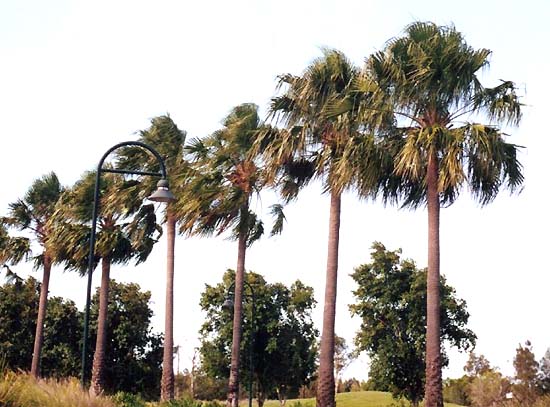
Gold Coast, Queensland. Photo by Daryl O'Connor

Dawson River, Queensland. Photo by Mike Crisp

Dawson River, Queensland. Photo by Mike Crisp

Dawson River, Queensland. Photo by Mike Crisp

Dawson River, Queensland. Photo by Mike Crisp

Botanic Gardens, Sydney. Photo by Dr. Tony Rodd

Naples, Italy. Photo by Gyuseppe

Palm shadow, Carnarvon National Park, QLD., Australia. (Sep. 1979) Photo by Paul Meir

Carnarvon National Park, QLD., Australia. (Sep. 1979) Photo by Paul Meir

Carnarvon National Park, QLD., Australia. The "guest" is a sand goanna (Varanus gouldii). – Scan from color slide (Sep. 1979) Photo by Paul Meir

Carnarvon National Park, QLD., Australia. The "guest" is a sand goanna (Varanus gouldii). – Scan from color slide (Sep. 1979) Photo by Paul Meir

Carnarvon National Park, QLD., Australia. (Sep. 1979) Photo by Paul Meir

Carnarvon Gorge, the habitat of Livistona nitida, Carnarvon National Park, QLD., Australia. (Sep. 1979) Photo by Paul Meir

Carnarvon Gorge, the habitat of Livistona nitida, Carnarvon National Park, QLD., Australia. (Sep. 1979) Photo by Paul Meir

Carnarvon Gorge, the habitat of Livistona nitida, Carnarvon National Park, QLD., Australia. A very tall Livistona (30 m?), This is a scan from the film negative, and not from a paper print. (Sep. 1979) Photo by Paul Meir

Carnarvon Gorge, the habitat of Livistona nitida, Carnarvon National Park, QLD., Australia. Livistona nitida, endemic to Carnarvon Gorge and environment. This is a scan from the film negative, and not from a paper print. (Sep. 1979) Photo by Paul Meir

Carnarvon Gorge, the habitat of Livistona nitida, Carnarvon National Park, QLD., Australia. Livistona nitida, endemic to Carnarvon Gorge and environment. Even the smallest ones, can withstand full sun. This is a scan from the film negative, and not from a paper print. (Sep. 1979) Photo by Paul Meir

On the road to Carnarvon National Park, QLD., Australia. The Livistona palms were the only trees which withstood a heavy bushfire before (caused by deforestation); even the eucalyptus trees did not. This is a scan from the film negative, and not from a paper print. (Sep. 1979) Photo by Paul Meir

Sydney Botanic Gardens. Photo by Dr. Tony Rodd

Carnarvon Gorge (near the camp ground), north-west of Injune, Queensland, Australia. Photographed on 17 July 1975. Photo by Arthur Chapman

Carnarvon Gorge (near the camp ground), north-west of Injune, Queensland, Australia. Photographed on 17 July 1975. Photo by Arthur Chapman

Dawson River, Carnarvon Range, eastern Queensland, Australia. Photo by Bruce Ironmonger

Dawson River, Carnarvon Range, eastern Queensland, Australia. Photo by Bruce Ironmonger

Dawson River, Carnarvon Range, eastern Queensland, Australia. Photo by Bruce Ironmonger

Dawson River, Carnarvon Range, eastern Queensland, Australia. Photo by Bruce Ironmonger

Near Taroom Village, along "Palm Creek", Dawson River, Carnarvon Range, eastern Queensland, Australia. Photo by Bruce Ironmonger

Near Taroom Village, along "Palm Creek", Dawson River, Carnarvon Range, eastern Queensland, Australia. Photo by Bruce Ironmonger

Near Taroom Village, along "Palm Creek", Dawson River, Carnarvon Range, eastern Queensland, Australia. Photo by Bruce Ironmonger

Near Taroom Village, along "Palm Creek", Dawson River, Carnarvon Range, eastern Queensland, Australia. Photo by Bruce Ironmonger

Northern Territory, Australia. Photo by Zig.

Northern Territory, Australia. Photo by Zig.

Corpus Christi, Texas. Photo by Jon Watson

Cooran, northern end of the Sunshine Coast region, southeast Queensland, Australia. Garden of John and Jeanne Price. Photo by Daryl O'Connor

Northeast Texas zone 8a. This palm has seen 19 F. two years in ground. Photo by James Carey

Corona, CA. Photo by Randy

Hardee County, Florida. Photo-Fish Branch Tree Farm

Hardee County, Florida. Photo-Fish Branch Tree Farm

Hardee County, Florida. Photo-Fish Branch Tree Farm

Hardee County, Florida. Photo-Fish Branch Tree Farm

Huntington Gardens, Pasadena California. Photo by Geoff Stein

Riverside California. Photo by Geoff Stein

Huntington Gardens, Pasadena California. Photo by Geoff Stein

Huntington Gardens, Pasadena California. Photo by Geoff Stein

Huntington Gardens, Pasadena California. Photo by Geoff Stein

SoCal. Photo by Geoff Stein

SoCal. Photo by Geoff Stein

SoCal. Photo by Geoff Stein

SoCal. Photo by Geoff Stein

SoCal. Photo by Geoff Stein

SoCal. Photo by Geoff Stein

Huntington Botanical Gardens, Pasadena California. Photo by growin

Huntington Botanical Gardens, Pasadena California. Photo by growin

Huntington Botanical Gardens, Pasadena California. Photo by growin

Citrus Bowl, Orlando, FL. Photo by H.P. Leu Gardens Botanist Eric S.

Citrus Bowl, Orlando, FL. Photo by H.P. Leu Gardens Botanist Eric S.

Citrus Bowl, Orlando, FL. Photo by H.P. Leu Gardens Botanist Eric S.

Citrus Bowl, Orlando, FL. Photo by H.P. Leu Gardens Botanist Eric S.

Citrus Bowl, Orlando, FL. Photo by H.P. Leu Gardens Botanist Eric S.

Citrus Bowl, Orlando, FL. Photo by H.P. Leu Gardens Botanist Eric S.

Citrus Bowl, Orlando, FL. Photo by H.P. Leu Gardens Botanist Eric S.

Citrus Bowl, Orlando, FL. Photo by H.P. Leu Gardens Botanist Eric S.

Citrus Bowl, Orlando, FL. Photo by H.P. Leu Gardens Botanist Eric S.

Citrus Bowl, Orlando, FL. Photo by H.P. Leu Gardens Botanist Eric S.

Citrus Bowl, Orlando, FL. Photo by H.P. Leu Gardens Botanist Eric S.

Brisbane Botanic Gardens, Mount Coot-tha, Brisbane, Australia. Photo by Daryl O'Connor.

Brisbane Botanic Gardens, Mount Coot-tha, Brisbane, Australia. Livistona nitida and fulva transplants getting settled. Photo by Daryl O'Connor.

Brisbane Botanic Gardens, Mount Coot-tha, Brisbane, Australia. Livistona nitida var. 'Carnarvon' Photo by Daryl O'Connor.

Carnarvon Gorge - Livistona nitida and Sandstone Cliffs near The Ampitheatre. Black Diamond Images.

Carnarvon Gorge - Livistona nitida and Sandstone Cliffs near The Ampitheatre. Black Diamond Images.

Carnarvon Gorge - Livistona nitida and Sandstone Cliffs near The Ampitheatre. Black Diamond Images.

Carnarvon Range, eastern Queensland, Australia. Photo by Kristopher Kupsch.

Carnarvon Range, eastern Queensland, Australia. Carnarvon Gorge is a stronghold for Carnarvon Fan Palms, a species which is endemic to the Dawson River catchment area. Photo by Ray Wilson.

Carnarvon Range, eastern Queensland, Australia. Carnarvon Gorge is a stronghold for Carnarvon Fan Palms, a species which is endemic to the Dawson River catchment area. Photo by Ray Wilson.

Carnarvon Range, eastern Queensland, Australia. Carnarvon Gorge is a stronghold for Carnarvon Fan Palms, a species which is endemic to the Dawson River catchment area. Photo by Ray Wilson.


External Links
- Glossary of Palm Terms
- MODERN BOTANICAL LATIN
- "Just To Be Clear"
- Click on Arecaceae, for list of photos
- Revision of Livistona (Arecaceae) in Australia, By Dr. A.N. Rodd
- Australian Palms, By John Leslie Dowe
References
Phonetic spelling of Latin names by edric.
Special thanks to Geoff Stein, (Palmbob) for his hundreds of photos.
Special thanks to Palmweb.org, Dr. John Dransfield, Dr. Bill Baker & team, for their volumes of information and photos.
Glossary of Palm Terms; Based on the glossary in Dransfield, J., N.W. Uhl, C.B. Asmussen-Lange, W.J. Baker, M.M. Harley & C.E. Lewis. 2008. Genera Palmarum - Evolution and Classification of the Palms. Royal Botanic Gardens, Kew. All images copyright of the artists and photographers (see images for credits).
Dowe, J.L., A taxonomic account of Livistona R.Br. (Arecaceae). A taxonomic account of Livistona R.Br. (Arecaceae).
Many Special Thanks to Ed Vaile for his long hours of tireless editing and numerous contributions.