Difference between revisions of "Pritchardia hillebrandii"
| Line 32: | Line 32: | ||
==Comments and Curiosities== | ==Comments and Curiosities== | ||
| − | Etymology: Pritchardia name is dedicated to W.T.Pritchard, British official stationed in Fiji in the 19th Century. | + | Etymology: Pritchardia name is dedicated to W.T. Pritchard, British official stationed in Fiji in the 19th Century. |
| − | Hillebrandii name honors the botanist W.F.Hillebrand (1853-1925). | + | Hillebrandii name honors the botanist W.F. Hillebrand (1853-1925). |
The palm is variable in overall appearance with green leaves, ranging to the "blue dwarf" which has, according to specimen, more or less waxy glaucous leaves on both sides. The "blue dwarf" is regarded as especially attractive. Rock (1921) described a 'robust' variety with very large leaves, being cultivated near Kamalo on Molokai, but commented that the size of the palm may be due to soil conditions. {Wagner, W.L., Herbst, D.R. & Sohmer, S.H. 1990) | The palm is variable in overall appearance with green leaves, ranging to the "blue dwarf" which has, according to specimen, more or less waxy glaucous leaves on both sides. The "blue dwarf" is regarded as especially attractive. Rock (1921) described a 'robust' variety with very large leaves, being cultivated near Kamalo on Molokai, but commented that the size of the palm may be due to soil conditions. {Wagner, W.L., Herbst, D.R. & Sohmer, S.H. 1990) | ||
| Line 42: | Line 42: | ||
*[http://www.plantapalm.com/wianame.htm Pronunciation Key] | *[http://www.plantapalm.com/wianame.htm Pronunciation Key] | ||
*http://itp.lucidcentral.org/id/palms/palm-id/Pritchardia_hillebrandii.htm | *http://itp.lucidcentral.org/id/palms/palm-id/Pritchardia_hillebrandii.htm | ||
| + | *http://myloulu.wordpress.com/2010/09/13/the-island-of-oahu/ | ||
| + | *http://myloulu.wordpress.com/2010/09/08/the-island-of-maui/ | ||
| + | *http://hanapalms.wordpress.com/2010/07/ | ||
| + | *http://www.biomedcentral.com/1471-2148/12/23 | ||
==References== | ==References== | ||
Phonetic spelling of Latin names by edric. | Phonetic spelling of Latin names by edric. | ||
Revision as of 05:06, 3 February 2014
<google>CH02</google>

| Pritchardia (pritch-AHR-dee-uh) hillebrandii (hill-eh-BRAND-ee-eye) | |||||||
|---|---|---|---|---|---|---|---|
 Hawaii. Photo by Geoff Stein, edric. | |||||||
| Scientific Classification | |||||||
| |||||||
| Synonyms | |||||||
|
| |||||||
| Native Continent | |||||||
 | |||||||
| Morphology | |||||||
| |||||||
| Culture | |||||||
|
| |||||||
| Survivability index | |||||||
|
| |||||||
| Common names | |||||||
|
| |||||||
Contents
Habitat and Distribution
Hawaii. Now restricted to the tops of the stack-like, rocky islets of Huelo and Mokapa off the north coast of Molokai, 75-100 m elevation (Front Cover). As recently as the 1970s, a few plants of Pritchardia hillebrandii were also on the valley floors and at the base of the immense coastal sea cliffs along the north coast of Molokai although these may have been cultivated because they were near or at sites of human activity. Nonetheless, they are gone today, rats and goats likely having driven them to extinction (S. Perlman and K. Wood, pers. comm.). (Hodel, D. 2007)
Description
To 8 m tall; proximal margins of petiole with only a few fibers; ieaf biade strongly undulate and often of a rather coarse appearance, divided 2/5-1/2, conspicuously waxy-glaucous, grayish green, rarely to nearly white or plain green, abaxial surface more or less devoid of lepidia, segment tips stiff to drooping; inflorescences composed of 1-5 panicles, shorter than or equaling petioles in flower and fruit, panicles branched to 3 orders, rachillae glabrous; fruits 15-22 x 14-19 mm, globose, often keeled or ridged. (Hodel, D. 2007) Editing by edric.
Pritchardia hillebrandii is distinctive in its conspicuously waxy glaucous leaf blades more or less devoid of lepidia, inflorescences shorter than or equaling the petioles, and small fruits. Leaf blades can be so heavily glaucous that they appear nearly white (Fig. 18). It is similar to P. maideniana but the latter differs in its diamond-shaped (in outline) leaf blades (the result of strong and conspicuous folding) that mostly lack the giaucous covering. It is unclear whether Hillebrand's type material originated from cultivated plants in Honolulu or from wild or cuitivated plants on Molokai. Beccari (1890) noted that much confusion surrounded the provenance and labels on Hillebrand's specimens at B, although there is a loose note in the photograph at FI of the type at B with the name Molokai handwritten on it. It is also unclear whether the numbers identifying the syntypes of P. insignis (7970 and 8800) were applied by the Botanic Garden in Guyana or its herbarium or by the Berlin Herbarium. (Hodel, D. 2007)
Culture
Comments and Curiosities
Etymology: Pritchardia name is dedicated to W.T. Pritchard, British official stationed in Fiji in the 19th Century. Hillebrandii name honors the botanist W.F. Hillebrand (1853-1925).
The palm is variable in overall appearance with green leaves, ranging to the "blue dwarf" which has, according to specimen, more or less waxy glaucous leaves on both sides. The "blue dwarf" is regarded as especially attractive. Rock (1921) described a 'robust' variety with very large leaves, being cultivated near Kamalo on Molokai, but commented that the size of the palm may be due to soil conditions. {Wagner, W.L., Herbst, D.R. & Sohmer, S.H. 1990)
"This is just one of about 20-plus species of Pritchardia that grow well in southern California. There are a few species from the South Pacific that do not, but just about all the Pritchardias native to Hawaii do fine here in So Cal. Some are much rarer than others; this is one of the most common species. A pretty robust grower, it has large, only slightly divided leaves that don't droop much, if at all. It loves water, but doesn't require a ton of it. This palm can do great in full sun near the coast but prefers some shade inland. Intense, dry heat (over 100°F) is tough on it. There are several varieties of this palm including a 'dwarf' form that has slightly bluish leaves." (Geoff Stein), edric.
External Links
- Glossary of Palm Terms
- Pronunciation Key
- http://itp.lucidcentral.org/id/palms/palm-id/Pritchardia_hillebrandii.htm
- http://myloulu.wordpress.com/2010/09/13/the-island-of-oahu/
- http://myloulu.wordpress.com/2010/09/08/the-island-of-maui/
- http://hanapalms.wordpress.com/2010/07/
- http://www.biomedcentral.com/1471-2148/12/23
References
Phonetic spelling of Latin names by edric.
Special thanks to Geoff Stein, (Palmbob) for his hundreds of photos, edric.
Special thanks to palmweb.org, Dr. John Dransfield, Dr. Bill Baker & team, for their volumes of information and photos, edric.
- IMAGE GALLERY

Ventura, California.

Hawaii. Photo by Geoff Stein, edric.
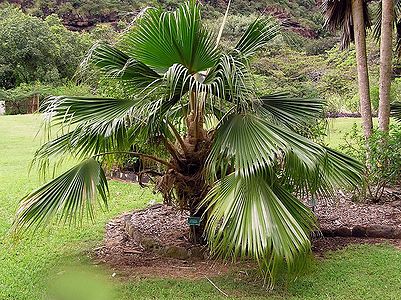
Hawaii. Photo by Geoff Stein, edric.

Lyon Arboretum, Oahu, Hawaii. Photo by Geoff Stein, edric.

Hawaii. Photo by Geoff Stein, edric.

Lyon Arboretum, Oahu, Hawaii. Photo by Geoff Stein, edric.

"close up of petioles showing the thick orange scurf on them (easily rubs off)" Photo by Geoff Stein, edric.

Encinitas California. Photo by Geoff Stein, edric.

Miami Florida. Photo by Geoff Stein, edric.

Santa Barbara, California's Lotus Land. Photo by Geoff Stein, edric.

Photo by Geoff Stein, edric.
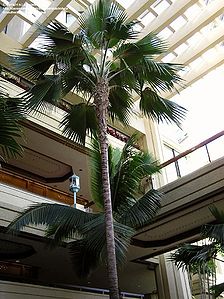
"Exceptional tree in Hawaii protected by some overhead glass (still outdoors)- nearly perfect" Photo by Geoff Stein, edric.

Fresh seed, some fruit still extant. Photo by Wallaby, edric.

Seeds germinating, 23 days. Photo by Wallaby, edric.

Half day sun, inland, southern California. Photo by Geoff Stein, edric.

Photo by Geoff Stein, edric.

Hawaii. Photo by Dr. P. Gotra, edric.

Hawaii. Photo by Dr. P. Gotra, edric.

Hawaii. Photo by Dr. P. Gotra, edric.

Hawaii. Photo by Dr. P. Gotra, edric.

Hawaii. Photo by Dr. P. Gotra, edric.

Hawaii. Photo by Dr. P. Gotra, edric.

Hawaii. Photo by Dr. P. Gotra, edric.

Waimea Valley Audubon Center, Oahu, Hawaii. Photo by Dr. David Eickhoff, edric.

Waimea Valley Audubon Center, Oahu, Hawaii. Photo by Dr. David Eickhoff, edric.

Waimea Valley Audubon Center, Oahu, Hawaii. Photo by Dr. David Eickhoff, edric.

Photo by Melany Chapin, edric.

Photo by Greg Roulinavage, edric.

Hanamu Rd Makawao, Maui, Hawaii. Photo by Forest & Kim Starr, edric.

Makawao, Maui, Hawaii. Photo by Forest & Kim Starr, edric.

Hanamu Rd Makawao, Maui, Hawaii. Photo by Forest & Kim Starr, edric.

Makawao, Maui, Hawaii. Photo by Forest & Kim Starr, edric.

Hanamu Rd Makawao, Maui, Hawaii. Photo by Forest & Kim Starr, edric.

Makawao, Maui, Hawaii. Photo by Forest & Kim Starr, edric.

Makawao, Maui, Hawaii. Photo by Forest & Kim Starr, edric.

Habitat. Huelo, Molokai, Hawaii. Photo by Forest & Kim Starr, edric.

Habitat aerial at Huelo Islet North Shore, Molokai, Hawaii. Photo by Forest & Kim Starr, edric.

Habitat aerial at Huelo Okala and Mokapu Islets Waikolu Valley North Shore, Molokai, Hawaii. Photo by Forest & Kim Starr, edric.

Habitat aerial at Huelo and Okala Islets Waikolu Valley North Shore, Molokai, Hawaii. Photo by Forest & Kim Starr, edric.

Habitat aerial at Huelo Islet North Shore, Molokai, Hawaii. Photo by Forest & Kim Starr, edric.

Habitat aerial at Huelo Islet North Shore, Molokai, Hawaii. Photo by Forest & Kim Starr, edric.

Habitat aerial at Huelo and Okala Islets Waikolu Valley North Shore, Molokai, Hawaii. Photo by Forest & Kim Starr, edric.

Habitat aerial at Huelo Islet North Shore, Molokai, Hawaii. Photo by Forest & Kim Starr, edric.

Habitat aerial at Huelo Okala and Mokapu Islets North Shore, Molokai, Hawaii. Photo by Forest & Kim Starr, edric.

Habitat aerial at Huelo Islet and Papaiki Flats North Shore, Molokai, Hawaii. Photo by Forest & Kim Starr, edric.

Habitat aerial at Huelo Okala and Mokapu Islets North Shore, Molokai, Hawaii. Photo by Forest & Kim Starr, edric.

Habitat aerial at Huelo Islet and Papaiki Flats North Shore, Molokai, Hawaii. Photo by Forest & Kim Starr, edric.

Photo by Melany Chapin, edric.


Many Special Thanks to Ed Vaile for his long hours of tireless editing and numerous contributions.