Difference between revisions of "Geonoma hugonis"
| Line 1: | Line 1: | ||
__noeditsection__ | __noeditsection__ | ||
| − | |||
| − | |||
{{Palmbox | {{Palmbox | ||
|image=GeoHugz.jpg | |image=GeoHugz.jpg | ||
|image_caption=In habitat. Photo-Rare Palm Seeds.com | |image_caption=In habitat. Photo-Rare Palm Seeds.com | ||
| − | |genus=Geonoma (geo-NO- | + | |genus=Geonoma (geo-NO-mah) |
| − | |species=hugonis (hoo-GO-nis) | + | |species=<br>hugonis (hoo-GO-nis) |
|subspecies= | |subspecies= | ||
|cultivar= | |cultivar= | ||
| Line 21: | Line 19: | ||
|common_names= | |common_names= | ||
}} | }} | ||
| − | |||
==Habitat and Distribution== | ==Habitat and Distribution== | ||
| − | Panamá. From 8°30'-°46'N and 81°45-82°17'W in western Panama at 1243(1100-1450) m elevation in montane rainforest. | + | Panamá. From 8°30'-°46'N and 81°45-82°17'W in western Panama at 1243(1100-1450) m elevation in montane rainforest. |
| + | [[Image:GeoHug2z.jpg|thumb|left|400px|In habitat. Photo-Rare Palm Seeds.com]] | ||
==Description== | ==Description== | ||
Palm 0.8 (0.3-1.5) m tall; stems 0.7 (0.1-1.2) m tall, 0.6 (0.4-0.8) cm in diameter, solitary or clustered, canelike; internodes 1.9 (1.0-3.5) cm long, covered with reddish or brownish scales, especially in their distal part. Leaves 8 (4-12) per stem, undivided, not plicate, bases of blades running diagonally into the rachis; sheaths 7.2 (3.5-14.0) cm long; petioles 7.0 (1.0-12.0) cm long, drying green or yellowish; rachis 12.7 (7.0-20.0) cm long, 1.8 (1.3-2.7) mm in diameter; veins raised and rectangular in cross-section adaxially; pinnae 1 per side of rachis; basal pinna length and width not applicable, forming an angle of 29 (22-40)° with the rachis; apical pinna 10.4 (5.8-17.2) cm long, width not applicable, forming an angle of 32 (22-42)° with the rachis. Inflorescences unbranched; prophylls and peduncular bracts ribbed with elongate, unbranched fibers, both bracts tubular, narrow, elongate, closely sheathing the peduncle, more or less persistent; prophylls 12.8 (11.0-17.0) cm long, not short and asymmetrically apiculate, the surfaces not ridged, without unequally wide ridges; peduncular bracts 11.4 (1.5-18.4) cm long, well-developed, inserted 20.4 (17.8-23.0) cm above the prophyll; peduncles 29.9(13.5-43.5) cm long, 1.3 (0.9-2.0) mm in diameter; rachillae1, 7.1 (4.6-12.5) cm long, 2.4 (1.7-3.5) mm in diameter the surfaces without spiky, fibrous projections or ridges, drying brown or yellow-brown, without short, transverse ridges, not filiform and not narrowed between the flower pits; flower pits spirally arranged, glabrous internally; proximal lips with a central notch before anthesis, often the two sides of the notch overlapping, not recurved after anthesis, not hood-shaped at anthesis; proximal and distal lips drying the same color as the rachillae, not joined to form a raised cupule, the proximal lip margins overlapping the distal lip margins; distal lips well-developed; staminate and pistillate petals not emergent, not valvate throughout; staminate flowers deciduous after anthesis; stamens 6; thecae diverging at anthesis, inserted almost directly onto the filament apices, the connectives bifid but scarcely developed; anthers short and curled over at anthesis; non-fertilized pistillate flowers deciduous after anthesis; staminodial tubes lobed, the lobes not spreading at anthesis, not acuminate; staminodial tubes of non-fertilized pistillate flowers not projecting and persistent after anthesis; fruits 6.2 (5.4-6.9) mm long, 5.4 (4.7-6.3) mm in diameter, the bases without a prominent stipe, the apices not conical, the surfaces not splitting at maturity, without fibers emerging, bumpy from the numerous, subepidermal, tangential, short fibers present, these coming to a point at fruit apices; locular epidermis without operculum, smooth, without pores. (Henderson, A.J. 2011)/Palmweb. Editing by edric. | Palm 0.8 (0.3-1.5) m tall; stems 0.7 (0.1-1.2) m tall, 0.6 (0.4-0.8) cm in diameter, solitary or clustered, canelike; internodes 1.9 (1.0-3.5) cm long, covered with reddish or brownish scales, especially in their distal part. Leaves 8 (4-12) per stem, undivided, not plicate, bases of blades running diagonally into the rachis; sheaths 7.2 (3.5-14.0) cm long; petioles 7.0 (1.0-12.0) cm long, drying green or yellowish; rachis 12.7 (7.0-20.0) cm long, 1.8 (1.3-2.7) mm in diameter; veins raised and rectangular in cross-section adaxially; pinnae 1 per side of rachis; basal pinna length and width not applicable, forming an angle of 29 (22-40)° with the rachis; apical pinna 10.4 (5.8-17.2) cm long, width not applicable, forming an angle of 32 (22-42)° with the rachis. Inflorescences unbranched; prophylls and peduncular bracts ribbed with elongate, unbranched fibers, both bracts tubular, narrow, elongate, closely sheathing the peduncle, more or less persistent; prophylls 12.8 (11.0-17.0) cm long, not short and asymmetrically apiculate, the surfaces not ridged, without unequally wide ridges; peduncular bracts 11.4 (1.5-18.4) cm long, well-developed, inserted 20.4 (17.8-23.0) cm above the prophyll; peduncles 29.9(13.5-43.5) cm long, 1.3 (0.9-2.0) mm in diameter; rachillae1, 7.1 (4.6-12.5) cm long, 2.4 (1.7-3.5) mm in diameter the surfaces without spiky, fibrous projections or ridges, drying brown or yellow-brown, without short, transverse ridges, not filiform and not narrowed between the flower pits; flower pits spirally arranged, glabrous internally; proximal lips with a central notch before anthesis, often the two sides of the notch overlapping, not recurved after anthesis, not hood-shaped at anthesis; proximal and distal lips drying the same color as the rachillae, not joined to form a raised cupule, the proximal lip margins overlapping the distal lip margins; distal lips well-developed; staminate and pistillate petals not emergent, not valvate throughout; staminate flowers deciduous after anthesis; stamens 6; thecae diverging at anthesis, inserted almost directly onto the filament apices, the connectives bifid but scarcely developed; anthers short and curled over at anthesis; non-fertilized pistillate flowers deciduous after anthesis; staminodial tubes lobed, the lobes not spreading at anthesis, not acuminate; staminodial tubes of non-fertilized pistillate flowers not projecting and persistent after anthesis; fruits 6.2 (5.4-6.9) mm long, 5.4 (4.7-6.3) mm in diameter, the bases without a prominent stipe, the apices not conical, the surfaces not splitting at maturity, without fibers emerging, bumpy from the numerous, subepidermal, tangential, short fibers present, these coming to a point at fruit apices; locular epidermis without operculum, smooth, without pores. (Henderson, A.J. 2011)/Palmweb. Editing by edric. | ||
| − | + | {{read more top}} | |
Taxonomic notes: - Geonoma hugonis is a member of a group of four Central American species, part of the G. cuneata clade, also including G. brenesii, G. monospatha, and G. epetiolata. They all have unbranched or few-branched inflorescences and share the character state of the staminodial tubes being lobed at the apex, but the lobes are not spreading at anthesis and are not acuminate. Geonoma hugonis differs from these species in its internodes covered with reddish or brownish scales. (Henderson, A.J. 2011)/Palmweb. | Taxonomic notes: - Geonoma hugonis is a member of a group of four Central American species, part of the G. cuneata clade, also including G. brenesii, G. monospatha, and G. epetiolata. They all have unbranched or few-branched inflorescences and share the character state of the staminodial tubes being lobed at the apex, but the lobes are not spreading at anthesis and are not acuminate. Geonoma hugonis differs from these species in its internodes covered with reddish or brownish scales. (Henderson, A.J. 2011)/Palmweb. | ||
| Line 32: | Line 30: | ||
==Culture== | ==Culture== | ||
It would be best suited for a protected spot in the tropical garden, but may indeed not yet be in cultivation. | It would be best suited for a protected spot in the tropical garden, but may indeed not yet be in cultivation. | ||
| + | {{read more bottom}} | ||
==Comments and Curiosities== | ==Comments and Curiosities== | ||
| Line 42: | Line 41: | ||
Phonetic spelling of Latin names by edric. | Phonetic spelling of Latin names by edric. | ||
| − | Special thanks to Geoff Stein, (Palmbob) for his hundreds of photos | + | Special thanks to Geoff Stein, (Palmbob) for his hundreds of photos. |
| − | Special thanks to [http://palmweb.org/?q=node/2 Palmweb.org], Dr. John Dransfield, Dr. Bill Baker & team, for their volumes of information and photos | + | Special thanks to [http://palmweb.org/?q=node/2 Palmweb.org], Dr. John Dransfield, Dr. Bill Baker & team, for their volumes of information and photos. |
Glossary of Palm Terms; Based on the glossary in Dransfield, J., N.W. Uhl, C.B. Asmussen-Lange, W.J. Baker, M.M. Harley & C.E. Lewis. 2008. Genera Palmarum - Evolution and Classification of the Palms. Royal Botanic Gardens, Kew. All images copyright of the artists and photographers (see images for credits). | Glossary of Palm Terms; Based on the glossary in Dransfield, J., N.W. Uhl, C.B. Asmussen-Lange, W.J. Baker, M.M. Harley & C.E. Lewis. 2008. Genera Palmarum - Evolution and Classification of the Palms. Royal Botanic Gardens, Kew. All images copyright of the artists and photographers (see images for credits). | ||
| Line 50: | Line 49: | ||
Henderson, A.J. 2011. A revision of Geonoma. Magnolia Press. | Henderson, A.J. 2011. A revision of Geonoma. Magnolia Press. | ||
| − | <center><gallery caption="IMAGE GALLERY" perrow=" | + | <center><gallery caption="IMAGE GALLERY" perrow="" widths="" heights=""> |
image:GeoHugz.jpg|In habitat. Photo-Rare Palm Seeds.com | image:GeoHugz.jpg|In habitat. Photo-Rare Palm Seeds.com | ||
image:GeoHug2z.jpg|In habitat. Photo-Rare Palm Seeds.com | image:GeoHug2z.jpg|In habitat. Photo-Rare Palm Seeds.com | ||
Revision as of 00:34, 28 June 2014
| Geonoma (geo-NO-mah) hugonis (hoo-GO-nis) | |||||||
|---|---|---|---|---|---|---|---|
 In habitat. Photo-Rare Palm Seeds.com | |||||||
| Scientific Classification | |||||||
| |||||||
| Synonyms | |||||||
|
| |||||||
| Native Continent | |||||||
 | |||||||
| Morphology | |||||||
| |||||||
| Culture | |||||||
|
| |||||||
| Survivability index | |||||||
|
| |||||||
| Common names | |||||||
|
| |||||||
Contents
Habitat and Distribution
Panamá. From 8°30'-°46'N and 81°45-82°17'W in western Panama at 1243(1100-1450) m elevation in montane rainforest.

Description
Palm 0.8 (0.3-1.5) m tall; stems 0.7 (0.1-1.2) m tall, 0.6 (0.4-0.8) cm in diameter, solitary or clustered, canelike; internodes 1.9 (1.0-3.5) cm long, covered with reddish or brownish scales, especially in their distal part. Leaves 8 (4-12) per stem, undivided, not plicate, bases of blades running diagonally into the rachis; sheaths 7.2 (3.5-14.0) cm long; petioles 7.0 (1.0-12.0) cm long, drying green or yellowish; rachis 12.7 (7.0-20.0) cm long, 1.8 (1.3-2.7) mm in diameter; veins raised and rectangular in cross-section adaxially; pinnae 1 per side of rachis; basal pinna length and width not applicable, forming an angle of 29 (22-40)° with the rachis; apical pinna 10.4 (5.8-17.2) cm long, width not applicable, forming an angle of 32 (22-42)° with the rachis. Inflorescences unbranched; prophylls and peduncular bracts ribbed with elongate, unbranched fibers, both bracts tubular, narrow, elongate, closely sheathing the peduncle, more or less persistent; prophylls 12.8 (11.0-17.0) cm long, not short and asymmetrically apiculate, the surfaces not ridged, without unequally wide ridges; peduncular bracts 11.4 (1.5-18.4) cm long, well-developed, inserted 20.4 (17.8-23.0) cm above the prophyll; peduncles 29.9(13.5-43.5) cm long, 1.3 (0.9-2.0) mm in diameter; rachillae1, 7.1 (4.6-12.5) cm long, 2.4 (1.7-3.5) mm in diameter the surfaces without spiky, fibrous projections or ridges, drying brown or yellow-brown, without short, transverse ridges, not filiform and not narrowed between the flower pits; flower pits spirally arranged, glabrous internally; proximal lips with a central notch before anthesis, often the two sides of the notch overlapping, not recurved after anthesis, not hood-shaped at anthesis; proximal and distal lips drying the same color as the rachillae, not joined to form a raised cupule, the proximal lip margins overlapping the distal lip margins; distal lips well-developed; staminate and pistillate petals not emergent, not valvate throughout; staminate flowers deciduous after anthesis; stamens 6; thecae diverging at anthesis, inserted almost directly onto the filament apices, the connectives bifid but scarcely developed; anthers short and curled over at anthesis; non-fertilized pistillate flowers deciduous after anthesis; staminodial tubes lobed, the lobes not spreading at anthesis, not acuminate; staminodial tubes of non-fertilized pistillate flowers not projecting and persistent after anthesis; fruits 6.2 (5.4-6.9) mm long, 5.4 (4.7-6.3) mm in diameter, the bases without a prominent stipe, the apices not conical, the surfaces not splitting at maturity, without fibers emerging, bumpy from the numerous, subepidermal, tangential, short fibers present, these coming to a point at fruit apices; locular epidermis without operculum, smooth, without pores. (Henderson, A.J. 2011)/Palmweb. Editing by edric.
| read more |
|---|
|
Taxonomic notes: - Geonoma hugonis is a member of a group of four Central American species, part of the G. cuneata clade, also including G. brenesii, G. monospatha, and G. epetiolata. They all have unbranched or few-branched inflorescences and share the character state of the staminodial tubes being lobed at the apex, but the lobes are not spreading at anthesis and are not acuminate. Geonoma hugonis differs from these species in its internodes covered with reddish or brownish scales. (Henderson, A.J. 2011)/Palmweb. Subspecific variation: - Only one trait (stem branching) varies in this species. There is geographic disjunction but this is likely to be an artifact of insufficient collecting. (Henderson, A.J. 2011)/Palmweb. CultureIt would be best suited for a protected spot in the tropical garden, but may indeed not yet be in cultivation. |
Comments and Curiosities
External Links
References
Phonetic spelling of Latin names by edric.
Special thanks to Geoff Stein, (Palmbob) for his hundreds of photos.
Special thanks to Palmweb.org, Dr. John Dransfield, Dr. Bill Baker & team, for their volumes of information and photos.
Glossary of Palm Terms; Based on the glossary in Dransfield, J., N.W. Uhl, C.B. Asmussen-Lange, W.J. Baker, M.M. Harley & C.E. Lewis. 2008. Genera Palmarum - Evolution and Classification of the Palms. Royal Botanic Gardens, Kew. All images copyright of the artists and photographers (see images for credits).
Henderson, A.J. 2011. A revision of Geonoma. Magnolia Press.
- IMAGE GALLERY
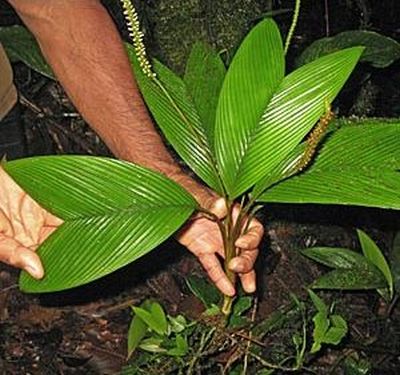
In habitat. Photo-Rare Palm Seeds.com

In habitat. Photo-Rare Palm Seeds.com

In habitat. Photo-Rare Palm Seeds.com

Many Special Thanks to Ed Vaile for his long hours of tireless editing and numerous contributions.