Livistona muelleri
| Livistona (liv-iss-TOH-nah) muelleri (mule-lehr'-ee) | |||||||
|---|---|---|---|---|---|---|---|
 Jacksonville, FL. Photo by Ed Brown III | |||||||
| Scientific Classification | |||||||
| |||||||
| Synonyms | |||||||
|
| |||||||
| Native Continent | |||||||
 | |||||||
| Morphology | |||||||
| |||||||
| Culture | |||||||
|
| |||||||
| Survivability index | |||||||
|
| |||||||
| Common names | |||||||
|
| |||||||
Contents
Habitat and Distribution
Australia, Indonesia and Papua New Guinea.
Description
Functionally dioecious palm. Trunk to 12 m tall, 15-25 cm in diameter; breast high, leaf scars narrow, raised, roughened and with remnant tissue, internodes narrow, grey, petiole stubs persistent, or deciduous with extreme age or fire. Leaves 25- 35 in a globose crown, held erect; petiole 70-100 cm long, 14-20 mm wide, adaxially concave, margins with single curved black spines 2-12 mm long throughout, larger and closer spaced in the proximal portion; both adaxial and abaxial surfaces with rows of corky scales, persistent, at first redbrown aging to grey; leaf-base fibres not prominent, fine, disintegrating; lamina costapalmate, regularly segmented, circular, 60-90 cm long, rigid, flat, chartaceous, adaxially olive green to grey green, abaxially dull bluish green, glabrous except for a few scales on ribs; lamina divided for 50-65% of its length, with 48-60 segments, depth of apical cleft 5-14% of the segment length; apical lobes acute, rigid; parallel veins ca 8 each side of midrib; transverse veins thinner than parallel veins. Inflorescences unbranched at the base, not sexually dimorphic, 80-160 cm long, not extending beyond the limit of the crown, branched to 4 orders; partial inflorescences 5-10; peduncular bract(s) lacking; rachis bracts loosely tubular, with silver scales, splitting and disintegrating with age, but margins not lacerate; rachillae 2-13 cm long, papillose, maroon to red. Flowers solitary or in clusters of 2-3, 1.3-1.6 mm long; sepals broadly triangular, 0.8-1 mm long, maroon, fleshy, cuspidate; petals ovate, 1.3-1.6 mm long, bright yellow, subacute; stamens about 1.4 mm long, yellow; carpels pink to maroon. Fruit ellipsoid, 10-12 mm long, 8.5-10 mm in diam., powdery blue, reddish black or bluish black; epicarp smooth, pruinose; suture line extends for full length of the fruit, marked with lip-like structures; mesocarp thin, dry; endocarp very thin, brittle; pedicel 0.5-1 mm long. Seed globose, 8-9 mm wide. Eophyll 3-ribbed. (Dowe, J.L.)/Palmweb. Editing by edric.
| read more |
|---|
|
Livistona muelleri was first recognised as distinct and described as 'L. humilis R.Br. 'var' by Bailey (1898), and then as L. muelleri in 1902 based on the collection Cowley s.n. from Cairns, Queensland. It was named for Ferdinand von Mueller (1825-1896), Victorian Government botanist, 1853-1896. Previously, Solander (1768-1771) had included it as another manuscript name in his hand-written Plantae novae hollandiae, based on plants he saw near the Endeavour R., Queensland, but this name was never published. Previous to Bailey's account, Wendland, in a contribution to Kerchove (1878), used the name Livistona mülleri in a list of Australian palms, but this was merely a name in a list without a description or reference to specimens and therefore a nomem nudum. Bailey (1898) made Bailey's choice of the name, as in reference to L. benthamii noted that he named both of these species to honour the authors of Flora Australiensis. Beccari (1921) described two varieties of L. humilis that are attributable to L. muelleri: L. humilis var. sclerophylla, based on Bauer 3 from the Bloomfield R., Queensland, and L. humilis var. novoguineensis, based on Jaheri s.n., from Merauke, Papua, Indonesia. Burret (1935, 1939) described L. brassii and L. crustacea from Western Prov., Papua New Guinea, based on the collections Brass 5950 and Brass 7668 respectively. Both taxa were synonymised under L. muelleri by Rodd (1998). Although the relationships of L. muelleri are obscure, it most closely resembles L. eastonii from the Kimberleys, Western Australia. However, this may be an example of ecological convergence, and its true relationships may possibly be with moist forest species such as L. benthamii, with which it shares at least a close association in distribution. Livistona muelleri also bears morphological resemblance to L. fulva of central Queensland, with similarity in both leaf and inflorescence. Livistona muelleri is a moderate sub-canopy palm to 12 m tall; leaves are moderate and regularly segmented; segment apices are rigid, and with a bifurcate cleft to 14% of the segment length; the inflorescence is unbranched, not extending beyond the limit of the crown, and with up to 10 partial inflorescences; bracts are loosely sheathing; flowers have maroon sepals, yellow petals and mauve carpels, on maroon to red rachillae; fruit are ellipsoid, pyriform, to obovoid, to 12 mm long to 10 mm wide, and powdery blue, reddish black to bluish black at maturity. (Dowe, J.L.)/Palmweb. |
Culture
Cold Hardiness, Zone: 9b
Comments and Curiosities
Phenology: Flowers Sep-Apr; fruits Nov-May.
Conservation: Least concern. (Dowe, J.L.)/Palmweb.
With its numerous small, stiff leaves arranged in a very orderly and ornamental fashion, this mid-sized palm from northeastern Australia grows to about 10 m (30 ft.) tall and looks a lot like a small Copernicia. Most impressive are its large, spreading, red inflorescences. In cultivation it has proven to be surprisingly adaptable; it is easily grown in any warm temperate to tropical climate, and will resist moderate freezes. (RPS.com)
- IMAGE GALLERY

Near Kuranda, Queensland, Australia. Photo by Dr. John Dransfield, Royal Botanic Gardens, Kew/Palmweb.

Near Kuranda, Queensland, Australia. Photo by Dr. John Dransfield, Royal Botanic Gardens, Kew/Palmweb.

Semi-open woodland. Photo by Dr. J. L. Dowe.

In habitat. Photo by Jonathan Cruickshank

In habitat. Photo by Jonathan Cruickshank

Livistona muelleri - Lakefield National Park, Queensland. Photo by Daryl O'Connor

George Brown Darwin Botanic Gardens, Northern Territory, Australia. Photo by Daryl O'Connor

Townsville Botanic Gardens. Photo-blackdiamond Images

Townsville Botanic Gardens. Photo-blackdiamond Images

Townsville Botanic Gardens. Photo-blackdiamond Images

Sunshine Coast Hinterland, Queensland, Australia. Photo by Wal

Rama IX Royal Park, Bangkok, Thailand. Photo by Dr. Tony Rodd

Jacksonville, FL. Photo by Ed Brown III

Jacksonville, FL. Photo by Ed Brown III

Jacksonville, FL. Photo by Ed Brown III

Carambeí-second tableland of the state of Paraná-south Brazil. Alt: 1030 m. "From Gileno´s palm. More a grey/green color." Photo by Alberto Leonardo Barkema

Carambeí-second tableland of the state of Paraná-south Brazil. Alt: 1030 m. "From Gileno´s palm. More a grey/green color." Photo by Alberto Leonardo Barkema

Carambeí-second tableland of the state of Paraná-south Brazil. Alt: 1030 m. "From Gileno´s palm. More a grey/green color." Photo by Alberto Leonardo Barkema

Carambeí-second tableland of the state of Paraná-south Brazil. Alt: 1030 m. "From Gileno´s palm. More a grey/green color." Photo by Alberto Leonardo Barkema

Carambeí-second tableland of the state of Paraná-south Brazil. Alt: 1030 m. "var. 'RPS'" Photo by Alberto Leonardo Barkema

Carambeí-second tableland of the state of Paraná-south Brazil. Alt: 1030 m. "var. 'RPS'" Photo by Alberto Leonardo Barkema

Carambeí-second tableland of the state of Paraná-south Brazil. Alt: 1030 m. "var. 'RPS'" Photo by Alberto Leonardo Barkema

Botanic Garden of Málaga, Andalucía, España. Photo by Luis

Botanic Garden of Málaga, Andalucía, España. Photo by Luis

Botanic Garden of Málaga, Andalucía, España. Photo by Luis

Bandung, Indonesia. 800 meter above sea level. Photo by Hendriks

Bandung, Indonesia. 800 meter above sea level. Photo by Hendriks

Thailand. Photo by Geoff Stein

Thailand. Photo by Geoff Stein

SoCal. Photo by Geoff Stein
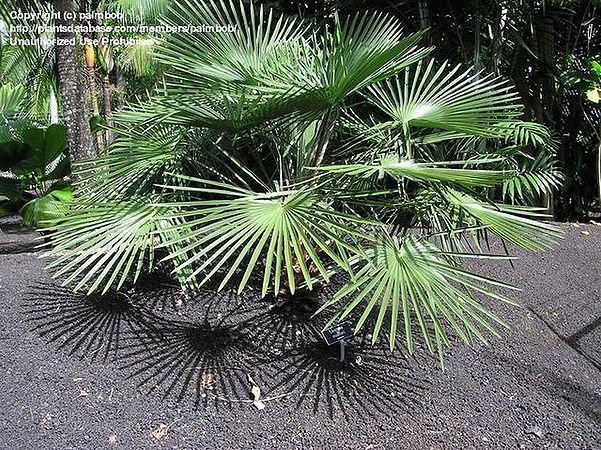
Hawaii. Photo by Geoff Stein

SoCal. Photo by Geoff Stein

Hawaii. Photo by Geoff Stein

Hawaii. Photo by Geoff Stein

Hawaii. Photo by Geoff Stein

San Diego Botanic Garden. Photo by Geoff Stein

Photo-palmseeds.net

Photo by TH

Photo by TH

Photo by TH

Photo-ladtongpalm.tarad.com

Photo-Rare Palm Seeds.com


External Links
- Glossary of Palm Terms
- MODERN BOTANICAL LATIN
- "Just To Be Clear"
- Click on Arecaceae, for list of photos
- http://keys.trin.org.au/key-server/data/0e0f0504-0103-430d-8004-060d07080d04/media/Html/taxon/Livistona_muelleri.htm
- Revision of Livistona (Arecaceae) in Australia, By Dr. A.N. Rodd
- Australian Palms, By John Leslie Dowe
References
Phonetic spelling of Latin names by edric.
Special thanks to Geoff Stein, (Palmbob) for his hundreds of photos.
Special thanks to Palmweb.org, Dr. John Dransfield, Dr. Bill Baker & team, for their volumes of information and photos.
Glossary of Palm Terms; Based on the glossary in Dransfield, J., N.W. Uhl, C.B. Asmussen-Lange, W.J. Baker, M.M. Harley & C.E. Lewis. 2008. Genera Palmarum - Evolution and Classification of the Palms. Royal Botanic Gardens, Kew. All images copyright of the artists and photographers (see images for credits).
Dowe, J.L., A taxonomic account of Livistona R.Br. (Arecaceae). A taxonomic account of Livistona R.Br. (Arecaceae).
Many Special Thanks to Ed Vaile for his long hours of tireless editing and numerous contributions.