Rhapidophyllum hystrix
| Rhapidophyllum (rahp-ih-DOH-fee-luhm) hystrix (HISS-triks) | |||||||
|---|---|---|---|---|---|---|---|
 Bowie, MD. This palm has withstood temperatures down to -8.4F. Photo by Tom Waters | |||||||
| Scientific Classification | |||||||
| |||||||
| Synonyms | |||||||
|
| |||||||
| Native Continent | |||||||
 | |||||||
| Morphology | |||||||
| |||||||
| Culture | |||||||
| |||||||
| Survivability index | |||||||
|
| |||||||
| Common names | |||||||
|
| |||||||
Contents
Habitat and Distribution
Native to southeastern United States, central Florida to Georgia,
Description
A palmate palm with a short, dense clustered base eventually to 1-1.2 m tall, covered in dense long needle-like spines from the leaf bases. Editing by edric.
Old specimens have a rounded crown up to 3 m tall, of dark green palmate leaves 1-2 m long, with 8-16 leaflets, these 60-80 cm long, arranged in an open fan at the end of a 60-120 cm petiole.
The species is dioecious, with separate male and female trees. The fruit is dark brown when ripe, oval, about 2 cm long, with a single seed. They are produced on densely branched panicles.
Culture
Rhapidophyllum hystrix is likely the hardiest palm known, tolerating winter temperatures down to about -20°C but unlike Trachycarpus fortunei, the hardiest large trunk-forming palm, it demands a hot summer continental climate with long periods over 30°C. Winter temperatures below -20°C will cut this palm to the ground, but as it is a suckering palm, it may come back from freezes that kill the foliage. The length of the freeze is important, though, and any prolonged freeze that low will freeze the soil will kill the palm.
In the eastern United States, successful outdoor cultivation has been reported as far north as New York.
Because of its need for hot summers, cultivation in more northern areas like most of Europe, and the Pacific Northwest of North America, has not been successful even where winters are mild.

Comments and Curiosities
Etymology: The specific epithet from the latin, literally; 'porcupine'
This is a monotypic genus.
- IMAGE GALLERY

"Devil's Millhopper in Gainesville, FL. This is a natural sinkhole 120 feet deep. This photo was taken along the descent." Photo by Kyle Wicomb

"Devil's Millhopper in Gainesville, FL." Photo by Kyle Wicomb

"Growing at the bottom of a ravine in Mike Roess Gold Head Branch State Park. This is southwest of Jacksonville, FL. It seemed to display a trunk." Photo by Kyle Wicomb

"Growing at the bottom of a ravine in Mike Roess Gold Head Branch State Park. This is southwest of Jacksonville, FL." Photo by Kyle Wicomb

"Growing at the bottom of a ravine in Mike Roess Gold Head Branch State Park. This is southwest of Jacksonville, FL." Photo by Kyle Wicomb

"Growing at the bottom of a ravine in Mike Roess Gold Head Branch State Park. This is southwest of Jacksonville, FL." Photo by Kyle Wicomb

"Growing at the bottom of a ravine in Mike Roess Gold Head Branch State Park. This is southwest of Jacksonville, FL." Photo by Kyle Wicomb

"Growing at the bottom of a ravine in Mike Roess Gold Head Branch State Park. This is southwest of Jacksonville, FL. Look closely, you can see the needles." Photo by Kyle Wicomb

"Growing at the bottom of a ravine in Mike Roess Gold Head Branch State Park. This is southwest of Jacksonville, FL. This particular palm had shorter leaflets than the others." Photo by Kyle Wicomb

"Growing at the bottom of a ravine in Mike Roess Gold Head Branch State Park. This is southwest of Jacksonville, FL. This one is growing right in the water." Photo by Kyle Wicomb

"Growing at the bottom of a ravine in Mike Roess Gold Head Branch State Park. This is southwest of Jacksonville, FL. This one is growing right in the water." Photo by Kyle Wicomb

"Growing at the bottom of a ravine in Mike Roess Gold Head Branch State Park. This is southwest of Jacksonville, FL. This one is growing right in the water." Photo by Kyle Wicomb

"Growing at the bottom of a ravine in Mike Roess Gold Head Branch State Park. This is southwest of Jacksonville, FL." Photo by Kyle Wicomb

"Growing at the bottom of a ravine in Mike Roess Gold Head Branch State Park. This is southwest of Jacksonville, FL." Photo by Kyle Wicomb

"Here's a pic of R. hystrix in USDA Zone 6B where the average lowest temps of the year are between 0 and -5F (-18 to -20C). This plant has been in the ground for 5 winters and never been protected. It was transplanted from a 5 gallon (20L) pot. It has been covered with snow and ice for up to a month at a time but I cannot say the lowest temperature its experienced. Its in my parent's garden in Smithton IL, a suburb of St Louis MO." (Keith in Sojax)

Sydney, Australia. Photo by Dr. Tony Rodd.

Fairchild Tropical Botanic Garden, Florida. Photo by Dr. John Dransfield, Royal Botanic Gardens, Kew/Palmweb.

Bowie, MD. This palm has withstood temperatures down to -8.4F. Photo by Tom Waters.

Philadelphia, PA. Photo by Mark Glicksman.
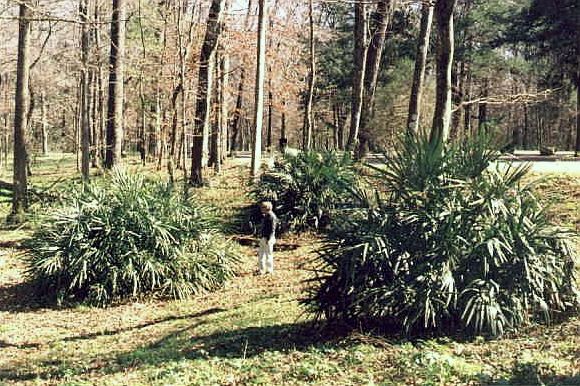
North FL. Photo by Mark Glicksman.

Image Text: Mark Glicksman.
Image Text: Mark Glicksman.

Image Text: Mark Glicksman.


External Links
- Glossary of Palm Terms
- MODERN BOTANICAL LATIN
- "Just To Be Clear"
- https://www.palms.org/principes/1956/v1n1p5-7.pdf
- https://www.youtube.com/watch?v=Od6pXRiGig8
- https://youtu.be/FlKiM52VkwM
References
Phonetic spelling of Latin names by edric.
Special thanks to Geoff Stein, (Palmbob) for his hundreds of photos.
Special thanks to Palmweb.org, Dr. John Dransfield, Dr. Bill Baker & team, for their volumes of information and photos.
Glossary of Palm Terms; Based on the glossary in Dransfield, J., N.W. Uhl, C.B. Asmussen-Lange, W.J. Baker, M.M. Harley & C.E. Lewis. 2008. Genera Palmarum - Evolution and Classification of the Palms. Royal Botanic Gardens, Kew. All images copyright of the artists and photographers (see images for credits).
Many Special Thanks to Ed Vaile for his long hours of tireless editing and numerous contributions.