Basselinia favieri
<google>CH02</google>

| Basselinia favieri | |||||||
|---|---|---|---|---|---|---|---|
 Habitat | |||||||
| Scientific Classification | |||||||
| |||||||
| Synonyms | |||||||
|
| |||||||
| Native Continent | |||||||
 | |||||||
| Morphology | |||||||
| |||||||
| Culture | |||||||
|
| |||||||
| Survivability index | |||||||
|
| |||||||
| Common names | |||||||
|
| |||||||
Habitat and Distribution
Very wet forest on the east side of Mt. Panie, north-east New Caledonia.
Description
This is a medium sized emergant palm, to about 12m. Trunk type: Crownshaft, Inflorescence: Flower emerges below crownshaft, Infructescence: Fruit when ripe, has the appearance of black olives. Even though it has the reputation of being one of the easiest of the Basselinia to grow, this lovely palm is by no means commonly encountered even in enthusiasts collections. In its native home New Caledonia it is found only in one location in tropical rainforest in the northeast of the island between 300 and 500 m (1000 and 1600 ft.) elevation. Basselinia favieri forms a slender, smooth, brown trunk to about 10 m (33 ft.) tall that holds a fairly dense crown of 8 to 10 spreading, regularly pinnate, slightly keeled leaves on short stalks. The leafbases form a slender green or yellowish green crownshaft with a grayish tinge. The spectacular and rather large, spreading inflorescences hold numerous long flowering branches that are thickly covered in dense, felt-like, pale pinkish hairs.
Culture
Curiosities
References
Special thanks to Geoff Stein, (Palmbob) for his hundreds of photos.
- IMAGE GALLERY

Ventura, California

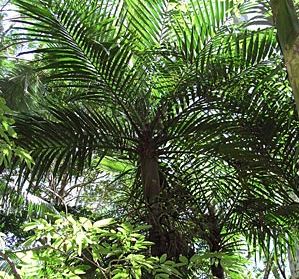
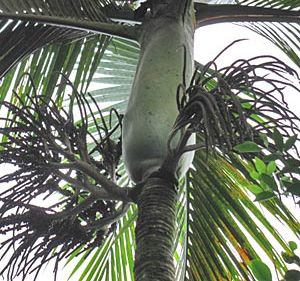


Mt. Panie.


Many Special Thanks to Ed Vaile for his long hours of tireless editing and numerous contributions.