Chamaedorea stenocarpa
<google>CH02</google>

| Chamaedorea stenocarpa | |||||||
|---|---|---|---|---|---|---|---|
 | |||||||
| Scientific Classification | |||||||
| |||||||
| Synonyms | |||||||
|
| |||||||
| Native Continent | |||||||
 | |||||||
| Morphology | |||||||
| |||||||
| Culture | |||||||
|
| |||||||
| Survivability index | |||||||
|
| |||||||
| Common names | |||||||
|
| |||||||
Habitat and Distribution
Wet forest, mainly on the Atlantic slope in Guatemala, but the Atlantic and Pacific slopes, in Costa Rica and Panamá; 300-900 m elevation, (1000 to 3000 ft.). Somewhat rare and locally distributed in the wild, C. stenocarpa is known from only a few collections from Guatemala, Costa Rica, and Panama. It inhabits wet forests at or near the Continental Divide in the latter two countries and in Guatemala is apparently restricted to Cerro San Gil in Izabal on the Atlantic slope.
Description
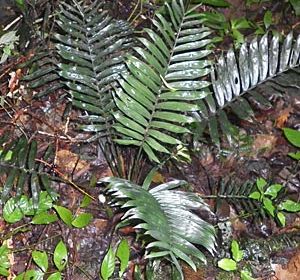
This rare dwarf, acaulescent palm, usually remains nearly stemless, and rarely reaches 75 cm (30 in.) tall. The crown consists of a few densely pinnate leaves with beautifully undulate and prominently nerved leaflets. solitary, erect, appearing stemless, to 75 cm tall. Stem: 1-2 cm diam., very short, creeping, 15 cm long, at or below ground or leaf litter, green, densely ringed, internodes 2-10 mm long. Leaves: 3-5 erect-spreading, pinnate, 40-60 cm long, but often flowering when much shorter One of the smallest of Guatemalan palms. Oblong-ellipsoid fruits, in the mature state these become more rounded. Material from Guatemala tends to have more elongated fruits, than that from Panama or Costa Rica, however, when considered over its whole range, the shape of the fruits does not seem to be a reliable diagnostic character. Chamaedorea stenocarpa is allied to C. pygmaea, C. scheryi, C. brachyclada, and C. undulatifolia. These species form a more or less natural subgroup of Chamaedoropsis
Culture
In cultivation it does best in a humid, mild tropical or warm temperate climate. While not one of the easiest Chamaedorea to grow, it is well worth the effort.
Curiosities
From the Greek steno meaning narrow, and carpus meaning fruit, in reference to the elongated fruit.
References
Special thanks to Geoff Stein, (Palmbob) for his hundreds of photos, edric.
- IMAGE GALLERY

Guatemala: Dept. Izabal: Dense wet forest, Cerro San Gil, alt. 650-900 meters, December 25, 1941.


COSTA RICA: Watson Garden, San Vito de Java.




Many Special Thanks to Ed Vaile for his long hours of tireless editing and numerous contributions.