Chamaedorea oreophila
<google>CH02</google>

| Chamaedorea oreophila | |||||||
|---|---|---|---|---|---|---|---|
 | |||||||
| Scientific Classification | |||||||
| |||||||
| Synonyms | |||||||
|
| |||||||
| Native Continent | |||||||
 | |||||||
| Morphology | |||||||
| |||||||
| Culture | |||||||
|
| |||||||
| Survivability index | |||||||
|
| |||||||
| Common names | |||||||
|
| |||||||
Contents
Habitat and Distribution
It is native to cloud forests in the Mexican States of Veracruz and Oaxaca, where it grows between 1000 and 1500 m on the Atlantic slope. Rainforest of Mexico, elevation up to 1500 meters.
Description
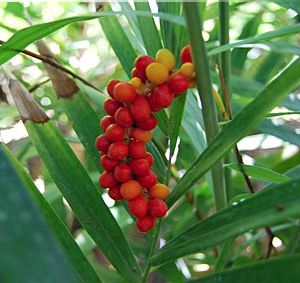
Trunk type: Solitary, dark green, prominent rings from leaf base scars, trunk seldom exceeds 3 centimeters, (1.25"). Hight: To 3 meters, (9'). Spread: To 1.2 meters, (4'). Leaf detail: Pinnately compound, diametrically opposed pinnae, moderately spaced, long dark green, finely pinnate, erect, slightly arching leaves. Flower detail: It differs from most Chamaedorea, as it sends out multiple bloom spikes from the same node on the trunk, long, ascending, unbranched inflorescences that reach well beyond the leaves. Most only send out one. It also has beautiful orange/red fruit which will remain on the plant for a long time before they fall off. The male plant has attractive cream/yellow "catkins" that hang down.
Culture
Requirements: Full shade to filtered light when young, filtered light to partial shade when mature. Consistently moist soil, well drained position. Often planted in groupings. Cold hardy to below 25`F. with cover. It makes a pretty potted plant and does well outside under some canopy in the warm temperate garden. Likes it very humid.
Curiosities
Chamaedorea are dioecious, male, and female flowers, on separate plants.
External Links
References
Special thanks to Geoff Stein, (Palmbob) for his hundreds of photos, edric.
- IMAGE GALLERY




Male flower.

Male flower.

Male flower.


So. California


Many Special Thanks to Ed Vaile for his long hours of tireless editing and numerous contributions.