Pinanga dicksonii
<google>CH02</google>

| Pinanga (pih-NAHN-gah) dicksonii (dik-sohn'-ee-eye) | |||||||
|---|---|---|---|---|---|---|---|
 India. Photo by Clayton York, Utopia Palms & Cycads, edric. | |||||||
| Scientific Classification | |||||||
| |||||||
| Synonyms | |||||||
|
| |||||||
| Native Continent | |||||||
 | |||||||
| Morphology | |||||||
| |||||||
| Culture | |||||||
|
| |||||||
| Survivability index | |||||||
|
| |||||||
| Common names | |||||||
|
| |||||||
Contents
Habitat and Distribution
India. Native to the Andaman Islands east of India.
Description
Culture
Comments and Curiosities
Even though native to the Andaman Islands east of India, this pretty Pinanga has proven to be one of the most robust and cold tolerant in the Genus. It is a clustering palm with green, ringed trunks to about 5 m (15 ft.) tall and yellow crownshafts. The leaves are light green and have attractive, broad segments. Best suited for the tropical and frost-free warm temperate garden. (RPS.com), edric.
External Links
References
Phonetic spelling of Latin names by edric.
Special thanks to Geoff Stein, (Palmbob) for his hundreds of photos, edric.
Special thanks to palmweb.org, Dr. John Dransfield, Dr. Bill Baker & team, for their volumes of information and photos, edric.
- IMAGE GALLERY

Saint Denis, La Réunion Island. "Photo by Olivier Reilhes", edric.

Saint Denis, La Réunion Island. "Photo by Olivier Reilhes", edric.
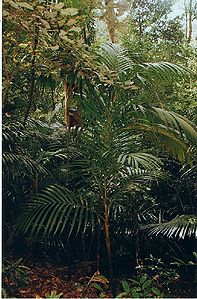
India. Photo by Clayton York, Utopia Palms & Cycads, edric.

India. Photo by Clayton York, Utopia Palms & Cycads, edric.
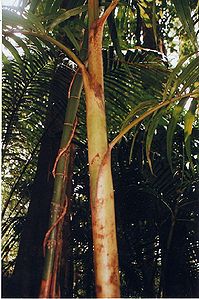
India. Photo by Clayton York, Utopia Palms & Cycads, edric.

Photo-Rare Palm Seeds.com

Photo-Rare Palm Seeds.com


Many Special Thanks to Ed Vaile for his long hours of tireless editing and numerous contributions.